Overview
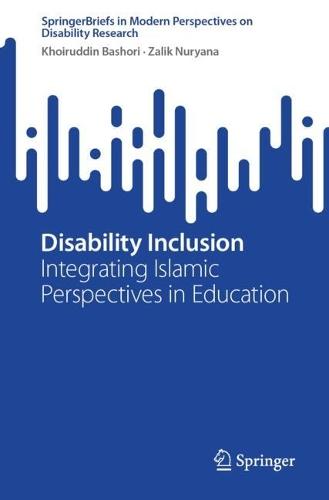
This book offers a timely and interdisciplinary exploration of disability inclusion through the lens of Islamic education. Drawing on core Islamic values such as rahmah (compassion), ʿadl (justice), and karāmah (dignity), it presents a faith-informed framework for inclusive pedagogy in Muslim-majority contexts. The authors integrate theological insights from the Qurʾān, Ḥadīth, and maqāṣid al-Sharīʿah with contemporary educational practices, highlighting how religious ethics can inform systemic change in schools, mosques, and communities. Structured around six thematic chapters, the book addresses stigma and attitudinal barriers, curriculum adaptation, assistive technology, Universal Design for Learning (UDL), and spiritual development of learners with disabilities. Case studies from Indonesia and other Muslim contexts provide practical illustrations of inclusive strategies in Islamic Religious Education (PAI). This book contributes to the growing literature on culturally responsive education by bridging disability studies with Islamic pedagogy. It will be of interest to scholars in education, religious studies, and disability inclusion, as well as policymakers and practitioners seeking contextually grounded models for reform. By offering actionable insights and ethical foundations, the book supports efforts to create equitable learning environments that honor both faith and diversity.
Full Product Details
Author: Khoiruddin Bashori ,
Zalik Nuryana
Publisher: Springer Verlag, Singapore
Imprint: Springer Verlag, Singapore
ISBN: 9789819589067
ISBN 10: 9819589061
Pages: 74
Publication Date: 18 May 2026
Audience:
Professional and scholarly
,
Professional & Vocational
Format: Paperback
Publisher's Status: Forthcoming
Availability: Not yet available

This item is yet to be released. You can pre-order this item and we will dispatch it to you upon its release.
Author Information
Khoiruddin Bashori is Faculty Member in the Department of Psychology at Ahmad Dahlan University, Yogyakarta. Born in Yogyakarta on October 2, 1962, he completed his doctorate in Educational Psychology at Gadjah Mada University (UGM), earning his S3 in Psychology in 2001. He previously served as Rector of Universitas Muhammadiyah Yogyakarta from 2002 to 2008, Chair of APTISI Region V (Special Region of Yogyakarta), and Director of the Postgraduate Program at Universitas Muhammadiyah Ponorogo. Currently, he holds several leadership positions: Deputy Chair of LP2M PP Muhammadiyah [Department of Islamic Boarding School Development, Central Board of Muhammadiyah]; Chair of the PDHI [Brotherhood of Indonesian Hajj Pilgrims] Executive Board; and Chair of the RSIY PDH. Zalik Nuryana earned his Bachelor’s and Master’s degrees in Islamic Education from Universitas Islam Negeri Sunan Kalijaga Yogyakarta, and completed his PhD in Curriculum and Didactic at the School of Education Science, Nanjing Normal University, China. He is currently an Associate Professor in the Department of Islamic Education at Universitas Ahmad Dahlan, Indonesia. His research focuses on Islamic Education, curriculum development, and mental health from various perspectives, with a particular interest in studies employing bibliometric analysis to map research trends and scholarly developments. He also serves as an editorial member of Discover Education published by Springer.