Overview
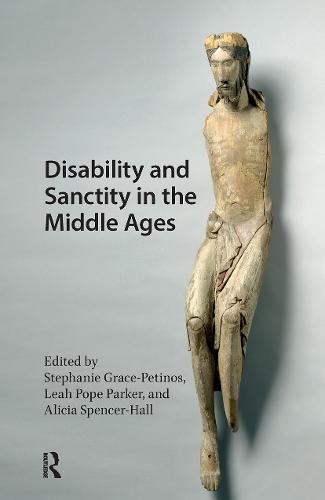
This volume significantly expands current understandings of both disability and sanctity in the Middle Ages. Across the collection, heterogeneous constructions, and experiences, of disability and holiness are excavated. Analyses span the sixth to the fifteenth century, with discussion of holy men and holy women, Western Christian and Buddhist traditions, hagiographic texts, images, and artefacts. Each chapter underscores that disability and sanctity co-exist with a vast array of connotations, not just fully positive or fully negative, but also every inflection in between. The collection is a powerful rebuttal to the notion of the integral relationship of disability—medieval and otherwise—with sin, stigma, and shame. So doing, it recentres medieval disability history as a lived history that merits exploration and celebration. In this way, the volume serves to reclaim sanctity in disability histories as a means to affirm the possibility of radical disability futures.
Full Product Details
Author: Stephanie Grace-Petinos ,
Leah Parker ,
Alicia Spencer-Hall ,
Alicia Spencer-Hall
Publisher: Amsterdam University Press
Imprint: Amsterdam University Press
ISBN: 9789463724333
ISBN 10: 9463724338
Pages: 308
Publication Date: 28 April 2025
Audience:
College/higher education
,
Postgraduate, Research & Scholarly
Format: Hardback
Publisher's Status: No Longer Our Product
Availability: In Print

This item will be ordered in for you from one of our suppliers. Upon receipt, we will promptly dispatch it out to you. For in store availability, please contact us.
Author Information
Stephanie Grace-Petinos is Assistant Editor of the Film and Media list at Bloomsbury Academic Publishing. She received her PhD in 2016 from the City University of New York Graduate Center and is the former Outreach Chair for the Hagiography Society. Her research interests include medieval hagiography, medieval spirituality, disability, dismemberment, and materiality. Leah Pope Parker is Assistant Professor of English and English Undergraduate Coordinator at the University of Southern Mississippi. Parker’s research explores disability and religion in medieval English literature and has been published in the Journal of English and Germanic Philology and Early Middle English. Her monograph, Light of the Everlasting Life: Disability and Crip Eschatology in Old English Literature, is forthcoming in 2025 from University of Michigan Press. Alicia Spencer-Hall is an Honorary Senior Research Fellow at University College London. Their research interests include: medieval hagiography, disability, gender, digital culture, and film and media studies. Her first monograph, Medieval Saints and Modern Screens: Divine Visions as Cinematic Experience was published by Amsterdam University Press in 2018, and is now available Open Access. Trans and Genderqueer Subjects in Medieval Hagiography, a collection co-edited with Blake Gutt, was published in 2021. Shortlisted for the Transgender Non-Fiction award at the 34th Lambda Literary Awards, the volume is now also available Open Access. Their second monograph, Medieval Twitter, was published by Arc Humanities Press in 2024. Alicia Spencer-Hall is an Honorary Senior Research Fellow at University College London. Their research interests include: medieval hagiography, disability, gender, digital culture, and film and media studies. Her first monograph, Medieval Saints and Modern Screens: Divine Visions as Cinematic Experience was published by Amsterdam University Press in 2018, and is now available Open Access. Trans and Genderqueer Subjects in Medieval Hagiography, a collection co-edited with Blake Gutt, was published in 2021. Shortlisted for the Transgender Non-Fiction award at the 34th Lambda Literary Awards, the volume is now also available Open Access. Their second monograph, Medieval Twitter, was published by Arc Humanities Press in 2024.