Overview
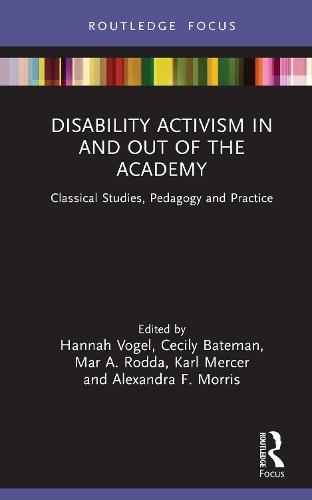
This book explores how ancient disability and its reception in Classics, Ancient Mediterranean Studies (AMS), and related disciplines are relevant to disabled people today. Written by disabled and neurodivergent scholars, this book outlines the multifaceted contributions studies of the ancient world can have on contemporary Disability Studies, pedagogy, research, and activism. It addresses how ableism has impacted the disability rights movement, pedagogy, and research in Classics, as well as misconceptions about disability in the ancient world, which remain pervasive across modern scholarship. The volume highlights what Ancient Disability Studies has to offer towards modern disability activism, with studies of disability in the past posing fascinating questions for educators and disability community members today. This book is suitable for students and scholars in Classics and AMS, Disability Studies, and Museum Studies, as well as teachers and university educators. It will also appeal to disabled people and those interested in pedagogy and disability history.
Full Product Details
Author: Hannah Vogel ,
Cecily Bateman ,
Mar A. Rodda ,
Karl Mercer
Publisher: Taylor & Francis Ltd
Imprint: Routledge
Weight: 0.380kg
ISBN: 9781041110972
ISBN 10: 1041110979
Pages: 112
Publication Date: 30 March 2026
Audience:
Professional and scholarly
,
College/higher education
,
Professional & Vocational
,
Postgraduate, Research & Scholarly
Format: Hardback
Publisher's Status: Active
Availability: Not yet available

This item is yet to be released. You can pre-order this item and we will dispatch it to you upon its release.
Author Information
Alexandra F. Morris is a disabled Egyptologist and disability activist tying the past to the present. She is currently a Lecturer (Education) in Ancient History at Queens University Belfast. Her research is on disability in ancient Egypt, the Classical world, and creating inclusive museums. She holds many roles in academic, disability, heritage, and government sectors. She has cerebral palsy and dyspraxia. Cecily Bateman is a PhD student at the University of Cambridge, UK, writing their dissertation on the use of Classics by the post-war European far-right. When not looking at the worst of humanity, they are interested in disability history and theory. Alongside academic work, Cecily mentors disabled students for the Accessibility and Disability Resource Centre at the University of Cambridge. Hannah Vogel is researching ableism and disability in the ancient world and in the disciplines of history and archaeology. She is a PhD student and sessional teaching academic at Macquarie University, Sydney, Australia. Hannah is an advocate for accessibility and has worked in public outreach, education, and inclusive pedagogies. Karl Mercer is a disabled, working-class independent scholar of Ancient History and Classics and self-identified ‘Outsider.’ His museum work has involved in-person and media engagement and designing casual learning activities. His Curating Visibility exhibition at Dover Museum—At the End of History—featured a VR piece that may be the first of its kind for visually impaired access. Mar A. Rodda is an assistant professor of Greek and Latin language teaching at the University of Cambridge, UK. Their recent postdoctoral work focuses on disability in Lucian of Samosata, which they explore through queer and trans perspectives. They also maintain an interest in digital humanities and computational approaches to classical languages, which were the topic of their PhD thesis.