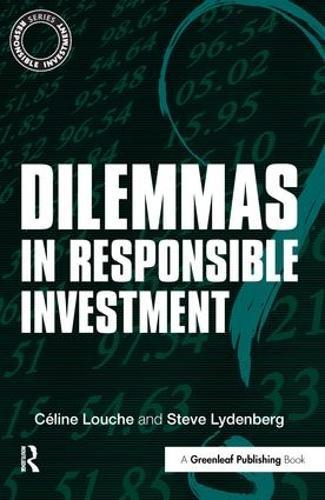
Full Product Details
Author: Céline Louche ,
Steve Lydenberg
Publisher: Taylor & Francis Ltd
Imprint: Greenleaf Publishing
Dimensions:
Width: 15.60cm
, Height: 1.30cm
, Length: 23.40cm
Weight: 0.362kg
ISBN: 9781906093518
ISBN 10: 1906093512
Pages: 240
Publication Date: 01 June 2011
Audience:
General/trade
,
Professional and scholarly
,
General
,
Professional & Vocational
Format: Paperback
Publisher's Status: Active
Availability: In Print

This item will be ordered in for you from one of our suppliers. Upon receipt, we will promptly dispatch it out to you. For in store availability, please contact us.
Reviews
Social Responsible Investment sounds easy enough. Step 1: Negative screening, positive screening, decide and place your cash where it will do what you want it to do. Step 2: Review the financials with set values in mind and pick your portfolio. Step 3: Against sin stocks, for the environment, what could be simpler? When you read Dilemmas in Responsible Investment, you realize that it isn't as simple as it sounds. While written for responsible investment practitioners, the book has much to teach anyone with an interest in how money makes the sustainable world go round. Dilemma 1: Conventional Money Manager & Responsible InvestmentYou are a conventional money manager and have become interested in the responsible investment market. You advertise your responsible investment services and four different types of potential clients approach you. A single working mother, passionate about sustainability issues with a modest sum to invest; a wealthy investor, who is toying with the idea of directing his investments towards a more environmentally friendly portfolio; a CFO for a small church with an endowment to invest and a focus on fairness and societal justice; and the head of the board of trustees for a large pension fund, pressured by retirees not to invest in companies that manufacture landmines. How do you prepare for these meetings? You can either start with one general presentation for all four clients or tailor your response to each one's specific needs, right? Or you can target your presentations with a focus on ethical issues or sustainability issues, highlighting business risk/opportunity elements and, therefore, potential consequences for your clients' return on investment. Dilemma One is a taster for the series of progressively more specific and detailed dilemmas or case studies (12 in total), which teach us the detailed considerations that come in to play when responsible investment is the subject. This first dilemma shows how each potential responsible investor comes with certain expectations, a greater or limited understanding of responsible investment options and the need for investment practitioners to develop customized investment products to accommodate different needs. Dilemma One may not sound that complicated, however, so let's consider some other dilemmas that come up: A client has read about a manufacturer of electronic games in China which has abusive labor conditions, and wants you to sell the stock. However, the company in question denies the allegations and the facts are not altogether clear. Sell, buy time to investigate or tell your client not to believe everything he reads? Ten years ago, you sold a large successful company that was criticized for poor labor conditions, poor environmental record, discrimination in the workplace and more. In the two years, the company has apparently turned things around and is now talking CSR. Do you continue to stay away or recommend your clients to invest? You want to develop a Responsible Investment product that will have global appeal. However, responsible investment standards are different in several countries and many have conflicting demands or standards. How do you balance local values and practices in a single new investment product? Your client, an environmental foundation, wants you to hold back on any investments, which include use of nanotechnology. She fears that use of nanotechnology can be potentially harmful with unpredictable consequences for human health and the environment. Scientists are divided on the issue - there is no clear cut case against nanotechnology. Do you immediately sell all nanotechnology-related stocks or do you try to persuade your client that it is premature to exit? This is but a small selection of the interesting questions posed in the field of responsible investment. In the book, Dilemmas in Responsible Investment, Louche and Lyndenberg dissect these issues from multiple angles and offer possibilities for action and the implications of each. A fascinating read, like I said before, for anyone even remotely interested in understanding the connections between sustainability, ethics, financial services and our global economy. -- Elaine Cohen * <i>CSR Wire</i>, 21 December 2011 *
Social Responsible Investment sounds easy enough. Step 1: Negative screening, positive screening, decide and place your cash where it will do what you want it to do. Step 2: Review the financials with set values in mind and pick your portfolio. Step 3: Against sin stocks, for the environment, what could be simpler? When you read Dilemmas in Responsible Investment, you realize that it isn't as simple as it sounds. While written for responsible investment practitioners, the book has much to teach anyone with an interest in how money makes the sustainable world go round. Dilemma 1: Conventional Money Manager & Responsible InvestmentYou are a conventional money manager and have become interested in the responsible investment market. You advertise your responsible investment services and four different types of potential clients approach you. A single working mother, passionate about sustainability issues with a modest sum to invest; a wealthy investor, who is toying with the idea of directing his investments towards a more environmentally friendly portfolio; a CFO for a small church with an endowment to invest and a focus on fairness and societal justice; and the head of the board of trustees for a large pension fund, pressured by retirees not to invest in companies that manufacture landmines. How do you prepare for these meetings? You can either start with one general presentation for all four clients or tailor your response to each one's specific needs, right? Or you can target your presentations with a focus on ethical issues or sustainability issues, highlighting business risk/opportunity elements and, therefore, potential consequences for your clients' return on investment. Dilemma One is a taster for the series of progressively more specific and detailed dilemmas or case studies (12 in total), which teach us the detailed considerations that come in to play when responsible investment is the subject. This first dilemma shows how each potential responsible investor comes with certain expectations, a greater or limited understanding of responsible investment options and the need for investment practitioners to develop customized investment products to accommodate different needs. Dilemma One may not sound that complicated, however, so let's consider some other dilemmas that come up: A client has read about a manufacturer of electronic games in China which has abusive labor conditions, and wants you to sell the stock. However, the company in question denies the allegations and the facts are not altogether clear. Sell, buy time to investigate or tell your client not to believe everything he reads? Ten years ago, you sold a large successful company that was criticized for poor labor conditions, poor environmental record, discrimination in the workplace and more. In the two years, the company has apparently turned things around and is now talking CSR. Do you continue to stay away or recommend your clients to invest? You want to develop a Responsible Investment product that will have global appeal. However, responsible investment standards are different in several countries and many have conflicting demands or standards. How do you balance local values and practices in a single new investment product? Your client, an environmental foundation, wants you to hold back on any investments, which include use of nanotechnology. She fears that use of nanotechnology can be potentially harmful with unpredictable consequences for human health and the environment. Scientists are divided on the issue - there is no clear cut case against nanotechnology. Do you immediately sell all nanotechnology-related stocks or do you try to persuade your client that it is premature to exit? This is but a small selection of the interesting questions posed in the field of responsible investment. In the book, Dilemmas in Responsible Investment, Louche and Lyndenberg dissect these issues from multiple angles and offer possibilities for action and the implications of each. A fascinating read, like I said before, for anyone even remotely interested in understanding the connections between sustainability, ethics, financial services and our global economy. -- Elaine Cohen * <i>CSR Wire</i>, 21 December 2011 *
Social Responsible Investment sounds easy enough. Step 1: Negative screening, positive screening, decide and place your cash where it will do what you want it to do. Step 2: Review the financials with set values in mind and pick your portfolio. Step 3: Against sin stocks, for the environment, what could be simpler? When you read Dilemmas in Responsible Investment, you realize that it isn't as simple as it sounds. While written for responsible investment practitioners, the book has much to teach anyone with an interest in how money makes the sustainable world go round. Dilemma 1: Conventional Money Manager & Responsible InvestmentYou are a conventional money manager and have become interested in the responsible investment market. You advertise your responsible investment services and four different types of potential clients approach you. A single working mother, passionate about sustainability issues with a modest sum to invest; a wealthy investor, who is toying with the idea of directing his investments towards a more environmentally friendly portfolio; a CFO for a small church with an endowment to invest and a focus on fairness and societal justice; and the head of the board of trustees for a large pension fund, pressured by retirees not to invest in companies that manufacture landmines. How do you prepare for these meetings? You can either start with one general presentation for all four clients or tailor your response to each one's specific needs, right? Or you can target your presentations with a focus on ethical issues or sustainability issues, highlighting business risk/opportunity elements and, therefore, potential consequences for your clients' return on investment. Dilemma One is a taster for the series of progressively more specific and detailed dilemmas or case studies (12 in total), which teach us the detailed considerations that come in to play when responsible investment is the subject. This first dilemma shows how each potential responsible investor comes with certain expectations, a greater or limited understanding of responsible investment options and the need for investment practitioners to develop customized investment products to accommodate different needs. Dilemma One may not sound that complicated, however, so let's consider some other dilemmas that come up: A client has read about a manufacturer of electronic games in China which has abusive labor conditions, and wants you to sell the stock. However, the company in question denies the allegations and the facts are not altogether clear. Sell, buy time to investigate or tell your client not to believe everything he reads? Ten years ago, you sold a large successful company that was criticized for poor labor conditions, poor environmental record, discrimination in the workplace and more. In the two years, the company has apparently turned things around and is now talking CSR. Do you continue to stay away or recommend your clients to invest? You want to develop a Responsible Investment product that will have global appeal. However, responsible investment standards are different in several countries and many have conflicting demands or standards. How do you balance local values and practices in a single new investment product? Your client, an environmental foundation, wants you to hold back on any investments, which include use of nanotechnology. She fears that use of nanotechnology can be potentially harmful with unpredictable consequences for human health and the environment. Scientists are divided on the issue – there is no clear cut case against nanotechnology. Do you immediately sell all nanotechnology-related stocks or do you try to persuade your client that it is premature to exit? This is but a small selection of the interesting questions posed in the field of responsible investment. In the book, Dilemmas in Responsible Investment, Louche and Lyndenberg dissect these issues from multiple angles and offer possibilities for action and the implications of each. A fascinating read, like I said before, for anyone even remotely interested in understanding the connections between sustainability, ethics, financial services and our global economy. -- Elaine Cohen * <i>CSR Wire</i>, 21 December 2011 *
Social Responsible Investment sounds easy enough. Step 1: Negative screening, positive screening, decide and place your cash where it will do what you want it to do. Step 2: Review the financials with set values in mind and pick your portfolio. Step 3: Against sin stocks, for the environment, what could be simpler? When you read Dilemmas in Responsible Investment, you realize that it isn't as simple as it sounds. While written for responsible investment practitioners, the book has much to teach anyone with an interest in how money makes the sustainable world go round. Dilemma 1: Conventional Money Manager & Responsible InvestmentYou are a conventional money manager and have become interested in the responsible investment market. You advertise your responsible investment services and four different types of potential clients approach you. A single working mother, passionate about sustainability issues with a modest sum to invest; a wealthy investor, who is toying with the idea of directing his investments towards a more environmentally friendly portfolio; a CFO for a small church with an endowment to invest and a focus on fairness and societal justice; and the head of the board of trustees for a large pension fund, pressured by retirees not to invest in companies that manufacture landmines. How do you prepare for these meetings? You can either start with one general presentation for all four clients or tailor your response to each one's specific needs, right? Or you can target your presentations with a focus on ethical issues or sustainability issues, highlighting business risk/opportunity elements and, therefore, potential consequences for your clients' return on investment. Dilemma One is a taster for the series of progressively more specific and detailed dilemmas or case studies (12 in total), which teach us the detailed considerations that come in to play when responsible investment is the subject. This first dilemma shows how each potential responsible investor comes with certain expectations, a greater or limited understanding of responsible investment options and the need for investment practitioners to develop customized investment products to accommodate different needs. Dilemma One may not sound that complicated, however, so let's consider some other dilemmas that come up: * A client has read about a manufacturer of electronic games in China which has abusive labor conditions, and wants you to sell the stock. However, the company in question denies the allegations and the facts are not altogether clear. Sell, buy time to investigate or tell your client not to believe everything he reads? * Ten years ago, you sold a large successful company that was criticized for poor labor conditions, poor environmental record, discrimination in the workplace and more. In the two years, the company has apparently turned things around and is now talking CSR. Do you continue to stay away or recommend your clients to invest? * You want to develop a Responsible Investment product that will have global appeal. However, responsible investment standards are different in several countries and many have conflicting demands or standards. How do you balance local values and practices in a single new investment product? * Your client, an environmental foundation, wants you to hold back on any investments, which include use of nanotechnology. She fears that use of nanotechnology can be potentially harmful with unpredictable consequences for human health and the environment. Scientists are divided on the issue - there is no clear cut case against nanotechnology. Do you immediately sell all nanotechnology-related stocks or do you try to persuade your client that it is premature to exit? This is but a small selection of the interesting questions posed in the field of responsible investment. In the book, Dilemmas in Responsible Investment, Louche and Lyndenberg dissect these issues from multiple angles and offer possibilities for action and the implications of each. A fascinating read, like I said before, for anyone even remotely interested in understanding the connections between sustainability, ethics, financial services and our global economy. -- Elaine Cohen CSR Wire, 21 December 2011
Author Information
Celine Louche is Assistant Professor at Vlerick Leuven Gent Management School, Belgium, where she teaches and researches in corporate social responsibility (CSR). She previously worked as Sustainability Analyst for responsible investment at the Dutch Sustainability Research institute (now Jantzi-Sustainalytics). In her work, she explores the way processes of change take place. A major research interest is the construction of the CSR field with a special focus on responsible investment and stakeholder processes. Celine is the editor of 'Innovative CSR' (with Samuel O. Idowu and Walter Leal Filho; Greenleaf Publishing, 2009) and 'Theory and Practice of Corporate Social Responsibility' (with Samuel O. Idowu; Springer, forthcoming). She has a PhD in management and environmental sciences from the Erasmus University Rotterdam in the Netherland for which she was awarded the 2005 FIR Finance & Sustainability Award. She is member of the academic and management board of the European Academy of Business in Society, the Scientific Committee of the International Network for Research on Organisations and Sustainable Development, and the Responsible Investment Advisory Committee of Dexia Asset Management. Steve Lydenberg has worked for over 35 years in the responsible investment field. He has worked with responsible investment money management firms as chief investment officer for Domini Social Investments and research associate with Trillium Asset Management, and with corporate social responsibility research firms as research director for KLD Research & Analytics and the Council on Economic Priorities. Steve is author of 'Corporations and the Public Interest: Guiding the Invisible Hand' (Berrett-Koehler, 2005) and co-author of 'Investing for Good' (with Peter Kinder and Amy Domini; Harper Business, 1993). His articles on responsible investment and corporate social responsibility have appeared in the 'Journal of Corporate Citizenship', 'Corporate Governance: An International Review' and the 'Journal of Investing'.