Overview
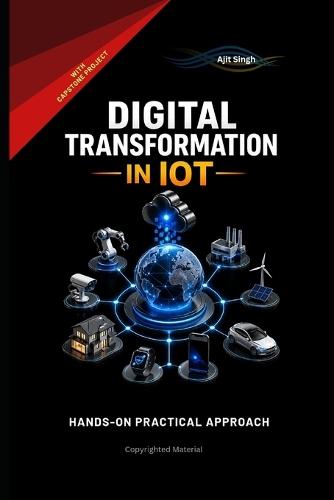
""Digital Transformation in IoT"" is a comprehensive, practical guide designed to equip students and professionals with the skills to design, develop, and deploy end-to-end Internet of Things solutions that drive meaningful business and technological change. This book systematically demystifies the IoT landscape, moving beyond buzzwords to provide a structured learning path grounded in real-world application and industry-standard practices. Philosophy The core philosophy of this book is ""learning by building."" I believe that true understanding in a field as applied as IoT comes not from passive reading of theory, but from the active process of creation. The digital transformation enabled by IoT is not a theoretical concept; it is the result of functional systems collecting real data and enabling intelligent action. Therefore, this book is architected as a ""blueprint and toolbox"" rather than a purely descriptive encyclopedia. Every concept is treated as a building block, and readers are guided on how to assemble these blocks to construct sophisticated, value-driven applications. I prioritized clarity and feasibility, ensuring that even complex topics are broken down into manageable, implementable steps. Key Features 1. Application-Centric Focus: The book is fundamentally oriented towards building working applications. The primary goal is to empower readers to develop solutions. 2. End-to-End Coverage: It covers the entire IoT stack, from hardware selection and sensor interfacing to cloud-based data analytics, application development, and security implementation. 3. Industry-Aligned Technologies: The content features technologies and platforms that are dominant in the industry, including Raspberry Pi, Arduino, ESP32, MQTT, AWS IoT Core, Azure IoT Hub, Docker, and modern data visualization tools. 4. Simplified Algorithms and Code: All code examples are written for clarity and ease of understanding, with extensive comments and step-by-step explanations. 5. Complete Capstone Project: The final chapter guides the reader through building a full-fledged ""Smart Environment Monitoring System,"" including hardware setup, code for the device, cloud configuration, and a web-based dashboard-with all source code provided. 6. Balanced for Academia and Industry: The structure and content are rigorous enough for a university course (B.Tech/M.Tech) while being practical and direct enough for a professional seeking to upskill. Key Takeaways Upon completing this book, the reader will be able to: 1. Architect a complete, end-to-end IoT solution for a given problem statement. 2. Select appropriate microcontrollers, sensors, and actuators for a project. 3. Implement device-level programming to read sensor data and control actuators. 4. Establish reliable and efficient communication using protocols like MQTT. 5. Leverage both edge and cloud computing paradigms for data processing. 6. Utilize major cloud platforms (like AWS or Azure) for device management, data ingestion, and storage. 7. Develop web-based dashboards to visualize data and control devices remotely. 8. Apply fundamental security principles to protect the IoT ecosystem. 9. Build a portfolio-worthy capstone project from scratch. Disclaimer: Earnest request from the Author. Kindly go through the table of contents and refer kindle edition for a glance on the related contents. Thank you for your kind consideration!
Full Product Details
Author: Ajit Singh
Publisher: Independently Published
Imprint: Independently Published
Dimensions:
Width: 15.20cm
, Height: 1.50cm
, Length: 22.90cm
Weight: 0.381kg
ISBN: 9798259346215
Pages: 284
Publication Date: 29 April 2026
Audience:
General/trade
,
General
Format: Paperback
Publisher's Status: Active
Availability: Available To Order

We have confirmation that this item is in stock with the supplier. It will be ordered in for you and dispatched immediately.