Overview
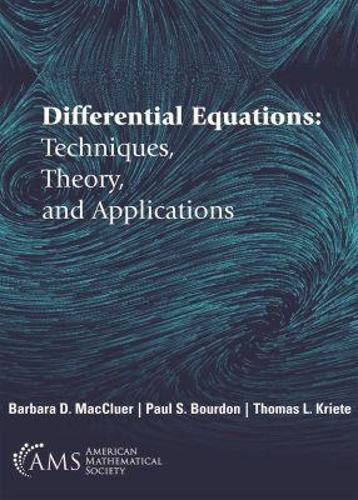
Differential Equations: Techniques, Theory, and Applications is designed for a modern first course in differential equations either one or two semesters in length. The organization of the book interweaves the three components in the subtitle, with each building on and supporting the others. Techniques include not just computational methods for producing solutions to differential equations, but also qualitative methods for extracting conceptual information about differential equations and the systems modeled by them. Theory is developed as a means of organizing, understanding, and codifying general principles. Applications show the usefulness of the subject as a whole and heighten interest in both solution techniques and theory. Formal proofs are included in cases where they enhance core understanding; otherwise, they are replaced by informal justifications containing key ideas of a proof in a more conversational format. Applications are drawn from a wide variety of fields: those in physical science and engineering are prominent, of course, but models from biology, medicine, ecology, economics, and sports are also featured. The 1,400 exercises are especially compelling. They range from routine calculations to large-scale projects. The more difficult problems, both theoretical and applied, are typically presented in manageable steps. The hundreds of meticulously detailed modeling problems were deliberately designed along pedagogical principles found especially effective in the MAA study Characteristics of Successful Calculus Programs, namely, that asking students to work problems that require them to grapple with concepts (or even proofs) and do modeling activities is key to successful student experiences and retention in STEM programs. The exposition itself is exceptionally readable, rigorous yet conversational. Students will find it inviting and approachable. The text supports many different styles of pedagogy from traditional lecture to a flipped classroom model. The availability of a computer algebra system is not assumed, but there are many opportunities to incorporate the use of one.
Full Product Details
Author: Barbara D. MacCluer ,
Paul S. Bourdon ,
Thomas L. Kriete
Publisher: American Mathematical Society
Imprint: American Mathematical Society
Weight: 2.235kg
ISBN: 9781470447977
ISBN 10: 1470447975
Pages: 880
Publication Date: 30 November 2019
Audience:
Professional and scholarly
,
Professional & Vocational
Format: Hardback
Publisher's Status: Active
Availability: In Print

This item will be ordered in for you from one of our suppliers. Upon receipt, we will promptly dispatch it out to you. For in store availability, please contact us.
Author Information
Barbara D. MacCluer, University of Virginia, Charlottesville, VA. Paul S. Bourdon, University of Virginia, Charlottesville, VA. Thomas L. Kriete, University of Virginia, Charlottesville, VA.