|
|
|||
|
||||
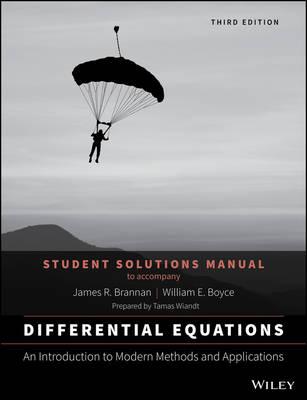
OverviewThis is the Student Solutions Manual to accompany Differential Equations: An Introduction to Modern Methods and Applications, 3rd Edition. Brannan/Boyce’s Differential Equations: An Introduction to Modern Methods and Applications, 3rd Edition is consistent with the way engineers and scientists use mathematics in their daily work. The text emphasizes a systems approach to the subject and integrates the use of modern computing technology in the context of contemporary applications from engineering and science. The focus on fundamental skills, careful application of technology, and practice in modeling complex systems prepares students for the realities of the new millennium, providing the building blocks to be successful problem-solvers in today’s workplace. Section exercises throughout the text provide hands-on experience in modeling, analysis, and computer experimentation. Projects at the end of each chapter provide additional opportunities for students to explore the role played by differential equations in the sciences and engineering. Full Product DetailsAuthor: James R. Brannan , William E. BoycePublisher: John Wiley & Sons Inc Imprint: John Wiley & Sons Inc Edition: 3rd ed. Dimensions: Width: 21.30cm , Height: 1.80cm , Length: 27.60cm Weight: 0.771kg ISBN: 9781118981252ISBN 10: 1118981251 Pages: 336 Publication Date: 24 October 2016 Audience: Professional and scholarly , Professional & Vocational Format: Paperback Publisher's Status: Active Availability: Out of stock The supplier is temporarily out of stock of this item. It will be ordered for you on backorder and shipped when it becomes available. Table of Contents1 Introduction 1.1 Mathematical Models and Solutions…1 1.2 Qualitative Methods: Phase Lines and Direction Fields…2 1.3 Definitions, Classification, and Terminology…8 2 First Order Differential Equations 2.1 Separable Equations…11 2.2 Linear Equations: Method of Integrating Factors…16 2.3 Modeling with First Order Equations…23 2.4 Differences between Linear and Nonlinear Equations…30 2.5 Autonomous Equations and Population Dynamics…33 2.6 Exact Equations and Integrating Factors…36 2.7 Substitution Methods…42 3 Systems of Two First Order Equations 3.1 Systems of Two Linear Algebraic Equations…49 3.2 Systems of Two First Order Linear Differential Equations…56 3.3 Homogeneous Linear Systems with Constant Coefficients…62 3.4 Complex Eigenvalues…79 3.5 Repeated Eigenvalues…87 3.6 A Brief Introduction to Nonlinear Systems…94 4 Second Order Linear Equations 4.1 Definitions and Examples…103 4.2 Theory of Second Order Linear Homogeneous Equations…106 4.3 Linear Homogeneous Equations with Constant Coefficients…108 4.4 Mechanical and Electrical Vibrations…122 4.5 Nonhomogeneous Equations; Method of Undetermined Coefficients…128 4.6 Forced Vibrations, Frequency Response, and Resonance…134 4.7 Variation of Parameters…139 5 The Laplace Transform 5.1 Definition of the Laplace Transform…149 5.2 Properties of the Laplace Transform…154 5.3 The Inverse Laplace Transform…159 5.4 Solving Differential Equations with Laplace Transforms…163 5.5 Discontinuous Functions and Periodic Functions…170 5.6 Differential Equations with Discontinuous Forcing Functions…174 5.7 Impulse Functions…185 5.8 Convolution Integrals and Their Applications…193 5.9 Linear Systems and Feedback Control…201 6 Systems of First Order Linear Equations 6.1 Definitions and Examples…205 6.2 Basic Theory of First Order Linear Systems…209 6.3 Homogeneous Linear Systems with Constant Coefficients…211 6.4 Nondefective Matrices with Complex Eigenvalues…228 6.5 Fundamental Matrices and the Exponential of a Matrix…240 6.6 Nonhomogeneous Linear Systems…249 6.7 Defective Matrices…255 7 Nonlinear Differential Equations and Stability 7.1 Autonomous Systems and Stability…263 7.2 Almost Linear Systems…269 7.3 Competing Species…283 7.4 Predator-Prey Equations…293 7.5 Periodic Solutions and Limit Cycles…302 7.6 Chaos and Strange Attractors: The Lorenz Equations…310 8 Numerical Methods 8.1 Numerical Approximations: Euler's Method…315 8.2 Accuracy of Numerical Methods…317 8.3 Improved Euler and Runge-Kutta Methods…321 8.4 Numerical Methods for Systems of First Order Equations…326 9 Series Solutions of Second Order Linear Equations 9.1 Review of Power Series…331 9.2 Series Solutions Near an Ordinary Point, Part I…334 9.3 Series Solutions Near an Ordinary Point, Part II…349 9.4 Regular Singular Points…355 9.5 Series Solutions Near a Regular Singular Point, Part I…361 9.6 Series Solutions Near a Regular Singular Point, Part II…368 9.7 Bessel's Equation…377 10 Orthogonal Functions, Fourier Series, and Boundary Value Problems 10.1 Orthogonal Systems in the Space PC[a,b]…383 10.2 Fourier Series…385 10.3 Elementary Two-Point Boundary Value Problems…394 10.4 General Sturm-Liouville Boundary Value Problems…398 10.5 Generalized Fourier Series and Eigenfunction Expansions…407 10.6 Singular Sturm-Liouville Boundary Value Problems…415 10.7 Convergence Issues…418 11 Elementary Partial Differential Equations 11.1 Heat Conduction in a Rod: Homogeneous Case…431 11.2 Heat Conduction in a Rod: Nonhomogeneous Case…443 11.3 The Wave Equation: Vibrations of an Elastic String…450 11.4 The Wave Equation: Vibrations of a Circular Membrane…459 11.5 Laplace's Equation…459ReviewsAuthor InformationJames R. Brannan is the author of Differential Equations: An Introduction to Modern Methods and Applications 3E Student Solutions Manual, published by Wiley. William E. Boyce is the author of Differential Equations: An Introduction to Modern Methods and Applications 3E Student Solutions Manual, published by Wiley. Tab Content 6Author Website:Countries AvailableAll regions |
||||