Overview
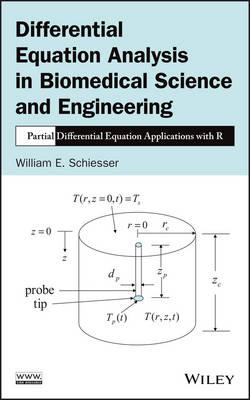
Features a solid foundation of mathematical and computational tools to formulate and solve real-world PDE problems across various fields With a step-by-step approach to solving partial differential equations (PDEs), Differential Equation Analysis in Biomedical Science and Engineering: Partial Differential Equation Applications with R successfully applies computational techniques for solving real-world PDE problems that are found in a variety of fields, including chemistry, physics, biology, and physiology. The book provides readers with the necessary knowledge to reproduce and extend the computed numerical solutions and is a valuable resource for dealing with a broad class of linear and nonlinear partial differential equations. The author’s primary focus is on models expressed as systems of PDEs, which generally result from including spatial effects so that the PDE dependent variables are functions of both space and time, unlike ordinary differential equation (ODE) systems that pertain to time only. As such, the book emphasizes details of the numerical algorithms and how the solutions were computed. Featuring computer-based mathematical models for solving real-world problems in the biological and biomedical sciences and engineering, the book also includes: R routines to facilitate the immediate use of computation for solving differential equation problems without having to first learn the basic concepts of numerical analysis and programming for PDEs Models as systems of PDEs and associated initial and boundary conditions with explanations of the associated chemistry, physics, biology, and physiology Numerical solutions of the presented model equations with a discussion of the important features of the solutions Aspects of general PDE computation through various biomedical science and engineering applications Differential Equation Analysis in Biomedical Science and Engineering: Partial Differential Equation Applications with R is an excellent reference for researchers, scientists, clinicians, medical researchers, engineers, statisticians, epidemiologists, and pharmacokineticists who are interested in both clinical applications and interpretation of experimental data with mathematical models in order to efficiently solve the associated differential equations. The book is also useful as a textbook for graduate-level courses in mathematics, biomedical science and engineering, biology, biophysics, biochemistry, medicine, and engineering.
Full Product Details
Author: William E. Schiesser (Lehigh University)
Publisher: John Wiley & Sons Inc
Imprint: John Wiley & Sons Inc
Dimensions:
Width: 16.30cm
, Height: 2.50cm
, Length: 24.30cm
Weight: 0.590kg
ISBN: 9781118705186
ISBN 10: 1118705181
Pages: 344
Publication Date: 23 May 2014
Audience:
Professional and scholarly
,
Professional & Vocational
Format: Hardback
Publisher's Status: Active
Availability: Out of stock

The supplier is temporarily out of stock of this item. It will be ordered for you on backorder and shipped when it becomes available.
Author Information
WILLIAM E. SCHIESSER, PHD, ScD (hon.) is Emeritus McCann Professor of Engineering and Professor of Mathematics at Lehigh University. The author or coauthor of thirteen books, Dr. Schiesser’s research interests include numerical software; ordinary, differential algebraic, and partial differential equations; and computational mathematics.