Overview
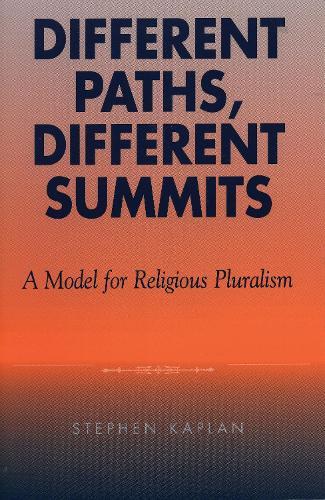
In a world where religious pluralism is a necessity of modern life, diverse religions exist for the diverse people populating the earth. Theologically, how do people of different faiths find liberation in their separate gods simultaneously? Stephen Kaplan answers this question with his new book, Different Paths, Different Summits. He presents a model for religious pluralism that does not fall victim to the criticisms of pluralist models. Religious positions do not need to be transcended in order for varying faiths to be both honored and liberating simultaneously. Kaplan skillfully depicts three different realties, a theistic ultimate reality, a monistic ultimate reality, and a process non-dualism, along with their beliefs. His model allows for each to exit simultaneously, mutually interpenetrating and distinct.
Full Product Details
Author: Stephen Kaplan
Publisher: Bloomsbury Publishing Plc
Imprint: Rowman & Littlefield
Dimensions:
Width: 14.80cm
, Height: 1.50cm
, Length: 22.80cm
Weight: 0.299kg
ISBN: 9780742513327
ISBN 10: 0742513327
Pages: 256
Publication Date: 17 December 2001
Audience:
General/trade
,
Professional and scholarly
,
General
,
Postgraduate, Research & Scholarly
Format: Paperback
Publisher's Status: Active
Availability: Manufactured on demand

We will order this item for you from a manufactured on demand supplier.
Reviews
Stephen Kaplan's latest book is a singularly creative answer to a thorny problem in theology and religious studies. How can one simultaneously affirm religious pluralism as well as the ultimacy of each religion? His answer is both refreshing and tightly-argued. Kaplan's brilliant proposal is for a 'pluralistic ontology and soteriology, ' a timely message which will help define the debate for decades to come.--Nathan Katz
Stephen Kaplan's latest book is a singularly creative answer to a thorny problem in theology and religious studies. How can one simultaneously affirm religious pluralism as well as the ultimacy of each religion? His answer is both refreshing and tightly-argued. Kaplan's brilliant proposal is for a 'pluralistic ontology and soteriology,' a timely message which will help define the debate for decades to come. -- Nathan Katz, Distinguished Professor, Emeritus, Florida International University A strikingly original contribution to the growing body of literature on religious pluralism. It will be useful to scholars interested in religious pluralism and the theology of religions, and for graduate-level courses in those areas. * Anglican Theological Review * Kaplan has provided a basis for reconsidering the notion of religious pluralism in terms of both soteriology and ontology. This work, therefore, deserves the attention of philosophers and theologians currently interested in the concept of religious pluralism, as he enlists one of the great scientific minds of our time to provide a foundation for his novel ideas. * Philosophy East and West * A deep assumption of most students of religious experience has been that what is experienced in diverse ways is ultimately the same. A protest in favor of a deeper pluralism is emerging. Kaplan has given us the most richly developed argument for this liberating pluralism. If it is taken seriously, it will deeply affect the future study of religious experience. -- John B. Cobb Jr., Claremont School of Theology, Co-founder of the Center for Process Studies
Stephen Kaplan's latest book is a singularly creative answer to a thorny problem in theology and religious studies. How can one simultaneously affirm religious pluralism as well as the ultimacy of each religion? His answer is both refreshing and tightly-argued. Kaplan's brilliant proposal is for a 'pluralistic ontology and soteriology,' a timely message which will help define the debate for decades to come. -- Nathan Katz, Professor and Chair, Dept. of Religious Studies, Florida International University A strikingly original contribution to the growing body of literature on religious pluralism. It will be useful to scholars interested in religious pluralism and the theology of religions, and for graduate-level courses in those areas. Anglican Theological Review Kaplan has provided a basis for reconsidering the notion of religious pluralism in terms of both soteriology and ontology. This work, therefore, deserves the attention of philosophers and theologians currently interested in the concept of religious pluralism, as he enlists one of the great scientific minds of our time to provide a foundation for his novel ideas. Philosophy East and West A deep assumption of most students of religious experience has been that what is experienced in diverse ways is ultimately the same. A protest in favor of a deeper pluralism is emerging. Kaplan has given us the most richly developed argument for this liberating pluralism. If it is taken seriously, it will deeply affect the future study of religious experience. -- John B. Cobb, Jr., professor of theology and philosophy at the Claremont Graduate School
Author Information
Stephen Kaplan is professor of Indian and Comparative Religions at Manhattan College in New York City. He holds a doctorate from Temple University in Philadelphia. He is the author of numerous articles on the subject of holography and eastern religions.