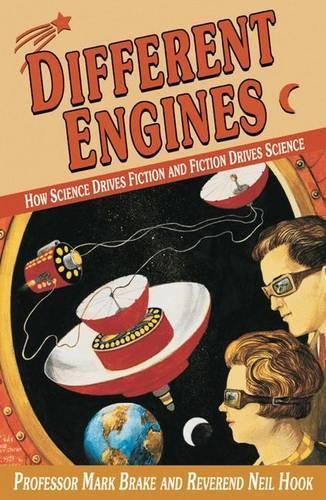
Full Product Details
Author: Neil Hook ,
Professor Mark L. Brake
Publisher: Palgrave Macmillan
Imprint: Palgrave Macmillan
Dimensions:
Width: 15.50cm
, Height: 2.30cm
, Length: 23.50cm
Weight: 0.360kg
ISBN: 9780230019805
ISBN 10: 0230019803
Pages: 250
Publication Date: 01 January 2007
Audience:
College/higher education
,
Professional and scholarly
,
Undergraduate
,
Postgraduate, Research & Scholarly
Format: Hardback
Publisher's Status: Unknown
Availability: In Print

Limited stock is available. It will be ordered for you and shipped pending supplier's limited stock.
Reviews
'An excellent starting point for passionate arguments on fascinating subjects.' www.asimovs.com 'In Different Engines, Professor Mark Brake and Reverend Neil Hook take us on a tour of science fiction through the ages. They show how the genre extends far beyond mere entertainment and often provides a profound exploration of the interface between science and society and the impact that new technologies or discoveries, such as that of alien life, are likely to have.' - Lewis Dartnell, The Astrobiology Society of Britain
'An excellent starting point for passionate arguments on fascinating subjects.' www.asimovs.com 'In Different Engines, Professor Mark Brake and Reverend Neil Hook take us on a tour of science fiction through the ages. They show how the genre extends far beyond mere entertainment and often provides a profound exploration of the interface between science and society and the impact that new technologies or discoveries, such as that of alien life, are likely to have.' - Lewis Dartnell, The Astrobiology Society of Britain
Two British academics explore the interplay of science and science fiction.Brake (Science Communication/Univ. of Glamorgan) and Hook (Science Fiction/Univ. of Glamorgan) begin with the late Renaissance, the age of discovery and probably the first period in history when the term science fiction meant anything useful. Johannes Kepler's Somnium, which smuggled a heretical Copernican viewpoint into the story of a lunar voyage, may be the first scientifically informed piece of fiction. The authors follow the genre through several eras of science, looking in each chapter at a handful of works that reveal the period's common themes. For example, Mary Shelley was the first great skeptic of the mechanical age, warning in Frankenstein that science can overreach, while the works of Jules Verne, its chief positivist, exemplify the period's faith in the truths of science. H.G. Wells, a student of Darwin's champion T.H. Huxley, brings evolutionary themes to such books as The War of the Worlds. Some of the authors' choices are provocative: French, German and Russian writers and filmmakers are the primary focus of their chapters on the astounding age, the first half of the 20th century. American fans may find this focus odd, but it recognizes the genre's international scope. More surprising is the omission, in the discussion of the atomic age (1945 - 60), of some of its most popular writers: Ray Bradbury, Robert Heinlein and Isaac Asimov. On the other hand, the titles Brake and Hook choose to characterize the era - 1984, Cat's Cradle, A Canticle for Leibowitz and Earth Abides - are all first-rate and worthy of the attention they receive. The book is at its best in the last two chapters, which examine the works of William Gibson, Vernor Vinge and China Mieville, plus films like Blade Runner and Terminator 2, as illustrations of the unease aroused by computers and genetic engineering.Sheds interesting new light on some familiar authors. (Kirkus Reviews)
Author Information
Author Website: http://www.markbrake.com
Reverend NEIL HOOK is Associate Lecturer in Science Fiction at the University of Glamorgan, UK, and an Anglican priest in the Welsh mountains. NeilAs research focuses on Seventeenth and Eighteenth-century science fiction. His international lecturing and writing on these subjects was recently profiled in the BBCAs Science Fiction Britannia series. He spends his academic life reminding people that science fiction is fun and shouldnAt be taken seriously and his parish work reminding people that God is fun and should be taken seriously. Professor MARK BRAKE holds a chair in science communic