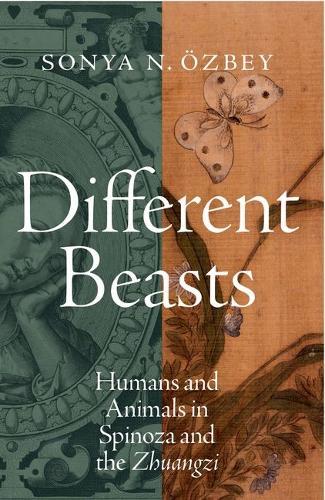
Different Beasts: Humans and Animals in Spinoza and the Zhuangzi

Author:   Sonya N. Özbey (Associate Professor of Chinese Philosophy, Associate Professor of Chinese Philosophy, University of Michigan)
Publisher:   Oxford University Press Inc
ISBN:  

9780197841013


Pages:   344
Publication Date:   18 March 2026
Format:   Paperback
Availability:   To order   Availability explained
Stock availability from the supplier is unknown. We will order it for you and ship this item to you once it is received by us.

Our Price $38.95 Quantity:  
Add to Cart

Share |

Different Beasts: Humans and Animals in Spinoza and the Zhuangzi


Overview

Full Product Details

Author:   Sonya N. Özbey (Associate Professor of Chinese Philosophy, Associate Professor of Chinese Philosophy, University of Michigan)
Publisher:   Oxford University Press Inc
Imprint:   Oxford University Press Inc
Dimensions:   Width: 15.60cm , Height: 2.10cm , Length: 23.40cm
Weight:   0.503kg
ISBN:  

9780197841013


ISBN 10:   0197841015
Pages:   344
Publication Date:   18 March 2026
Audience:   Professional and scholarly ,  Professional & Vocational
Format:   Paperback
Publisher's Status:   Active
Availability:   To order   Availability explained
Stock availability from the supplier is unknown. We will order it for you and ship this item to you once it is received by us.

Table of Contents

Acknowledgments List of Abbreviations Introduction: Cross-Cultural Philosophy and Critical Animality Studies A. Intersectional Critiques of Dualistic Thinking B. Seeking a Savior in ""Monistic"" Philosophies C. Why Compare? Critical Mimesis and New Areas of Inquiry D. Roadmap PART I. Reading Spinoza with the Zhuangzi: Conversations and Toolkits 1. Contexts and Means for Interpreting the Zhuangzi 1.1 Inching Out of Animality: Early Chinese Recipes for Power and Teachings for Humanity 1.2 Loitering Idly with Zhuangzi's Big but ""Useless"" Words 2. Contexts and Means for Interpreting Spinoza 2.1 Lifting Up and Placing Down Man into the Machine-World: Contested Routes to Knowledge and Salvation 2.2 Seeking True Philosophy, in the Proper Order, with Spinoza Conclusion: Strange Companions--Thinking about Animals with Spinoza and the Zhuangzi A. Form, Context, and Function B. Hermeneutical Challenges and Opportunities PART II. Portrayals of Human Distinctiveness 3. Rich in Complexity: Human Distinctiveness in Spinoza 3.1 ""That Eternal and Infinite Being We Call God, or Nature"" 3.2 Eliminating the Anthropomorphic God and the Theomorphic Man 3.3 What Distinguishes a Man from an Ass 3.4 A Ladder of Complexity: From Worm to Man 4. Pinnacles of Versatility: Human Distinctiveness in the Zhuangzi 4.1 The Ten Thousand Things under Heaven 4.2 Dethroning the Heart 4.3 Finding the Pivot of All Daos 4.4 What Distinguishes People from Turtles and Fish Conclusion: Admiring and Humbling Humanity A. Like a Worm, Like a Tree B. Finding Empowerment in a Univocal versus Polyvocal World C. Certainty with a Bias, Humility without an Agenda PART III. Animal Affects: Curiosity versus Threat 5. Zhuangzi and the Happy Fish: Animal Affects in the Zhuangzi 5.1 Wandering with the Fish, Zhuangzi, and Huizi 5.2 Effective and Affective Communication in the Zhuangzi 5.3 Bonding through Banter and Laughter 6. Spinoza's Serpentine Worries: Animal Affects in Spinoza 6.1 Making Use of Beasts as We Please 6.2 Choosing Eve over the Serpent 6.3 On Misanthropic Melancholy and Fraternal Cheer Conclusion: Affects, Solidarity, and Power A. The Cementing and Loosening of Human Bonds B. The Power to Include and Exclude PART IV. The Orderly and the Chaotic 7.From Nature's Order to Civil Order: Onto-Political Formations in Spinoza 7.1 Individuation and Identity in an Orderly World 7.2 Uniting as One Mind and Body 7.3 Big Fish Eat Small Fish 8. Unmanaging the Personal and the Political Body in the Zhuangzi 8.1 From Unity to Fragmentation: Undermining the Heart of the Personal and Political Body 8.2 Transforming into a Rat's Liver or a Butterfly's Dream 8.3 Muddying the Waters: Reimagining Hundun and Antiquity Conclusion: The State of the World: The Topsy-Turvy and the Ship-Shape A. Tales of Identity and Disintegration B. In the Absence of Civil Order PART V. Humans' Animality: Textual Traces and Absences 9. Rethinking Animal Imagery in the Zhuangzi 9.1 The Zhuangzi on Distant Lands, Humble Professions, and Unruly Minds 9.2 Women in the Zhuangzi 10. Animalized Others in Spinoza's ""Imagination"" 10.1 On ""Turks"" and Common People 10.2 On Women, the Infantile, and the Sub-rational Conclusion: Our Kind A. Those ""We"" Uplift or Leave Behind B. The Limits of What ""We"" Can Imagine ""Us"" to Be Epilogue: Looking at There and Then to Reflect on Here and Now References Index

Reviews

The volume, although concise, contains succinct comparative remarks on the very different roles reserved for religious thought and practice in the two traditions. It is a strikingly readable and surprisingly original contribution to an essential topic of religious studies. * Barbara Hendrischke, Religious Studies Review * This is a long overdue project, the need for and relevance of which have long been felt by those who study these texts. But hitherto only cursory and brief attempts have been made to flesh out this comparison, largely due to the complexity of both oeuvres and of the conceptual universe of each. Özbey has finally given us a detailed, nuanced, deeply learned and philosophically incisive account of both, and of their various points of contact and divergence. * Brook Ziporyn, Mircea Eliade Professor of Chinese Religion, Philosophy and Comparative Thought, University of Chicago * Sonya Özbey's book on Spinoza and the Zhuangzi is a marvelous work. Beautifully written and deeply engaged with the thoughts of both beasts, Özbey succeeds to illuminate both by creating a philosophical conversation that transcends boundaries of space, time, and language. * Yitzhak Y. Melamed, author of Spinoza's Metaphysics: Substance and Thought *


Author Information

Sonya Özbey is an associate professor in the Department of Asian Languages & Cultures and the Department of Philosophy at the University of Michigan.

Tab Content 6

Author Website:  

Countries Available

All regions
Latest Reading Guide

MRG 26 2


Shopping Cart
Your cart is empty
Shopping cart
Mailing List