|
|
|||
|
||||
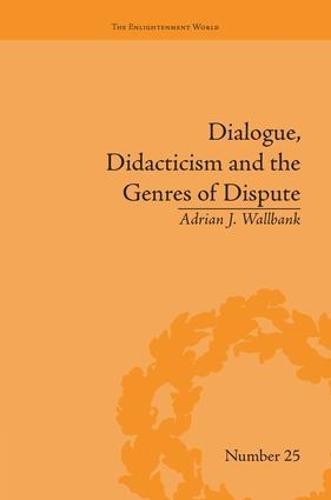
OverviewDialogue was a pivotal genre for the spread of Enlightenment ideas. Focusing on non-canonical British writers Wallbank examines the evolution of dialogue as a genre during the Romantic period. Full Product DetailsAuthor: Adrian J WallbankPublisher: Taylor & Francis Ltd Imprint: Routledge Volume: 25 Dimensions: Width: 15.60cm , Height: 1.60cm , Length: 23.40cm Weight: 0.453kg ISBN: 9781138661868ISBN 10: 1138661864 Pages: 304 Publication Date: 21 January 2016 Audience: Professional and scholarly , College/higher education , Professional & Vocational , Tertiary & Higher Education Format: Paperback Publisher's Status: Active Availability: In Print This item will be ordered in for you from one of our suppliers. Upon receipt, we will promptly dispatch it out to you. For in store availability, please contact us. Table of ContentsIntroduction: Theory and Practice; Chapter 1 Loyalist and Radical Dialogues of the Revolution Controversy: The ‘Ambiguities’ of ‘Popular Address’; Chapter 2 ‘I am Like that House or Kingdom Divided Against Itself, of Which I have Read Somewhere in the Holy Scriptures’: Psychological Disunity, Mentoring from the Heart, and Literary Innovation: Evangelical Dialogues, 1795–1801; Chapter 3 Religious ‘Enthusiasm’ and ‘Practical’ Mentoring: Dialogic Responses to the Blagdon Controversy; Chapter 4 Education and Philosophical Persuasion: The Dialogues of Dr Alexander Thomson and Sir Uvedale Price; Chapter 5 ‘Interrogative’ Philosophizing and the Ambiguities of Egalitarian Dialogues: Sir Richard Phillips’s Four Dialogues Between an Oxford Tutor and a Disciple of the Common-Sense Philosophy (1824) and Robert Southey’s Sir Thomas More: Colloquies on the Progress and Prospects of Society (1829); Chapter 6 Conversation and ‘Enlightened Philosophy’: The ‘Dialectical Comedies’ of Thomas Love Peacock and Imaginary Conversations (1824–9) of Walter Savage Landor;ReviewsAuthor InformationAdrian J. Wallbank Tab Content 6Author Website:Countries AvailableAll regions |
||||