Overview
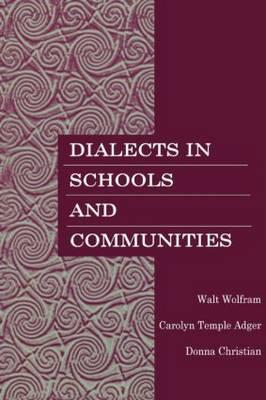
Curiosity about language variation and the role that dialects play in society is natural. In educational circles, concern with this topic has always been high, rising cyclicly to extraordinary levels. Today's awareness that America's students represent a rich array of linguistic and cultural resources brings this topic around again, with many of the related issues from the past still unresolved. In this book, the authors address this natural interest and educational concern about dialects by matching the major questions that educational practitioners raise about language variation with informed, research-based answers. The book presents and responds to the kinds of issues raised by actual practitioners in surveys, workshops, classes and discussion groups. This volume is a thoroughly updated, revised and expanded vesion of Wolfram and Christian's ""Dialects and Education: Issues and Answers"" (1989). The book is intended for use by elementary and secondary English language arts pre- and in-service teachers; specialists in early childhood, reading and writing, speech/language pathology, special education and language studies. Most of these fields now consider information about dialects to be an important part of professional preparation, but have no available text which addresses the specific needs of practitioners. In addition, this volume will illuminate the language issues which arise as other content areas place increasing emphasis on oral and written language in learning. The book is thus intended to fulfil an important need in a range of educational and related service fields. No previous background in linguistics or sociolinguistics is assumed on the part of the reader.
Full Product Details
Author: Walt Wolfram ,
Carolyn Temple Adger ,
Donna Christian
Publisher: Taylor & Francis Inc
Imprint: Lawrence Erlbaum Associates Inc
Dimensions:
Width: 15.20cm
, Height: 1.30cm
, Length: 22.90cm
Weight: 0.408kg
ISBN: 9780805828634
ISBN 10: 080582863
Pages: 256
Publication Date: 01 January 1999
Audience:
College/higher education
,
Professional and scholarly
,
Postgraduate, Research & Scholarly
,
Professional & Vocational
Replaced By: 9780805843163
Format: Paperback
Publisher's Status: Out of Stock Indefinitely
Availability: Out of print, replaced by POD

We will order this item for you from a manufatured on demand supplier.
Reviews
A Because teaching and learning occur through language, teachers need a broad understanding of language variation and how it affects curriculum, instruction, and assessment. Adger, Wolfram, and Christian have made knowledge about language variation accessible and provide tools for teachers to use in gaining a deeper understanding of the languages and cultures of their own students. Teachers who care about educational equity and diversity will find the book important to their work. David Bloome, The Ohio State University A There are still widespread myths and negative attitudes about dialect variations in student language. This second edition of an already classic text can help all students become confidently bi-dialectal but only if all teachers, coaches, and professional developers B across the curriculum B take its conceptual messages to heart, and take its beautifully-designed exercises into all classrooms and workshops. Courtney Cazden, Harvard University This is a terrific book for both pre-service and in-service teacher education. The authors clearly illustrate dialect differences at all linguistic levels, from pronunciation to grammar to vocabulary, and they also analyze the linguistic and cultural implications of these differences for teaching and assessing speaking, reading, and writing in academic English. They deserve kudos for making dialect differences so interesting and accessible! Marcia Farr, The Ohio State University
""A Because teaching and learning occur through language, teachers need a broad understanding of language variation and how it affects curriculum, instruction, and assessment. Adger, Wolfram, and Christian have made knowledge about language variation accessible and provide tools for teachers to use in gaining a deeper understanding of the languages and cultures of their own students. Teachers who care about educational equity and diversity will find the book important to their work."" David Bloome, The Ohio State University ""A There are still widespread myths and negative attitudes about dialect variations in student language. This second edition of an already classic text can help all students become confidently bi-dialectal but only if all teachers, coaches, and professional developers B across the curriculum B take its conceptual messages to heart, and take its beautifully-designed exercises into all classrooms and workshops."" Courtney Cazden, Harvard University "" This is a terrific book for both pre-service and in-service teacher education. The authors clearly illustrate dialect differences at all linguistic levels, from pronunciation to grammar to vocabulary, and they also analyze the linguistic and cultural implications of these differences for teaching and assessing speaking, reading, and writing in academic English. They deserve kudos for making dialect differences so interesting and accessible!"" Marcia Farr, The Ohio State University
<p> A Because teaching and learning occur through language, teachers need a broad understanding of language variation and how it affects curriculum, instruction, and assessment. Adger, Wolfram, and Christian have made knowledge about language variation accessible and provide tools for teachers to use in gaining a deeper understanding of the languages and cultures of their own students. Teachers who care about educational equity and diversity will find the book important to their work. <p>David Bloome, The Ohio State University <p> A There are still widespread myths and negative attitudes about dialect variations in student language. This second edition of an already classic text can help all students become confidently bi-dialectal but only if all teachers, coaches, and professional developers B across the curriculum B take its conceptual messages to heart, and take its beautifully-designed exercises into all classrooms and workshops. <p>Courtney Cazden, Harvard University <p> Thi