|
Overview
Full Product Details
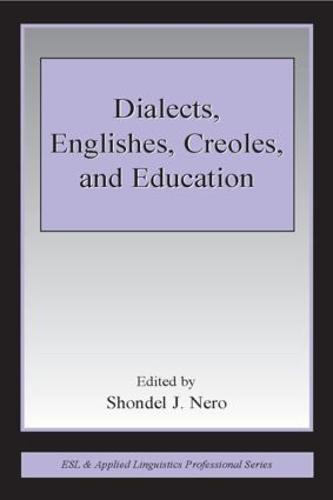
Author: Shondel J. Nero
Publisher: Taylor & Francis Inc
Imprint: Routledge
Dimensions:
Width: 15.20cm
, Height: 1.80cm
, Length: 22.90cm
Weight: 0.630kg
ISBN: 9780805846591
ISBN 10: 080584659
Pages: 368
Publication Date: 03 March 2006
Audience:
Professional and scholarly
,
Professional & Vocational
Format: Paperback
Publisher's Status: Active
Availability: In Print 
This item will be ordered in for you from one of our suppliers. Upon receipt, we will promptly dispatch it out to you. For in store availability, please contact us.
Table of Contents
Contents: P. Elbow, Foreword. Preface. S.J. Nero, Introduction. Part I: World Englishes, Creoles, and Education.Y. Kachru, World Englishes and Language Education. J. Siegel, Keeping Creoles and Dialects Out of the Classroom: Is It Justified? Part II: African American Vernacular English (AAVE)/Ebonics.J.R. Rickford, Linguistics, Education, and the Ebonics Firestorm. L. Delpit, What Should Teachers Do? Ebonics and Culturally Responsive Instruction. Part III: Caribbean Creole English.L. Winer, Teaching English to Caribbean English Creole-Speaking Students in the Caribbean and North America. Y. Pratt-Johnson, Teaching Jamaican Creole-Speaking Students. Part IV: Hawai'i Creole English (HCE)/Pidgin.D. Eades, S. Jacobs, E. Hargrove,T. Menacker, Pidgin, Local Identity, and Schooling in Hawai'i. Part V: Hispanized English.O. Garc¡a, K. Menken, The English of Latinos From a Plurilingual Transcultural Angle: Implications for Assessment and Schools. M.H. Kells, Tex Mex, Metalingual Discourse, and Teaching College Writing. Part VI: West African Pidgin English.C. de Kleine, West African World English Speakers in U.S. Classrooms: The Role of West African Pidgin English. Part VII: Asian Englishes.A. Govardhan, Indian Versus American Students' Writing in English. M.L.G. Tayao, A Transplant Takes Root: Philippine English and Education. S.J. Nero, Conclusion.
Reviews
<p> The book is a good collection of thought-provoking papers on the linguistic and educational tension created by the proliferation of vernacular Englishes and the need for language standardisation. --Language and Education, 2008<p> If we believe?that all children have a right to literacy and education, then as professional linguists we are obliged to advocate for more humane and effective ways of achieving this. This will no doubt involve?confronting conservative, blame-the-victims folk models of language and education with the truth about what language differences mean and, perhaps more importantly, what they don?t mean. This volume?makes a significant contribution to this enterprise. I hope it will find its way into many teacher education programs. --Ronald Kephart, Language Policy (2008), 7: 377-379
Author Information
Shondel J. Nero
Tab Content 6
Author Website:
Countries Available
All regions
|