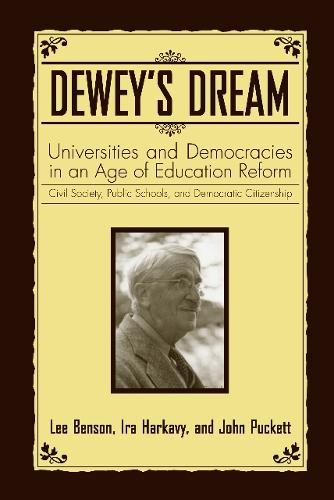
Overview
Discusses how to realize Dewey
Full Product Details
Author: Lee Benson ,
John Puckett ,
Ira Harkavy
Publisher: Temple University Press,U.S.
Imprint: Temple University Press,U.S.
Dimensions:
Width: 14.00cm
, Height: 1.20cm
, Length: 21.00cm
Weight: 0.172kg
ISBN: 9781592135929
ISBN 10: 1592135927
Pages: 160
Publication Date: 02 March 2007
Audience:
Professional and scholarly
,
Professional & Vocational
Format: Paperback
Publisher's Status: Active
Availability: In Print

This item will be ordered in for you from one of our suppliers. Upon receipt, we will promptly dispatch it out to you. For in store availability, please contact us.
Reviews
Dewey's Dreamis intellectually refreshing, provocative, persuasive, jargon free and downright practical. The authors organized the text to model for readers how to intertwine theory and practice to reveal ways that schools can promote participatory democracy. And John Dewey would be proud. -The Journal of Educational Research
One of the most startlingly impressive aspects of the ... text is that the authors have recast Dewey's work by a close reading and re-analysis of his legacy. In so doing, they have re-energized the progressive intent in his original work and provided a contemporary focus for a renewal of the progressive agenda in education. I found the argument compelling and exciting and, in my view, the authors have fully succeeded in identifying key tasks for a role for education in promoting participatory democracy. Henry Louis Taylor, Jr., Director of the Center for Urban Studies, The State University of New York at Buffalo Dewey's Dream's strength is its contribution to a re-visioning of higher education's democratic commitments...Perhaps the most important less from [Dewey's Dream] is that it is the generation of new knowledge that fundamentally demands engagement in the 21st century...This is Dewey's dream fulfilled. The Michigan Journal of Community Service Learning Dewey's Dream is both a tribute to the philosopher and a critical assessment of his work...For any university educator or administrator interested in facilitating collaborative community problem-solving projects part 2 should be required reading for its presentation of concrete strategies...This book could serve as a short, focused (albeit biased) introduction to [Dewey's] philosophy of education, and it would certainly provoke in-class debates about the extent to which Dewey's influence can still be found in public school classrooms today. The Journal of Educational Research review read, Dewey's Dream is intellectually refreshing, provocative, persuasive, jargon free and downright practical. The authors organized the text to model for readers how to intertwine theory and practice to reveal ways that schools can promote participatory democracy. And John Dewey would be proud. The Journal of Educational Research [The authors] offer their book as 'a democratic manifesto'...[T]he authors quote Dewey and secondary sources at length to explain Dewey's ideas about participatory democracy and the unfulfilled role of democratic schooling in its realization. Their aim...is hortatory. Political Science Quarterly [A] short and lively book...I have great respect for the practices, sites, and thinking of Harkavy, Benson, and Puckett. A particularly crucial contribution in this work and earlier writings is to raise the centrality of living places to civic attention. The Journal of Higher Education Outreach and Engagement Dewey's Dream is, they disarmingly say, a manifesto, aiming to be 'agenda-setting and movement-initiating, not thesis-proving,' and draws on the wealth of practical experience building community school partnerships at the University of Pennsylvania...The second part [of the book] is a fascinating discussion of a particular model for this [community school] movement, concentrating on the West Philadelphia community schools project, of which these authors are legitimately proud. There are particularly interesting brief discussions of the way university and school teaching, research, and community engagement can complement one another in programs on nutrition and health care. Perspectives on Politics Dewey's Dream has great merit. It provides an engagingly written overview of the educational philosophy and action of John Dewey...It also places the current movement of academic civic engagement...into proper historical and intellectual perspective... It should be read by all those interested in the role of higher education in modern society - and by those who should be. Education, Citizenship, and Social Justice [A] thoughtful and engaging collaborative manifesto...which [seeks] to bring Dewey's thought to bear on the current problems facing the academy and the good society. Gregory A. McBrayer -The book was also the basis of a symposium in The Good Society journal, vol. 17, No. 2, 2008 Lee Benson, Ira Harkavy, and John Puckett have provided us with a provocative discussion of a significant issue... One likely benefit of Dewey's Dream will be that more people will come to realize the need to challenge the unquestioned assumption that Dewey's views are unassailable... For no reason other than the challenges that are leveled against Dewey's views, Dewey's Dream should be read by university reformers, educational philosophers, and teacher educators. - The History of Education Quarterly, February 2009
One of the most startlingly impressive aspects of the ... text is that the authors have recast Dewey's work by a close reading and re-analysis of his legacy. In so doing, they have re-energized the progressive intent in his original work and provided a contemporary focus for a renewal of the progressive agenda in education. I found the argument compelling and exciting and, in my view, the authors have fully succeeded in identifying key tasks for a role for education in promoting participatory democracy. Henry Louis Taylor, Jr., Director of the Center for Urban Studies, The State University of New York at Buffalo Dewey's Dream's strength is its contribution to a re-visioning of higher education's democratic commitments...Perhaps the most important less from [Dewey's Dream] is that it is the generation of new knowledge that fundamentally demands engagement in the 21st century...This is Dewey's dream fulfilled. The Michigan Journal of Community Service Learning Dewey's Dream is both a tribute to the philosopher and a critical assessment of his work...For any university educator or administrator interested in facilitating collaborative community problem-solving projects part 2 should be required reading for its presentation of concrete strategies...This book could serve as a short, focused (albeit biased) introduction to [Dewey's] philosophy of education, and it would certainly provoke in-class debates about the extent to which Dewey's influence can still be found in public school classrooms today. The Journal of Educational Research review read, Dewey's Dream is intellectually refreshing, provocative, persuasive, jargon free and downright practical. The authors organized the text to model for readers how to intertwine theory and practice to reveal ways that schools can promote participatory democracy. And John Dewey would be proud. The Journal of Educational Research [The authors] offer their book as 'a democratic manifesto'...[T]he authors quote Dewey and secondary sources at length to explain Dewey's ideas about participatory democracy and the unfulfilled role of democratic schooling in its realization. Their aim...is hortatory. Political Science Quarterly [A] short and lively book...I have great respect for the practices, sites, and thinking of Harkavy, Benson, and Puckett. A particularly crucial contribution in this work and earlier writings is to raise the centrality of living places to civic attention. The Journal of Higher Education Outreach and Engagement Dewey's Dream is, they disarmingly say, a manifesto, aiming to be 'agenda-setting and movement-initiating, not thesis-proving,' and draws on the wealth of practical experience building community school partnerships at the University of Pennsylvania...The second part [of the book] is a fascinating discussion of a particular model for this [community school] movement, concentrating on the West Philadelphia community schools project, of which these authors are legitimately proud. There are particularly interesting brief discussions of the way university and school teaching, research, and community engagement can complement one another in programs on nutrition and health care. Perspectives on Politics Dewey's Dream has great merit. It provides an engagingly written overview of the educational philosophy and action of John Dewey...It also places the current movement of academic civic engagement...into proper historical and intellectual perspective... It should be read by all those interested in the role of higher education in modern society - and by those who should be. Education, Citizenship, and Social Justice [A] thoughtful and engaging collaborative manifesto...which [seeks] to bring Dewey's thought to bear on the current problems facing the academy and the good society. Gregory A. McBrayer -The book was also the basis of a symposium in The Good Society journal, vol. 17, No. 2, 2008 Lee Benson, Ira Harkavy, and John Puckett have provided us with a provocative discussion of a significant issue... One likely benefit of Dewey's Dream will be that more people will come to realize the need to challenge the unquestioned assumption that Dewey's views are unassailable... For no reason other than the challenges that are leveled against Dewey's views, Dewey's Dream should be read by university reformers, educational philosophers, and teacher educators. - The History of Education Quarterly, February 2009
""One of the most startlingly impressive aspects of the ... text is that the authors have recast Dewey's work by a close reading and re-analysis of his legacy. In so doing, they have re-energized the progressive intent in his original work and provided a contemporary focus for a renewal of the progressive agenda in education. I found the argument compelling and exciting and, in my view, the authors have fully succeeded in identifying key tasks for a role for education in promoting participatory democracy."" Henry Louis Taylor, Jr., Director of the Center for Urban Studies, The State University of New York at Buffalo ""Dewey's Dream's strength is its contribution to a re-visioning of higher education's democratic commitments...Perhaps the most important less from [Dewey's Dream] is that it is the generation of new knowledge that fundamentally demands engagement in the 21st century...This is Dewey's dream fulfilled."" The Michigan Journal of Community Service Learning ""Dewey's Dream is both a tribute to the philosopher and a critical assessment of his work...For any university educator or administrator interested in facilitating collaborative community problem-solving projects part 2 should be required reading for its presentation of concrete strategies...This book could serve as a short, focused (albeit biased) introduction to [Dewey's] philosophy of education, and it would certainly provoke in-class debates about the extent to which Dewey's influence can still be found in public school classrooms today."" The ""Journal of Educational Research"" review read, ""Dewey's Dream is intellectually refreshing, provocative, persuasive, jargon free and downright practical. The authors organized the text to model for readers how to intertwine theory and practice to reveal ways that schools can promote participatory democracy. And John Dewey would be proud."" The Journal of Educational Research ""[The authors] offer their book as 'a democratic manifesto'...[T]he authors quote Dewey and secondary sources at length to explain Dewey's ideas about participatory democracy and the unfulfilled role of democratic schooling in its realization. Their aim...is hortatory."" Political Science Quarterly ""[A] short and lively book...I have great respect for the practices, sites, and thinking of Harkavy, Benson, and Puckett. A particularly crucial contribution in this work and earlier writings is to raise the centrality of living places to civic attention."" The Journal of Higher Education Outreach and Engagement ""Dewey's Dream is, they disarmingly say, a manifesto, aiming to be 'agenda-setting and movement-initiating, not thesis-proving,' and draws on the wealth of practical experience building community school partnerships at the University of Pennsylvania...The second part [of the book] is a fascinating discussion of a particular model for this [community school] movement, concentrating on the West Philadelphia community schools project, of which these authors are legitimately proud. There are particularly interesting brief discussions of the way university and school teaching, research, and community engagement can complement one another in programs on nutrition and health care."" Perspectives on Politics ""Dewey's Dream has great merit. It provides an engagingly written overview of the educational philosophy and action of John Dewey...It also places the current movement of academic civic engagement...into proper historical and intellectual perspective... It should be read by all those interested in the role of higher education in modern society - and by those who should be."" Education, Citizenship, and Social Justice ""[A] thoughtful and engaging collaborative manifesto...which [seeks] to bring Dewey's thought to bear on the current problems facing the academy and the good society."" Gregory A. McBrayer -The book was also the basis of a symposium in The Good Society journal, vol. 17, No. 2, 2008 ""Lee Benson, Ira Harkavy, and John Puckett have provided us with a provocative discussion of a significant issue... One likely benefit of Dewey's Dream will be that more people will come to realize the need to challenge the unquestioned assumption that Dewey's views are unassailable... For no reason other than the challenges that are leveled against Dewey's views, Dewey's Dream should be read by university reformers, educational philosophers, and teacher educators."" - The History of Education Quarterly, February 2009
Author Information
Lee Benson is Emeritus Professor of History, University of Pennsylvania. Ira Harkavy is Associate Vice President and Director of the Center for Community Partnerships, University of Pennsylvania John Puckett is Associate Professor in the Policy, Management, and Evaluation Division of the University of Pennsylvania Graduate School of Education. He is the co-author of Leonard Covello and the Making of Benjamin Franklin High School: Education as if Citizenship Mattered.