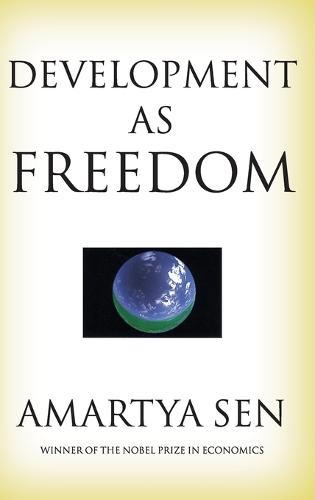
Full Product Details
Author: Amartya Sen, FBA (Master, Master, Trinity College, Cambridge)
Publisher: Oxford University Press
Imprint: Oxford University Press
Dimensions:
Width: 16.20cm
, Height: 2.60cm
, Length: 24.20cm
Weight: 0.685kg
ISBN: 9780198297581
ISBN 10: 0198297580
Pages: 384
Publication Date: 14 October 1999
Audience:
General/trade
,
General
Format: Hardback
Publisher's Status: Active
Availability: To order

Stock availability from the supplier is unknown. We will order it for you and ship this item to you once it is received by us.
Reviews
Development as Freedom is a personal manifesto: a summing up; a blend of vision, close argument, reflection and reminiscence. * The Economist 18/9/99 * Sen has looked for ways to empower the poor ... Development as Freedom is a testament to Sen's unwavering commitment to the task ... this is economics that should be read: not merely for the elegance of its arguments or the wisdom of its judgements, but for the deep and burnished humanity that animates it. * David Goldblatt, The Independent 29/11/99 * a brilliant book. Sen ranges over a vast intellectual landscape ... Many authors try this kind of tour d'horizon but few succeed as well as Amartya Sen. He is a multi-faceted scholar who has thought deeply and rigorously and has published extensively. Although Development as Freedom covers imense territory, it is subtle and nuanced and its careful scholarship is manifest at every turn. * Lars Osberg, Reviews, Compte Rendus, Autumn 2000. * the ideas are presented in a very accessible, nontechnical language. The writing is lucid with interesting story-telling openings ... a topical and timely appeal to an audience that cuts across disciplines. * S.V. Subramanian, Progress in Development Studies 1(1), Jan 01. * The connecting theme behind these essays is that development is about expanding people's ability to do things that they have a reason to value. The rationale for this is discussed with great force, clarity and consistency. * S.V. Subramanian, Progress in Development Studies 1(1), Jan 01. * Amartya Sen has made several key contributions to research on fundamental problems in welfare economics. By combining tools from economics and philosophy, he has restored an ethical dimension to the discussion of vital economic problems. From the Royal Swedish Academy Announcement of the Award of the 1998 Nobel Prize in Economic Science In this book, Amartya Sen develops elegantly, compactly, and yet broadly the concept that economic development is in its nature an increase in freedom. By historical examples, empirical evidence, and forceful and rigorous analysis, he shows how development, broadly and properly conceived, cannot be antagonistic to liberty but consists precisely in its increase. Kenneth J. Arrow, Nobel Laureate in Economic Science The world's poor and dispossed could have no more articulate or insightful a champion among economists than Amartya Sen. By showing that the quality of our lives should be measured not by our wealth but by our freedom, his writings have revolutionized the theory and practice of development. The United Nations, in its own development work, has benefited immensely from the wisdom and good sense of Professor Sen's views. Kofi A. Annan, Secretary-General of the United Nations
Economics meets philosophy in this wide-ranging manifesto that identifies freedom as the agent of universal development as well as its goal. Sen, the 1998 Nobel laureate in economics, points out, among many things, that there has never been famine in functioning democracies, including modern India, Botswana, and Zimbabwe (democratic officeholders, unlike colonial functionaries or dictators, are obliged to respond to impending shortages). High per capita income does not necessarily mean longer life (poor residents of Kerala, India, can expect to live longer than richer American blacks). In much of the world, gender inequality causes distorted male-female ratios (thus, there are missing women ). Sen analyzes a myriad of such considerations and offers a thoughtful synthesis of welfare economics, political principles, and ethics. He asks fundamental questions, challenges common assumptions, and takes on diverse shibboleths. Lest you think a statement like low income is clearly one of the major causes of poverty is foolishly simplistic, hold on as he proceeds to demonstrate that there are other important causes for capability deprivation, as he characterizes poverty. Human development . . . is ah ally of the poor, he says. It is an indication of the topsy-turvy world in which we live that the school-teacher or the nurse feels more threatened by financial conservatism than does the army general. The lucid insights are abundant as Sen marshals scores of thinkers from Aristotle to Rabindranath Tagore, Confucius to Bentham. His text is, as well, a sly review of his contemporaries and a sagacious reappraisal of Adam Smith. Casual readers may find rough going with a lexicon like complemantarity or chosen functioning vector, but the expansive discussion will surely attract contemplative public policy practitioners. This learned book, more diagnostic than prescriptive, convinces us of freedom's value and utility in economic development. Less clear: how to bring freedom about in the world. Sen's book must nevertheless be seen as a seminal and influential text for students and makers of policy. (Kirkus Reviews)
The world's poor and dispossed could have no more articulate or insightful a champion among economists than Amartya Sen. By showing that the quality of our lives should be measured not by our wealth but by our freedom, his writings have revolutionized the theory and practice of development. The United Nations, in its own development work, has benefited immensely from the wisdom and good sense of Professor Sen's views. Kofi A. Annan, Secretary-General of the United Nations In this book, Amartya Sen develops elegantly, compactly, and yet broadly the concept that economic development is in its nature an increase in freedom. By historical examples, empirical evidence, and forceful and rigorous analysis, he shows how development, broadly and properly conceived, cannot be antagonistic to liberty but consists precisely in its increase. Kenneth J. Arrow, Nobel Laureate in Economic Science Amartya Sen has made several key contributions to research on fundamental problems in welfare economics. By combining tools from economics and philosophy, he has restored an ethical dimension to the discussion of vital economic problems. From the Royal Swedish Academy Announcement of the Award of the 1998 Nobel Prize in Economic Science The connecting theme behind these essays is that development is about expanding people's ability to do things that they have a reason to value. The rationale for this is discussed with great force, clarity and consistency. S.V. Subramanian, Progress in Development Studies 1(1), Jan 01. the ideas are presented in a very accessible, nontechnical language. The writing is lucid with interesting story-telling openings ... a topical and timely appeal to an audience that cuts across disciplines. S.V. Subramanian, Progress in Development Studies 1(1), Jan 01. a brilliant book. Sen ranges over a vast intellectual landscape ... Many authors try this kind of tour d'horizon but few succeed as well as Amartya Sen. He is a multi-faceted scholar who has thought deeply and rigorously and has published extensively. Although Development as Freedom covers imense territory, it is subtle and nuanced and its careful scholarship is manifest at every turn. Lars Osberg, Reviews, Compte Rendus, Autumn 2000. Sen has looked for ways to empower the poor ... Development as Freedom is a testament to Sen's unwavering commitment to the task ... this is economics that should be read: not merely for the elegance of its arguments or the wisdom of its judgements, but for the deep and burnished humanity that animates it. David Goldblatt, The Independent 29/11/99 Development as Freedom is a personal manifesto: a summing up; a blend of vision, close argument, reflection and reminiscence. The Economist 18/9/99
Author Information
Amartya Sen is the Master of Trinity College Cambridge and the winner of the 1998 Nobel Prize in Economic Science. He has been President of the Indian Economic Association, the American Economic Association, the International Economic Association and the Econometrics Society. He has taught at Oxford, Cambridge, Harvard and the London School of Economics.