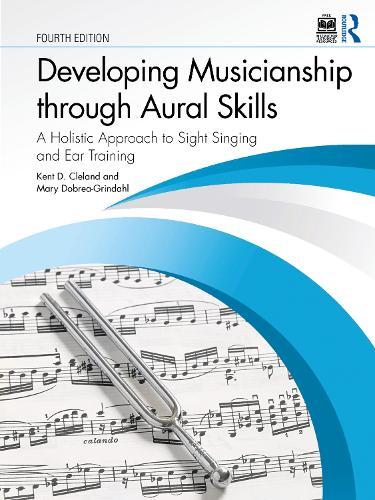
Developing Musicianship through Aural Skills: A Holistic Approach to Sight Singing and Ear Training

Author:   Kent D. Cleland (Baldwin-Wallace College, USA) ,  Mary Dobrea-Grindahl (Baldwin-Wallace College, USA)
Publisher:   Taylor & Francis Ltd
Edition:   4th edition
ISBN:  

9781032996127


Pages:   512
Publication Date:   17 June 2026
Format:   Paperback
Availability:   Not yet available   Availability explained
This item is yet to be released. You can pre-order this item and we will dispatch it to you upon its release.

Our Price $250.96 Quantity:  
Pre-Order

Share |

Developing Musicianship through Aural Skills: A Holistic Approach to Sight Singing and Ear Training


Overview

Developing Musicianship through Aural Skills, Fourth Edition, is a comprehensive method for learning to hear, sing, understand, and use the foundations of music as part of an integrated curriculum, incorporating both sight singing and ear training in one volume. Under the umbrella of musicianship, this textbook guides students to ""hear what they see, and see what they hear,"" with a trained, discerning ear on both a musical and an aesthetic level. Key features of this new edition include: Revised selection of musical examples, with added new examples including more excerpts from the literature and additional easy and intermediate examples. Several modules have been reorganized to enhance pedagogy and reflect instructor practice, including sections on ties and dotted notes; pentatonic scales; intervals; seventh chords; chromaticism in tonal scalar structures; and post-tonal music. Revised and updated ‘Intermezzo’ chapters offering reflections on a variety of subjects related to building a career as a musician. Supporting Online Resources now include enhanced identification and dictation instruction. The text reinforces both musicianship and theory in a systematic method, and its holistic approach provides students with the skills necessary to incorporate professionalism, creativity, confidence, and performance preparation in their music education. Over 1,600 musical examples represent a wide range of musical styles and genres, including classical, jazz, musical theatre, popular, and folk music. The fourth edition of Developing Musicianship through Aural Skills provides a strong foundation for undergraduate music students and answers the need for combining skills in a more holistic, integrated music theory core.

Full Product Details

Author:   Kent D. Cleland (Baldwin-Wallace College, USA) ,  Mary Dobrea-Grindahl (Baldwin-Wallace College, USA)
Publisher:   Taylor & Francis Ltd
Imprint:   Routledge
Edition:   4th edition
ISBN:  

9781032996127


ISBN 10:   1032996129
Pages:   512
Publication Date:   17 June 2026
Audience:   College/higher education ,  Tertiary & Higher Education
Format:   Paperback
Publisher's Status:   Forthcoming
Availability:   Not yet available   Availability explained
This item is yet to be released. You can pre-order this item and we will dispatch it to you upon its release.

Table of Contents

Overture (Preface): Why study aural skills? The Method Pitch and Rhythm Syllable Systems Unit 1: Simple Meter, Scales, and Intervals Chapter 1: Simple Meters 1a Simple Beats and Their First Division and Multiple Note Values 1b Simple Duple and Quadruple Meters 1c Simple Triple Meters 1d Second Division and Multiple in Simple Meters 1e Rests 1f Tied and Dotted Rhythms in Simple Meter 1g The Anacrusis 1h Less Common Simple Meters Intermezzo 1: Professionalism Chapter 2: Tonal Scales and Scale Degrees 2a Reading Pitches on a Staff 2b Major Scales and Scale Degrees 2c Minor Scales and Scale Degrees 2d How to Sing a Melody at Sight 2e Major and Minor Pentatonic Scales Intermezzo 2: Musicality Chapter 3: Intervals 3a The Process for Singing and Hearing Intervals 3b Group 1 Intervals (Ascending M2, M3, P5, Descending m2 and P4) 3c Group 2 Intervals (Reverse of Group 1 Intervals and the Minor 3rd) 3d Group 3 Intervals (Tritones, Sixths, and Sevenths) 3e Introduction to Melodic Improvisation Intermezzo 3: Listening Unit 2: Compound Meter and Diatonic Chords Chapter 4: Compound Meters 4a Compound Meter 4b Second Division of the Beat in Compound Meter 4c Less Common Compound Meters Intermezzo 4: Confidence Chapter 5: Diatonic Triads 5a The Process for Singing and Hearing Triads 5b Root Position Major Triads 5c Root Position Minor Triads 5d Inversions of Major and Minor Triads 5e Diminished Triads 5f Improvising through Arpeggiation 5g Common Harmonic Progressions I: TPDT, Circle of Fifths, Pachelbel Intermezzo 5: Creativity Chapter 6: Diatonic Seventh Chords 6a The Process for Singing and Hearing Seventh Chords 6b Dominant Seventh Chords 6c Seventh Chords in the Major Mode 6d Seventh Chords in the Minor Mode 6e Arpeggiation and Improvisation Using Seventh Chords 6f Common Harmonic Progressions II: Doo-Wop, Ascending Seconds, and Rhythm Changes Intermezzo 6: Perseverance Unit 3: Irregular Divisions of Beats, Chromaticism, and Modulation Chapter 7: Irregular Divisions of Beats 7a Beat-Level Triplets 7b Duplets 7c Triplets in Augmentation and Diminution 7d Other Divisions of the Beat Intermezzo 7: Energy, Space, and Time Chapter 8: Chromaticism in Tonal Scalar Structures 8a The Chromatic Scale 8b The Ecclesiastic Modes 8c Blues Scales 8d Synthetic Scales Intermezzo 8: Performance Preparation Chapter 9: Chromaticism in Tonal Harmonic Structures 9a Modal Mixture 9b Secondary Chords in the Major Mode 9c Secondary Chords in the Minor Mode 9d Neapolitan and Augmented 6th chords 9e Lead Sheets that Use Chromatic Chords Intermezzo 9: Working with Other Musicians Chapter 10: Syncopation 10a Syncopation Within a Measure (Intra-Measure Syncopation) 10b Syncopation Across a Barline (Inter-Measure Syncopation) 10c Syncopation in Compound Meters Intermezzo 10: Appreciating Diverse Musical Styles Chapter 11: Music that Modulates 11a Techniques for Modulation 11b Modulation Between Relative Keys 11c Modulation to the Dominant and Subdominant 11d Modulation to Other Closely Related Keys 11e Modulation to Distantly Related Keys Intermezzo 11: Taking Care of Yourself Unit 4: Advanced Rhythmic Concepts and Post-Tonal Music Chapter 12: Advanced Rhythmic Concepts 12a Changing Meter 12b Metric Modulation 12c Polyrhythms and Polymeters 12d Meters with Unequal Beats Intermezzo 12: Building a Career in Music Chapter 13: Post-Tonal Music 13a Polytonality and Polymodality 13b Whole-Tone and Octatonic Scales 13c Post-Tonal Music Coda: Living a Life in Music and Being an Advocate for Your Art Appendices: Appendix A Process for Taking Rhythmic Dictation Appendix B Process for Taking Harmonic Dictation Appendix C Process for Taking Melodic Dictation Glossary Index of Musical Examples Permissions

Reviews

Author Information

Kent D. Cleland is Distinguished Professor of Music Theory at the Baldwin Wallace Conservatory of Music, where he has taught music theory and aural skills since 1999. Mary Dobrea-Grindahl is Emeritus Professor of Piano at the Baldwin Wallace Conservatory of Music, where she taught solfège, eurhythmics, and private piano for over 30 years.

Tab Content 6

Author Website:  

Countries Available

All regions
Latest Reading Guide

RGJ26


Shopping Cart
Your cart is empty
Shopping cart
Mailing List