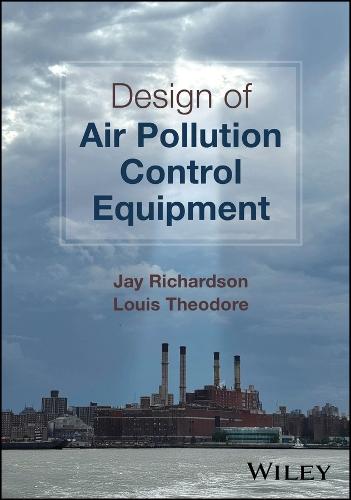
Design of Air Pollution Control Equipment

Author:   Jay Richardson (University of Connecticut) ,  Louis Theodore (Manhattan College)
Publisher:   John Wiley & Sons Inc
ISBN:  

9781394377688


Pages:   384
Publication Date:   15 May 2026
Format:   Hardback
Availability:   Awaiting stock   Availability explained
The supplier is currently out of stock of this item. It will be ordered for you and placed on backorder. Once it does come back in stock, we will ship it out for you.

Our Price $281.95 Quantity:  
Add to Cart

Share |

Design of Air Pollution Control Equipment


Overview

Essential Insights, Design Details, and Real-world Examples??for??the??Design of Air Pollution Control Equipment Providing the pragmatic perspective of practicing engineers and applied scientists, Design of Air Pollution Control Equipment serves as a unique technology-transfer guide in air pollution control, enabling readers to address pollutants across diverse industries. The book shows how to curb air pollutants produced throughout human-made industrial processes, by providing the guidance needed to ensure the effectiveness and efficiency of various types of air pollution control equipment. Readers will find: Comprehensive chapters on designing air pollution control equipment for gases and particulates, along with advanced systems such as hybrid systems, NOx control, CO2 control, and flue gas desulfurization systems 50 detailed examples and comprehensive field data for practical design and engineering solutions Technical details, calculation methods, and illustrative examples??in??a user-friendly format Design options to control air pollution emissions and the pros/cons of the alternatives Harmful effects of high concentrations of pollutants, including higher global temperatures, reduced visibility, and diminished overall air quality This book is an ideal reference for consultants, federal, state, and local agency personnel, advanced students, practicing engineers, and science professionals working in environmental science, environmental health, and environmental control.

Full Product Details

Author:   Jay Richardson (University of Connecticut) ,  Louis Theodore (Manhattan College)
Publisher:   John Wiley & Sons Inc
Imprint:   John Wiley & Sons Inc
ISBN:  

9781394377688


ISBN 10:   1394377681
Pages:   384
Publication Date:   15 May 2026
Audience:   Professional and scholarly ,  Professional & Vocational
Format:   Hardback
Publisher's Status:   Active
Availability:   Awaiting stock   Availability explained
The supplier is currently out of stock of this item. It will be ordered for you and placed on backorder. Once it does come back in stock, we will ship it out for you.

Table of Contents

Table of Contents About the Authors Preface Part I: Prologue Chapter 1: The Air Pollution Problem 1.1 The Role of Water and Air 1.2 Early History of Air Pollution 1.3 The Need for Air Pollution Control 1.4 The Environmental Movement and the Environmental Protection Agency 1.5 References Chapter 2: Sources, Classifications, and Effects of Air Pollution 2.1 Introduction 2.2 Human Responses to Air Pollution 2.3 Human Health Effects: Oxides of Sulfur, Carbon, and Nitrogen 2.4 Human Health Effects: Photochemical Oxidants and Organic Pollutants 2.5 Human Health Effects: Particulates 2.6 Effect on Animals, Vegetation, Materials, and Visibility 2.7 References Chapter 3: Air Pollution Regulatory Framework 3.1 Introduction 3.2 The Regulatory System 3.3 Laws and Regulations: The Differences 3.4 Provisions of the 1970 Clean Air Act 3.5 Current United States Air Quality Legislation And Regulations 3.6 Major Project Permitting 3.7 International Environmental Regulations 3.8 Future Trends 3.9 References Chapter 4: Introduction to Air Pollution Control Equipment Technology  4.1 Introduction 4.2 Control Technology Options 4.3 Introduction to Air Pollution Control Equipment 4.4 Air Pollution Control Equipment for Particulates 4.5 Air Pollution Control Equipment for Gaseous Pollutants 4.6 Factors in Control Equipment Selection 4.7 Factors in Purchasing Control Equipment 4.8 References Part II: Design of Air Pollution Control Equipment: Gases Chapter 5: Basic Principles: Gases 5.1 Introduction 5.2 Measurement Fundamentals 5.3 Chemical and Physical Properties 5.4 Ideal Gas Law 5.5 Phase Equilibrium 5.6 Conservation Laws 5.7 Thermochemistry and Kinetics 5.8 References Chapter 6: Absorbers Ernesto Daniel Cabezas Herrera 6.1 Introduction 6.2 Description of Absorber Equipment 6.3 Process Considerations 6.4 Equipment Design Considerations 6.5 Applications                 6.5.1 Absorber Design with No Data                 6.5.2 Tower Height and Diameter                 6.5.3 Absorber failure to meet performance guarantee 6.6 References Chapter 7: Adsorbers  7.1 Introduction 7.2 Description of Adsorber Equipment 7.3 Process Design Considerations 7.4 Equipment Design Considerations 7.5 Applications                 7.5.1 Working Capacity                 7.5.2 Ethyle Acetate Application                 7.5.3 Industrial Plant 7.6 References Chapter 8: Incinerators/Combustion Equipment 8.1 Introduction 8.2 Description of Combustion Equipment 8.3 Process Design Considerations 8.4 Equipment Design Considerations 8.5 Applications                 8.5.1 Available Heat Calculation                 8.5.2 A Permit Review                 8.5.3 Paint Baking Oven Application 8.6 References Chapter 9: Condensers 9.1 Introduction 9.2 Description of Condenser Equipment 9.3 Process Design Considerations 9.4 Equipment Design Considerations 9.5 Applications                 9.5.1 Heat Transfer Coefficient Value                 9.5.2 Heat Transfer Requirement                 9.5.3 Condenser Area Calculation 9.6 References Part III: Air Pollution Control Equipment for Particulates Chapter 10: Basic Principles: Particulates  10.1 Introduction 10.2 Fluid Particle Dynamics 10.3 Particle Sizing 10.4 Particle Size Distribution 10.5 Particle Collection Efficiency 10.6 Particle Collection Mechanisms 10.7 References Chapter 11: Gravity Settlers 11.1 Introduction 11.2 Description of Gravity Settler Equipment 11.3 Process Design Considerations 11.4 Equipment Design Considerations 11.5 Design Applications                 11.5.1 Gravity Settler Design                 11.5.2 Options to Increase the Efficiency of an Existing Settler                 11.5.3 Theodore7 has claimed that the key process design variable for gravity settlers is the          capture area, which is given by: 11.6 References Chapter 12: Cyclones 12.1 Introduction 12.2 Description of Cyclone Equipment 12.3 Process Design Considerations 12.4 Equipment Design Considerations 12.5 Design Applications                 12.5.1 Cyclone Selection                 12.5.2 Breakeven Efficiency                 12.5.3 THEO 12.6 References Chapter 13: Wet Scrubbers 13.1 Introduction 13.2 Description of Wet Scrubber Equipment 13.3 Process Design Considerations 13.4 Equipment Design Considerations 13.5 Applications                 13.5.1 Throat Area Calculation                 13.5.2 Collection Efficiency Calculation                 13.5.3 Overall Efficiency in Multiple Scrubbers in Parallel 13.6 References Chapter 14: Electrostatic Precipitators (ESPs) 14.1 Introduction 14.2 Description of Electrostatic Precipitation Equipment 14.3 Process Design Considerations 14.4 Equipment Design Considerations 14.5 Applications                 14.5.1 Design Factors                 14.5.2 Effect of Particle Size Distribution                 14.5.3 Bus Section Failure 14.6 References Chapter 15: Baghouses 15.1 Introduction 15.2 Description of Baghouse Equipment 15.3 Process Design Considerations 15.4 Equipment Design Considerations 15.5 Applications                 15.5.1 Filter Bag Fabric Selection                 15.5.2 Maximum Allowable Bag Failure                 15.5.3 Normally Distributed Bag Failures 15.6 References Part IV: Design of Other Air Pollution Control Equipment Chapter 16: Hybrid Systems 16.1 Introduction to Hybrid Systems 16.2 Dry Scrubbers (DRYS) 16.2 Ionizing Wet Scrubber (IWS) 16.4 Elektrofil ESP 16.5 Wet Electrostatic Precipitators (WEPs) 16.6 Electrostatic Stimulation of Fabric Filtration (ESFF) 16.7 Recent Advances in Control Equipment Technology 16.8 Conclusion 16.9 References Chapter 17: Flue Gas Desulfurization Systems 17.1 Introduction 17.2 Description of Control Device 17.3 Process Design Considerations 17.4 Installation Procedures 17.5 Operation                 17.5.1 Normal Operation                 17.5.2 System Health                 17.6 Startup 17.7 Maintenance 17.8 Improving Operation and Performance 17.9 Conclusions 17.10 References Chapter 18: Controlling the Oxides of Nitrogen 18.1 Introduction 18.2 The Oxides of Nitrogen 18.3 NOx Control Methods 18.4 Reducing NOx Generation via Pollution Prevention 18.5 Control of Flue Gas NOx 18.5 Selective Catalytic Reduction (SCR) Overview 18.6 Operation, Maintenance, Inspection, and Optimization Considerations 18.7 Conclusions 18.8 References Chapter 19: Carbon Capture and Storage  19.1 Introduction 19.2 Properties of Carbon Dioxide 19.3 Global Carbon Cycle 19.4 The Greenhouse Effect 19.5 Effects of Global Warming/Climate Change 19.6 Carbon Dioxide Control Technologies 19.7 Carbon Dioxide Sequestration 19.8 Final Editorial Thoughts (of One of the Authors) 19.9 Final Editorial Thoughts (of the Other Author) 19.10 References Chapter 20: Stacks 20.1 Introduction 20.2 Description of control device 20.3 Process Design Considerations 20.4 Equipment Design Considerations 20.5 Sulfuric Acid Attack 20.6 Inspection and Repair of Liners 20.7 Recent Advances 20.8 Conclusions 20.9 References Part V: Epilogue Chapter 21: Comparing, Selecting, and Purchasing Air Pollution Control Equipment 21.1 Introduction 21.2 Factors in Control Equipment Selection 21.3 Comparing Control Equipment Alternatives 21.4 Selecting Control Equipment for Specific Industries 21.5 Purchasing Equipment 21.6 References Part VI: Appendix Part VII: Index

Reviews

Author Information

Jay Richardson is the owner of Falcon Combustion and has over ten years’ experience in the engineering, design, construction, commissioning, and testing of combustion equipment for industrial and utility boilers, Low?NOx Burners, OFA, FGR, ignition, and control systems. He has designed over 1,000 industrial burners and has worked on combustion equipment that range in size from 6?MMBtu/hr catalyst activators to 100hp firetube boilers to 250 MMBtu/hr thermal oxidizers to 1,000 MW twin furnace T-fired utility boilers and everything in between. Louis Theodore is a retired professor of chemical engineering with 50 years of experience. He is the author of many leading publications and an internationally recognized lecturer who has provided nearly 200 courses to industry, government and technical associations. Dr. Theodore is the recipient of the International Air & Waste Management Association?s prestigious Ripperton award and the American Society of Engineering Education (ASEE) AT&T Foundation award for “excellence in the instruction of engineering students”.

Tab Content 6

Author Website:  

Countries Available

All regions
Latest Reading Guide

MRGC26


Shopping Cart
Your cart is empty
Shopping cart
Mailing List