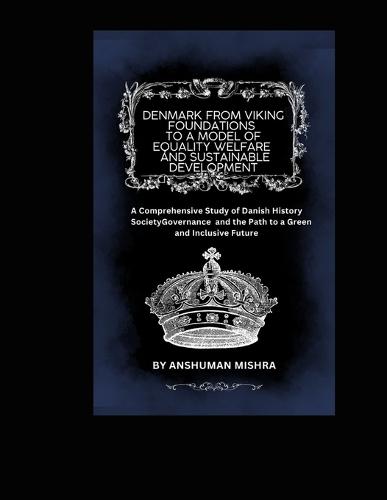
Overview
Denmark occupies a unique and influential position in world history and contemporary global affairs. Though small in geographical size and population, the Danish experience offers some of the most compelling lessons in governance, social equality, economic resilience, and environmental sustainability. This book, Denmark: From Viking Foundations to a Model of Equality, Welfare, and Sustainable Development, presents a comprehensive, carefully researched, and academically grounded exploration of Denmark's long journey-from early tribal societies and Viking kingdoms to one of the most stable, inclusive, and sustainable nations in the modern world. The central aim of this book is not merely to narrate Denmark's history but to explain how historical choices, cultural values, political institutions, and social consensus collectively shaped a distinctive national model. Denmark's success did not emerge overnight, nor was it the result of extraordinary natural resources or imperial expansion. Instead, it evolved through centuries of adaptation, reform, compromise, and collective responsibility. This book systematically traces those processes and presents them in a structured, reader-friendly manner suitable for students, researchers, policymakers, and general readers alike. A Journey Beginning with Early Kingdoms The book begins by examining Denmark's earliest foundations-prehistoric settlements, agrarian societies, and tribal structures that laid the groundwork for later political organization. Particular attention is given to the Viking Age, a period often misunderstood or oversimplified. Rather than portraying Vikings solely as warriors, the book highlights their role as traders, settlers, law-makers, and cultural innovators. Danish Vikings were instrumental in shaping Northern European trade networks, maritime technology, and early legal traditions that emphasized negotiation and collective decision-making. The formation of the Danish kingdom under early monarchs marked a turning point. The consolidation of royal authority, the adoption of Christianity, and the development of administrative systems provided the institutional stability necessary for long-term state formation. These early centuries established patterns of governance that would later evolve into constitutional democracy. From Absolutism to Democracy A major strength of this book lies in its detailed analysis of Denmark's political evolution. The transition from medieval feudalism to absolute monarchy, and eventually to constitutional democracy, is presented as a gradual and negotiated process rather than a violent rupture. Unlike many European states, Denmark experienced relatively limited internal conflict during these transformations, largely due to its tradition of compromise and institutional reform. The introduction of the 1849 Constitution marked a decisive moment in Danish history, ending absolute monarchy and establishing parliamentary governance. This book explains how democratic institutions were strengthened over time through electoral reforms, political participation, and the development of a strong civil society. The Danish model demonstrates how democracy can be built incrementally, with legitimacy rooted in public trust rather than coercion. The Birth of the Welfare State One of the most significant contributions of this book is its in-depth exploration of the Danish welfare state, widely regarded as one of the most effective in the world. Rather than treating welfare as a post-war phenomenon alone, the book traces its philosophical and social origins to earlier traditions of community support, cooperative movements, and agrarian reforms. The Danish welfare model is analyzed not as a system of dependency but as a framework that enhances individual freedom through collective security. Universal healthcare.
Full Product Details
Author: Anshuman Mishra
Publisher: Independently Published
Imprint: Independently Published
Volume: 20
Dimensions:
Width: 21.60cm
, Height: 1.30cm
, Length: 27.90cm
Weight: 0.576kg
ISBN: 9798243768085
Pages: 244
Publication Date: 13 January 2026
Audience:
General/trade
,
General
Format: Paperback
Publisher's Status: Active
Availability: Available To Order

We have confirmation that this item is in stock with the supplier. It will be ordered in for you and dispatched immediately.