Overview
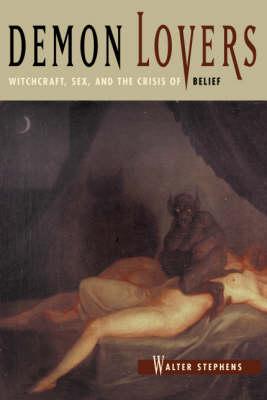
On September 20, 1587, Walpurga Hausmannin of Dillingen in southern Germany was burned at the stake as a witch. Although she had confessed to committing a long list of ""maleficia"" (deeds of harmful magic), including killing 41 infants and two mothers in labour, her evil career allegedly began with just one heinous act - sex with a demon. Fornication with demons was a major theme of her trial record, which detailed an almost continuous orgy of sexual excess with her diabolical paramour Federlin ""in many diverse places ...even in the street by night"". As Walter Stephens demonstrates in ""Demon Lovers"", it was not Hausmannin or other so-called witches who were obsessive about sex with demons - instead, a number of devout Christians, including trained theologians, displayed an uncanny preoccupation with the topic during the centuries of the ""witch craze"". Why? To find out, Stephens conducts a detailed investigation of the first and most influential treatises on witchcraft (written between 1430 and 1530), including the infamous ""Malleus Maleficarum"" (""Hammer of Witches""). Far from being credulous fools or mindless misogynists, early writers on witchcraft emerge in Stephens's account as rational but reluctant skeptics, trying desperately to resolve contradictions in Christian thought on God, spirits and sacraments that had bedeviled theologians for centuries. Proof of the physical existence of demons - for instance, through evidence of their intercourse with mortal witches - would provide strong evidence for the reality of the supernatural, the truth of the Bible, and the existence of God. Early modern witchcraft theory reflected a crisis of belief - a crisis that continues to be expressed today in popular debates over angels, Satanic ritual child abuse and alien abduction.
Full Product Details
Author: Walter Stephens
Publisher: The University of Chicago Press
Imprint: University of Chicago Press
Edition: 2nd ed.
Dimensions:
Width: 16.00cm
, Height: 3.10cm
, Length: 23.50cm
Weight: 0.798kg
ISBN: 9780226772615
ISBN 10: 0226772616
Pages: 408
Publication Date: 01 February 2002
Audience:
College/higher education
,
Professional and scholarly
,
Undergraduate
,
Postgraduate, Research & Scholarly
Format: Hardback
Publisher's Status: Out of Stock Indefinitely
Availability: Awaiting stock

Reviews
This important book moves witchcraft from the periphery to the center of late-medieval and early-modern intellectual and religious culture, challenges the very distinction between medieval and early modern, and forces us to reconsider seriously some basic categories of premodern European thought and life. --Michael D. Bailey Speculum
This book fills an important gap by exploring the often-tangled thought processes of the first generation of witchcraft theorists' . . . [who] constructed the essentials of the early modern notion of the witch. . . . This provocative, often fascinating, book poses an original and important perspective on the meaning of the witch-figure in the history of late-medieval and Renaissance theology. It is essential reading for those interested in the witch hunts, as well as those with a general interest in fifteenth- and sixteenth-century thought. -- Elspeth Whitney Renaissance Quarterly
Scholars of religion must be highly indebted to Walter Stephens for providing a responsible reading of witchcraft theorists. . . . His thesis is well supported, persuasive, and a welcome antidote to sensationalist accounts of witch persecution. . . . Demon Lovers is fascinating and instructive reading for anyone who notices and fears the gulf between human intentions and their effects. <br>--Margaret R. Miles Journal of the American Academy of Religion
This book fills an important gap by exploring the often-tangled thought processes of the first generation of 'witchcraft theorists' . . . [who] constructed the essentials of the early modern notion of the witch. . . . This provocative, often fascinating, book poses an original and important perspective on the meaning of the witch-figure in the history of late-medieval and Renaissance theology. It is essential reading for those interested in the witch hunts, as well as those with a general interest in fifteenth- and sixteenth-century thought. --Elspeth Whitney Renaissance Quarterly This important book moves witchcraft from the periphery to the center of late-medieval and early-modern intellectual and religious culture, challenges the very distinction between medieval and early modern, and forces us to reconsider seriously some basic categories of premodern European thought and life. --Michael D. Bailey Speculum Scholars of religion must be highly indebted to Walter Stephens for providing a responsible reading of witchcraft theorists. . . . His thesis is well supported, persuasive, and a welcome antidote to sensationalist accounts of witch persecution. . . . Demon Lovers is fascinating and instructive reading for anyone who notices and fears the gulf between human intentions and their effects. --Margaret R. Miles Journal of the American Academy of Religion The book is valuable not only because of its focus on witchcraft theoreticians and witchcraft in a theological context, but also because Stephens focuses on influential, but little-studied, early thinkers. . . . The book is essential reading for all serious students of the subject. It is a major contribution to the rehabilitation of the literature of witchcraft theory. --Edward Peters The Historian
Author Information
Walter Stephens is the Charles S. Singleton Professor of Italian Studies at The Johns Hopkins University. He is the author of Giants in Those Days: Folklore, Ancient History, and Nationalism and coeditor of Discourses of Authority in Medieval and Renaissance Literature.