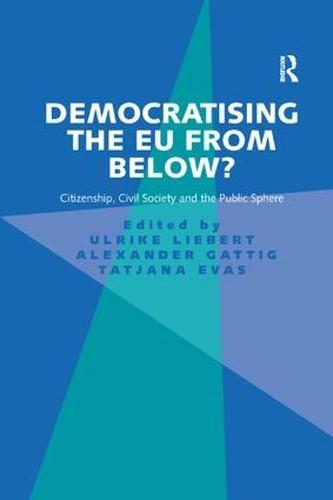
Full Product Details
Author: Ulrike Liebert ,
Alexander Gattig
Publisher: Taylor & Francis Ltd
Imprint: Routledge
Weight: 0.410kg
ISBN: 9781138490123
ISBN 10: 1138490121
Pages: 220
Publication Date: 31 July 2018
Audience:
College/higher education
,
General/trade
,
Tertiary & Higher Education
,
General
Format: Paperback
Publisher's Status: Active
Availability: In Print

This item will be ordered in for you from one of our suppliers. Upon receipt, we will promptly dispatch it out to you. For in store availability, please contact us.
Reviews
'More Europe is the answer most frequently articulated by elites in response to the current crisis of the Euro. This from above strategy has served several times in the past to drive the integration process forward, but will it suffice in the present context? This collection of essays suggests not. The impact of EU policies has become so extensive and controversial that it has attracted increased media attention, penetrated organizations of civil society, compelled political parties to take conflicting positions and mobilized citizens to act in novel ways from below - and much of this has been against rather than for more Europe. Scholars and politicians interested not just in understanding this rise in resistance, but also in acting to incorporate it within a new strategy for legitimating the emerging Euro-polity will find important insights in this book.' Philippe C. Schmitter, European University Institute, Italy 'By exploring how European citizens, civil society, the media, political parties, parliaments and courts engage with the problems of democracy in the EU, this book sheds new light on an inconclusive constitutional order. In the face of the present financial, economic and political crisis, the authors provide much appreciated knowledge of the more fundamental questions of EU's viability as a citizens' union .' Erik O. Eriksen, University of Oslo, Norway
"'More Europe is the answer most frequently articulated by elites in response to the current crisis of the Euro. This ""from above"" strategy has served several times in the past to drive the integration process forward, but will it suffice in the present context? This collection of essays suggests not. The impact of EU policies has become so extensive and controversial that it has attracted increased media attention, penetrated organizations of civil society, compelled political parties to take conflicting positions and mobilized citizens to act in novel ways ""from below"" - and much of this has been against rather than for more Europe. Scholars and politicians interested not just in understanding this rise in resistance, but also in acting to incorporate it within a new strategy for legitimating the emerging Euro-polity will find important insights in this book.’ Philippe C. Schmitter, European University Institute, Italy ’By exploring how European citizens, civil society, the media, political parties, parliaments and courts engage with the problems of democracy in the EU, this book sheds new light on an inconclusive constitutional order. In the face of the present financial, economic and political crisis, the authors provide much appreciated knowledge of the more fundamental questions of EU’s viability as a citizens’ union.’ Erik O. Eriksen, University of Oslo, Norway"
Author Information
Ulrike Liebert is Professor of Political Science, Jean Monnet Professor of European Politics, director of the Jean Monnet Centre for European Studies at Bremen University where she has co-directed the section ’European integration’ of the Bremen International Graduate School for Social Sciences. Alexander Gattig is a lecturer at the Department of Sociology’s Social Science Methods Centre at the University of Bremen. His research interests are in the area of social stratification, political sociology and rational choice theory. Tatjana Evas is an Associate Professor at the Tallinn Law School, Estonia and currently working as a researcher at the European University Institute. Her research interests are in the area of European constitutional law, judicial politics, legal theory and equality law.