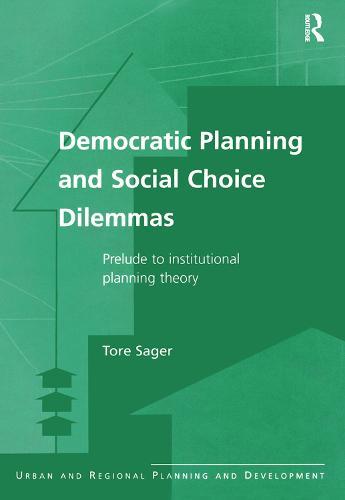
Full Product Details
Author: Tore Sager ,
Professor Graham Haughton
Publisher: Taylor & Francis Ltd
Imprint: Routledge
Edition: New edition
Dimensions:
Width: 15.30cm
, Height: 3.20cm
, Length: 21.90cm
Weight: 0.599kg
ISBN: 9780754619529
ISBN 10: 0754619524
Pages: 340
Publication Date: 28 October 2002
Audience:
College/higher education
,
Professional and scholarly
,
Tertiary & Higher Education
,
Professional & Vocational
Format: Hardback
Publisher's Status: Active
Availability: In Print

This item will be ordered in for you from one of our suppliers. Upon receipt, we will promptly dispatch it out to you. For in store availability, please contact us.
Reviews
'The significance of the nature of process or procedure in shaping decision patterns and outcomes has been well received by institutional theorists. Professor Sager's Democratic Planning and Social Choice Dilemmas: Prelude to institutional planning theory is an important contribution to the emerging literature on the institutional setting for planning. With systematic and critical reference to the impossibility theorems of Kenneth Arrow, Amartya Sen, Allan Gibbard and Mark Satterthwaite, this major work of Sager succeeds not only in presenting a case for constraining the ways in which planning decisions are made in a participatory process but also offering a perspective to reinterpret the paradigm of crisis for the planning profession.' Lawrence Wai-chung Lai, University of Hong Kong, Hong Kong 'Tore Sager has produced a tour de force by asking a simple question: How do groups choose? With it he shines the bright light of social choice theory on the foundations of communicative planning theory. Made visible are the voids, contradictions and undeclared assumptions. And the bar has been raised for rigour in planning theory. This book is a must for anyone with a serious interest in the field.' Michael Poulton, Director, School of Planning, Dalhousie University, Canada 'Tore Sager provides a sturdy Nordic anchor for the Trans-Atlantic network of scholars involved in the business of planning theory. After his highy regarded Communicative Planning Theory , his fellows will welcome this thoroughly argued advanced text with open arms.' Dr. Andreas Faludi, Professor, University of Nijmegen, The Netherlands 'There is much to be welcomed in this book, particularly its focus on practice and its foregrounding of the need to develop an institutional, political and strategic understanding of the contexts in which planning decision-making occurs...The book is rigorous in its approach and comprehensive in its treatment of social choice theor
'The significance of the nature of process or procedure in shaping decision patterns and outcomes has been well received by institutional theorists. Professor Sager's Democratic Planning and Social Choice Dilemmas: Prelude to institutional planning theory is an important contribution to the emerging literature on the institutional setting for planning. With systematic and critical reference to the impossibility theorems of Kenneth Arrow, Amartya Sen, Allan Gibbard and Mark Satterthwaite, this major work of Sager succeeds not only in presenting a case for constraining the ways in which planning decisions are made in a participatory process but also offering a perspective to reinterpret the paradigm of crisis for the planning profession.' Lawrence Wai-chung Lai, University of Hong Kong, Hong Kong 'Tore Sager has produced a tour de force by asking a simple question: How do groups choose? With it he shines the bright light of social choice theory on the foundations of communicative planning theory. Made visible are the voids, contradictions and undeclared assumptions. And the bar has been raised for rigour in planning theory. This book is a must for anyone with a serious interest in the field.' Michael Poulton, Director, School of Planning, Dalhousie University, Canada 'Tore Sager provides a sturdy Nordic anchor for the Trans-Atlantic network of scholars involved in the business of planning theory. After his highy regarded Communicative Planning Theory , his fellows will welcome this thoroughly argued advanced text with open arms.' Dr. Andreas Faludi, Professor, University of Nijmegen, The Netherlands 'There is much to be welcomed in this book, particularly its focus on practice and its foregrounding of the need to develop an institutional, political and strategic understanding of the contexts in which planning decision-making occurs...The book is rigorous in its approach and comprehensive in its treatment of social choice theory and its application to planning decision-making.' Urban Studies
Author Information
Tore Sager, Professor, Department of Transport Engineering, Norwegian University of Science and Technology (NTNU), Trondheim, Norway.