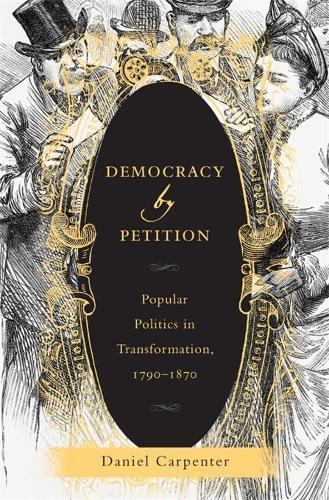
Full Product Details
Author: Daniel Carpenter
Publisher: Harvard University Press
Imprint: Harvard University Press
ISBN: 9780674247499
ISBN 10: 0674247493
Pages: 648
Publication Date: 04 May 2021
Audience:
Professional and scholarly
,
Professional & Vocational
Format: Hardback
Publisher's Status: Active
Availability: Out of stock

The supplier is temporarily out of stock of this item. It will be ordered for you on backorder and shipped when it becomes available.
Reviews
A tour de force of prodigious research and muscular analysis. Carpenter persuasively demonstrates that petitions were critical to the process of democratization in nineteenth-century North America. Along the way, he sheds new light on a wide range of issues and episodes, many of which have previously escaped the notice of historians and political scientists. The book, quite simply, is eye-opening. -- Alexander Keyssar, author of <i>Why Do We Still Have the Electoral College?</i> Democracy by Petition presents a magisterial view of an evolving political practice in which individuals and groups across North America seized the right to petition higher authorities for aid, redress, protection, or access. With riveting examples and clarifying analyses, Daniel Carpenter illuminates how Native Americans, African Americans, Irish Americans, Mexicans, French Canadians, women of all backgrounds, and many more became agents of political change, sharpening the possibility for real democracy by means of an antiquated though often effective tool: the paper prayer. A monumental achievement of political history, this book is crucial reading for anyone seeking to learn how democratic practices are forged through unexpected and 'emergent' politics. -- Tiya Miles, author of <i>The Dawn of Detroit: A Chronicle of Slavery and Freedom in the City of the Straits</i> In this landmark book, Daniel Carpenter demonstrates the essential role that petitioning has played in the politics of democratization. Drawing upon a massive data collection effort and deep archival research, Carpenter offers a new way of thinking about how the dialogue between government and citizens shapes political development. -- Eric Schickler, author of <i>Racial Realignment: The Transformation of American Liberalism, 1932-1965</i> An astonishing piece of scholarship, such as comes along once in a generation. Democracy by Petition urges us to reconsider what democracy is, how it extends beyond electoral politics, and how governance in North America actually works. -- Richard White, author of <i>The Republic for Which It Stands: The United States during Reconstruction and the Gilded Age, 1865-1896</i> Daniel Carpenter illuminates petitions as active agents of democratization, harnessed by diverse and divergent groups across North America-including Indigenous nations who refused removal and Black abolitionists who refused containment by an emergent 'settler republic.' As Democracy by Petition reveals, these efforts refashioned the petition itself from a humble plea into an instrument of political power. -- Lisa Brooks, author of <i>Our Beloved Kin: A New History of King Philip's War</i> Possibly the most original work on democracy in 2021...Offers lessons that transcend the American experience, because it allows us to think about democracy and democratization as something far more diverse than the package of the Western Consensus. * Democracy Paradox *
An astonishing piece of scholarship, such as comes along once in a generation. Democracy by Petition urges us to reconsider what democracy is, how it extends beyond electoral politics, and how governance in North America actually works.--Richard White, author of The Republic for Which It Stands: The United States during Reconstruction and the Gilded Age, 1865-1896 In this landmark book, Daniel Carpenter demonstrates the essential role that petitioning has played in the politics of democratization. Drawing upon a massive data collection effort and deep archival research, Carpenter offers a new way of thinking about how the dialogue between government and citizens shapes political development.--Eric Schickler, author of Racial Realignment: The Transformation of American Liberalism, 1932-1965 A tour de force of prodigious research and muscular analysis. Carpenter persuasively demonstrates that petitions were critical to the process of democratization in nineteenth-century North America. Along the way, he sheds new light on a wide range of issues and episodes, many of which have previously escaped the notice of historians and political scientists. The book, quite simply, is eye-opening.--Alexander Keyssar, author of Why Do We Still Have the Electoral College?
A tour de force of prodigious research and muscular analysis. Carpenter persuasively demonstrates that petitions were critical to the process of democratization in nineteenth-century North America. Along the way, he sheds new light on a wide range of issues and episodes, many of which have previously escaped the notice of historians and political scientists. The book, quite simply, is eye-opening. -- Alexander Keyssar, author of <i>Why Do We Still Have the Electoral College?</i> Democracy by Petition presents a magisterial view of an evolving political practice in which individuals and groups across North America seized the right to petition higher authorities for aid, redress, protection, or access. With riveting examples and clarifying analyses, Daniel Carpenter illuminates how Native Americans, African Americans, Irish Americans, Mexicans, French Canadians, women of all backgrounds, and many more became agents of political change, sharpening the possibility for real democracy by means of an antiquated though often effective tool: the paper prayer. A monumental achievement of political history, this book is crucial reading for anyone seeking to learn how democratic practices are forged through unexpected and 'emergent' politics. -- Tiya Miles, author of <i>The Dawn of Detroit: A Chronicle of Slavery and Freedom in the City of the Straits</i> In this landmark book, Daniel Carpenter demonstrates the essential role that petitioning has played in the politics of democratization. Drawing upon a massive data collection effort and deep archival research, Carpenter offers a new way of thinking about how the dialogue between government and citizens shapes political development. -- Eric Schickler, author of <i>Racial Realignment: The Transformation of American Liberalism, 1932-1965</i> An astonishing piece of scholarship, such as comes along once in a generation. Democracy by Petition urges us to reconsider what democracy is, how it extends beyond electoral politics, and how governance in North America actually works. -- Richard White, author of <i>The Republic for Which It Stands: The United States during Reconstruction and the Gilded Age, 1865-1896</i> Daniel Carpenter illuminates petitions as active agents of democratization, harnessed by diverse and divergent groups across North America-including Indigenous nations who refused removal and Black abolitionists who refused containment by an emergent 'settler republic.' As Democracy by Petition reveals, these efforts refashioned the petition itself from a humble plea into an instrument of political power. -- Lisa Brooks, author of <i>Our Beloved Kin: A New History of King Philip's War</i>
Author Information
Daniel Carpenter is Allie S. Freed Professor of Government at Harvard University and author of the prizewinning books Reputation and Power and The Forging of Bureaucratic Autonomy. At Harvard, he has led the creation of the Digital Archive of Antislavery and Anti-Segregation Petitions and the Digital Archive of Native American Petitions.