Overview
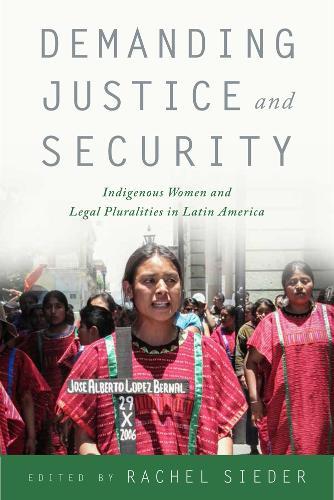
Across Latin America, indigenous women are organizing to challenge racial, gender, and class discrimination through the courts. Collectively, by engaging with various forms of law, they are forging new definitions of what justice and security mean within their own contexts and struggles. They have challenged racism and the exclusion of indigenous people in national reforms, but also have challenged ‘bad customs’ and gender ideologies that exclude women within their own communities. Featuring chapters on Bolivia, Colombia, Ecuador, Guatemala, and Mexico, the contributors to Demanding Justice and Security include both leading researchers and community activists. From Kichwa women in Ecuador lobbying for the inclusion of specific clauses in the national constitution that guarantee their rights to equality and protection within indigenous community law, to Me’phaa women from Guerrero, Mexico, battling to secure justice within the Inter-American Court of Human Rights for violations committed in the context of militarizing their home state, this book is a must-have for anyone who wants to understand the struggle of indigenous women in Latin America.
Full Product Details
Author: Rachel Sieder ,
Rachel Sieder ,
Rosalva Aida Hernandez Castillo ,
Adriana Terven Salinas
Publisher: Rutgers University Press
Imprint: Rutgers University Press
Dimensions:
Width: 15.20cm
, Height: 2.30cm
, Length: 22.90cm
Weight: 0.562kg
ISBN: 9780813587936
ISBN 10: 081358793
Pages: 310
Publication Date: 16 June 2017
Recommended Age: From 21 to 99 years
Audience:
Professional and scholarly
,
Professional & Vocational
Format: Hardback
Publisher's Status: Active
Availability: In Print

This item will be ordered in for you from one of our suppliers. Upon receipt, we will promptly dispatch it out to you. For in store availability, please contact us.
Reviews
<i>Demanding Justice and Security</i> offers a panoramic view of Latin American indigenous women s strategies for combating gendered violence and of creating constructive justice alternatives grounded in indigenous concepts of collective rights and autonomy. Beautifully written ethnography and crisp theory make this a particularly useful classroom book. --Lynn Stephen author of We are the Face of Oaxaca: Testimony and Social Movements
“Demanding Justice and Security offers a panoramic view of Latin American indigenous women’s strategies for combating gendered violence and of creating constructive justice alternatives grounded in indigenous concepts of collective rights and autonomy. Beautifully written ethnography and crisp theory make this a particularly useful classroom book.” - Lynn Stephen (author of We are the Face of Oaxaca: Testimony and Social Movements) ""Demanding Justice and Security constitutes a milestone in the study of indigenous women’s organizing, understanding and engaging legal pluralities in Latin America. Drawing on rich fieldwork from Bolivia, Mexico, Colombia, Ecuador and Guatemala, the authors of this collaborative research-action experience have crafted an outstanding multi-sited ethnography of gender, violence, injustice and insecurity in these countries. This remarkable volume allows for a unique opportunity to consider structural violence and its comparative effects on the gendered body politic."" - Pamela Calla (Center for Latin American and Caribbean Studies, New York University) ""Demanding Justice and Security...brings into focus communities often overlooked in much of the research on political institutions, particularly in political science. An important contribution of this work is its emphasis on intersectionality: the ways that indigenous women negotiate multiple identities of class, gender, and ethnicity and their struggles to balance gender and ethnic claims."" (Politics & Gender)
"""Demanding Justice and Security constitutes a milestone in the study of indigenous women's organizing, understanding and engaging legal pluralities in Latin America. Drawing on rich fieldwork from Bolivia, Mexico, Colombia, Ecuador and Guatemala, the authors of this collaborative research-action experience have crafted an outstanding multi-sited ethnography of gender, violence, injustice and insecurity in these countries. This remarkable volume allows for a unique opportunity to consider structural violence and its comparative effects on the gendered body politic."" --Pamela Calla ""Center for Latin American and Caribbean Studies, New York University"" ""Demanding Justice and Security offers a panoramic view of Latin American indigenous women's strategies for combating gendered violence and of creating constructive justice alternatives grounded in indigenous concepts of collective rights and autonomy. Beautifully written ethnography and crisp theory make this a particularly useful classroom book."" --Lynn Stephen ""author of We are the Face of Oaxaca: Testimony and Social Movements"" ""Demanding Justice and Security...brings into focus communities often overlooked in much of the research on political institutions, particularly in political science. An important contribution of this work is its emphasis on intersectionality: the ways that indigenous women negotiate multiple identities of class, gender, and ethnicity and their struggles to balance gender and ethnic claims.""-- ""Politics & Gender"""
Author Information
RACHEL SIEDER is a senior research professor at the Centre for Research and Advanced Study in Social Anthropology (CIESAS) in Mexico City. She is the coeditor of Gender Justice and Legal Pluralities: Latin American and African Perspectives.