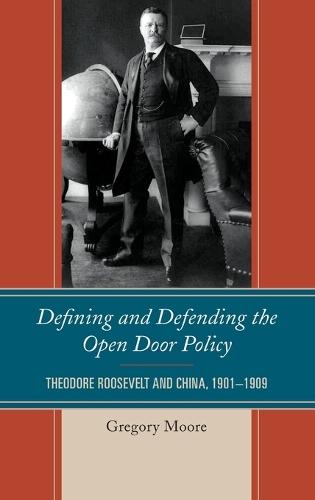
Full Product Details
Author: Gregory Moore
Publisher: Bloomsbury Publishing Plc
Imprint: Lexington Books
Dimensions:
Width: 15.80cm
, Height: 2.30cm
, Length: 23.40cm
Weight: 0.494kg
ISBN: 9780739199954
ISBN 10: 0739199951
Pages: 252
Publication Date: 27 May 2015
Audience:
College/higher education
,
Postgraduate, Research & Scholarly
Format: Hardback
Publisher's Status: Active
Availability: Manufactured on demand

We will order this item for you from a manufactured on demand supplier.
Reviews
Moore unravels the complicated legacy of the history and evolution of the US Open Door Policy in China, 1901-9. Making extensive use of archival sources and noting how broader global events and challenges at home helped influence and shape US foreign policy objectives in Asia, Moore argues that Theodore Roosevelt's administration pursued reactive rather than proactive foreign policy objectives in Asia. Given the limited US presence in China, Roosevelt pragmatically championed equal commercial opportunity in China while paying lip service to preserving China's territorial integrity. Recognizing Japanese interests in the region, the Roosevelt administration adapted the Open Door Policy to cultivate Japan as a buffer to check Russian ambitions in the region, thereby minimizing the risk of US military intervention. Moore concludes that the Roosevelt administration, though pragmatic, dealt with China from a limited, stereotyped point of view that failed to perceive the revolutionary forces and sentiments that were surfacing there. As a result, policymakers' appreciation of events taking place during the waning years of the Qing Dynasty was limited, and hindered the development of a more proactive foreign policy. Summing Up: Recommended. Most levels/libraries. * CHOICE * Where the book makes its most significant contribution is on the Taft-Katsura memo and Root-Takahira agreement. Moore does well exhibiting the historiographical debates over the informal/formal nature of the Taft-Katsura memo. He provides a contextualized and balanced view of the American-Japanese relations, and illustrates the diplomacy of Root in 1908 with State Department sources that add to our knowledge of the Takahira agreement. . . .Defining and Defending the Open Door Policy...demonstrates the chaos of geopolitics and how local, seemingly unimportant, events shape policy. * Reviews in History * Divided into an introduction, seven chapters, and a conclusion, this monograph fills an important gap in our understanding of Roosevelt's support, and in some unfortunate ways lack of support, for the Open Door Policy. * Pacific Historical Review * Professor Moore has been successful in illuminating two foreign cultures-China and US foreign policy making-which are often poorly understood by outsiders. Although the events he discusses happened more than a century ago, the issues covered are still having an impact today in both cultures. -- Timothy R. Walton, associate professor of Intelligence Analysis at James Madison University, retired CIA officer Gregory Moore has produced a study of the geopolitics of America's 'Open Door' policy towards China that is as rich in historical detail as it is important for contemporary thinking about American foreign policy. The book's conclusions about how the United States frequently does not adequately understand the cultures it is dealing with in its foreign policy is an ongoing lesson that contemporary decision-makers need to heed. This book is a must read, not only for students of U.S. foreign policy and Asian international history; it also will be a vital resource for contemporary policymakers seeking to understand the historical trends which shape today's international environment. -- Sean Kay, Ohio Wesleyan University Professor Gregory Moore adds welcome detail to our knowledge of President Theodore Roosevelt's approach to the China question from 1901 to 1909. Drawing on archival evidence, his book brings together generations of scholarship in the English speaking world on how Roosevelt shaped America's Open Door policy during the last years of the Qing. -- Dong Wang, Research Associate, Fairbank Center of Harvard University
Moore unravels the complicated legacy of the history and evolution of the US Open Door Policy in China, 1901-9. Making extensive use of archival sources and noting how broader global events and challenges at home helped influence and shape US foreign policy objectives in Asia, Moore argues that Theodore Roosevelt's administration pursued reactive rather than proactive foreign policy objectives in Asia. Given the limited US presence in China, Roosevelt pragmatically championed equal commercial opportunity in China while paying lip service to preserving China's territorial integrity. Recognizing Japanese interests in the region, the Roosevelt administration adapted the Open Door Policy to cultivate Japan as a buffer to check Russian ambitions in the region, thereby minimizing the risk of US military intervention. Moore concludes that the Roosevelt administration, though pragmatic, dealt with China from a limited, stereotyped point of view that failed to perceive the revolutionary forces and sentiments that were surfacing there. As a result, policymakers' appreciation of events taking place during the waning years of the Qing Dynasty was limited, and hindered the development of a more proactive foreign policy. Summing Up: Recommended. Most levels/libraries. CHOICE Professor Moore has been successful in illuminating two foreign cultures-China and US foreign policy making-which are often poorly understood by outsiders. Although the events he discusses happened more than a century ago, the issues covered are still having an impact today in both cultures. -- Timothy R. Walton, James Madison University and retired CIA Gregory Moore has produced a study of the geopolitics of America's 'Open Door' policy towards China that is as rich in historical detail as it is important for contemporary thinking about American foreign policy. The book's conclusions about how the United States frequently does not adequately understand the cultures it is dealing with in its foreign policy is an ongoing lesson that contemporary decision-makers need to heed. This book is a must read, not only for students of U.S. foreign policy and Asian international history; it also will be a vital resource for contemporary policymakers seeking to understand the historical trends which shape today's international environment. -- Sean Kay, Ohio Wesleyan University Professor Gregory Moore adds welcome detail to our knowledge of President Theodore Roosevelt's approach to the China question from 1901 to 1909. Drawing on archival evidence, his book brings together generations of scholarship in the English speaking world on how Roosevelt shaped America's Open Door policy during the last years of the Qing. -- Dong Wang, Research Associate, Fairbank Center of Harvard University
Professor Moore has been successful in illuminating two foreign cultures-China and US foreign policy making-which are often poorly understood by outsiders. Although the events he discusses happened more than a century ago, the issues covered are still having an impact today in both cultures. -- Timothy R. Walton, James Madison University and retired CIA Gregory Moore has produced a study of the geopolitics of America's 'Open Door' policy towards China that is as rich in historical detail as it is important for contemporary thinking about American foreign policy. The book's conclusions about how the United States frequently does not adequately understand the cultures it is dealing with in its foreign policy is an ongoing lesson that contemporary decision-makers need to heed. This book is a must read, not only for students of U.S. foreign policy and Asian international history; it also will be a vital resource for contemporary policymakers seeking to understand the historical trends which shape today's international environment. -- Sean Kay, Ohio Wesleyan University Professor Gregory Moore adds welcome detail to our knowledge of President Theodore Roosevelt's approach to the China question from 1901 to 1909. Drawing on archival evidence, his book brings together generations of scholarship in the English speaking world on how Roosevelt shaped America's Open Door policy during the last years of the Qing. -- Dong Wang, Research Associate, Fairbank Center of Harvard University
Professor Moore has been successful in illuminating two foreign cultures-China and US foreign policy making-which are often poorly understood by outsiders. Although the events he discusses happened more than a century ago, the issues covered are still having an impact today in both cultures. -- Timothy R. Walton, James Madison University and retired CIA
Author Information
Gregory Moore is professor of history, director of the Center for Intelligence Studies, and chairperson of the Department of History and Political Science at Notre Dame College.