Overview
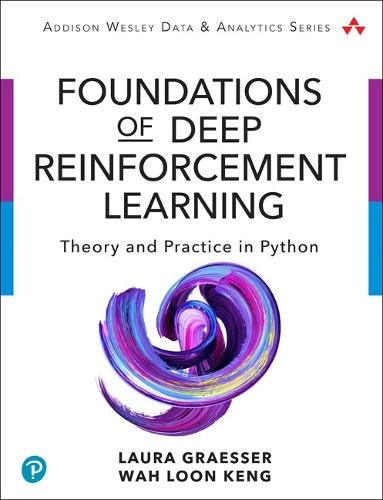
Deep reinforcement learning (deep RL) combines deep learning and reinforcement learning, in which artificial agents learn to solve sequential decision-making problems. In the past decade deep RL has achieved remarkable results on a range of problems, from single and multiplayer games - such as Go, Atari games, and DotA 2 - to robotics. Foundations of Deep Reinforcement Learning is an introduction to deep RL that uniquely combines both theory and implementation. It starts with intuition, then carefully explains the theory of deep RL algorithms, discusses implementations in its companion software library SLM Lab, and finishes with the practical details of getting deep RL to work. Understand each key aspect of a deep RL problem Explore policy- and value-based algorithms, including REINFORCE, SARSA, DQN, Double DQN, and Prioritized Experience Replay (PER) Delve into combined algorithms, including Actor-Critic and Proximal Policy Optimization (PPO) Understand how algorithms can be parallelised synchronously and asynchronously Run algorithms in SLM Lab and learn the practical implementation details for getting deep RL to work Explore algorithm benchmark results with tuned hyperparameters Understand how deep RL environments are designed This guide is ideal for both computer science students and software engineers who are familiar with basic machine learning concepts and have a working understanding of Python.
Full Product Details
Author: Laura Graesser ,
Wah Loon Keng
Publisher: Pearson Education (US)
Imprint: Addison Wesley
Dimensions:
Width: 17.60cm
, Height: 1.80cm
, Length: 23.40cm
Weight: 0.600kg
ISBN: 9780135172384
ISBN 10: 0135172381
Pages: 416
Publication Date: 11 February 2020
Audience:
Professional and scholarly
,
Professional & Vocational
Format: Paperback
Publisher's Status: Active
Availability: Available To Order

We have confirmation that this item is in stock with the supplier. It will be ordered in for you and dispatched immediately.
Reviews
This book provides an accessible introduction to deep reinforcement learning covering the mathematical concepts behind popular algorithms as well as their practical implementation. I think the book will be a valuable resource for anyone looking to apply deep reinforcement learning in practice. -Volodymyr Mnih, lead developer of DQN An excellent book to quickly develop expertise in the theory, language, and practical implementation of deep reinforcement learning algorithms. A limpid exposition which uses familiar notation; all the most recent techniques explained with concise, readable code, and not a page wasted in irrelevant detours: it is the perfect way to develop a solid foundation on the topic. -Vincent Vanhoucke, principal scientist, Google As someone who spends their days trying to make deep reinforcement learning methods more useful for the general public, I can say that Laura and Keng's book is a welcome addition to the literature. It provides both a readable introduction to the fundamental concepts in reinforcement learning as well as intuitive explanations and code for many of the major algorithms in the field. I imagine this will become an invaluable resource for individuals interested in learning about deep reinforcement learning for years to come. -Arthur Juliani, senior machine learning engineer, Unity Technologies Until now, the only way to get to grips with deep reinforcement learning was to slowly accumulate knowledge from dozens of different sources. Finally, we have a book bringing everything together in one place. -Matthew Rahtz, ML researcher, ETH Zurich
This book provides an accessible introduction to deep reinforcement learning covering the mathematical concepts behind popular algorithms as well as their practical implementation. I think the book will be a valuable resource for anyone looking to apply deep reinforcement learning in practice. -Volodymyr Mnih, lead developer of DQN An excellent book to quickly develop expertise in the theory, language, and practical implementation of deep reinforcement learning algorithms. A limpid exposition which uses familiar notation; all the most recent techniques explained with concise, readable code, and not a page wasted in irrelevant detours: it is the perfect way to develop a solid foundation on the topic. -Vincent Vanhoucke, principal scientist, Google As someone who spends their days trying to make deep reinforcement learning methods more useful for the general public, I can say that Laura and Keng's book is a welcome addition to the literature. It provides both a readable introduction to the fundamental concepts in reinforcement learning as well as intuitive explanations and code for many of the major algorithms in the field. I imagine this will become an invaluable resource for individuals interested in learning about deep reinforcement learning for years to come. -Arthur Juliani, senior machine learning engineer, Unity Technologies Until now, the only way to get to grips with deep reinforcement learning was to slowly accumulate knowledge from dozens of different sources. Finally, we have a book bringing everything together in one place. -Matthew Rahtz, ML researcher, ETH Zurich
Author Information
Laura Graesser is a research software engineer working in robotics at Google. She holds a master's degree in computer science from New York University, where she specialised in machine learning. Wah Loon Keng is an AI engineer at Machine Zone, where he applies deep reinforcement learning to industrial problems. He has a background in both theoretical physics and computer science.