Overview
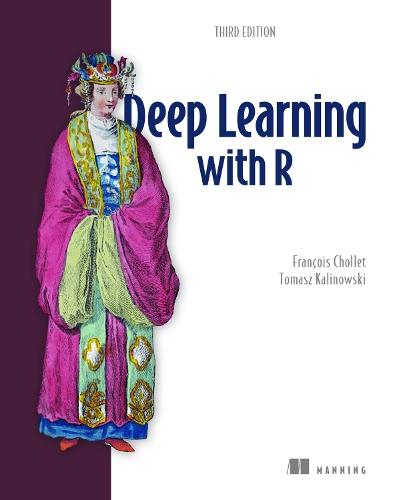
Ready to bring R code into the AI era? Stop switching languages. Build deep learning models in pure R. Master GPT-style transformers and diffusion. Skip complex math. Launch production-ready solutions confidently. Keras 3 interface: Code modern neural networks with the simplicity R users love. Vision, text, and time series: Apply models that classify images, translate text, and predict demand. Transformers and LLMs: Generate fluent language and summaries without Python detours. Diffusion imagery: Create new pictures and explore generative art inside RStudio. Scaling and tuning: Fine-tune hyperparameters for faster training and top-tier accuracy. Interpretability tools: Explain model decisions to bosses, regulators, and stakeholders. Deep Learning with R, Third Edition pairs Keras creator François Chollet with R expert Tomasz Kalinowski to deliver an authoritative guide. Step-by-step chapters move from first principles to advanced projects. Clear code, concise explanations, and runnable notebooks keep learning practical. New coverage of transformers, diffusion, and GPT-style language models brings bleeding-edge AI to R. By book’s end, you will design, train, and deploy high-performing models, interpret their outputs, and scale them for production. Your R workflow becomes an AI powerhouse. Ideal for data scientists and analysts with intermediate R skills who crave modern deep learning capabilities.
Full Product Details
Author: Tomasz Kalinowski ,
Tomasz Kalinowski
Publisher: Manning Publications
Imprint: Manning Publications
Edition: 3rd edition
Weight: 0.744kg
ISBN: 9781633435186
ISBN 10: 1633435180
Pages: 625
Publication Date: 04 March 2026
Audience:
Professional and scholarly
,
Professional & Vocational
Format: Hardback
Publisher's Status: Forthcoming
Availability: Not yet available

This item is yet to be released. You can pre-order this item and we will dispatch it to you upon its release.
Reviews
The writing is excellent: theoretical concepts introduced (without math) very adequately, balanced mix between ""theory"" and practice, well-chosen examples, realistic use cases. In a nutshell, this is one of the best writing I have reviewed (or read) over the last 5 years at Manning. Alain M. Couniot, Senior Enterprise Architect, Sopra Steria Benelux A fully updated classic in Deep Learning with the latest trends in Deep Learning including GPTs and image generation. Juan Delgado, Data Analyst, Sodexo BRS
Author Information
François Chollet is the creator of Keras and a leading voice in practical deep learning. With global teaching experience, François delivers clarity and rigor on every page. He distills cutting-edge research into approachable lessons that help readers build real models fast. Tomasz Kalinowski is a software engineer at Posit, maintaining the Keras and TensorFlow R packages. Drawing on years of community support, Tomasz writes with empathy and hands-on insight. He translates complex APIs into smooth R workflows that empower readers to innovate.