Overview
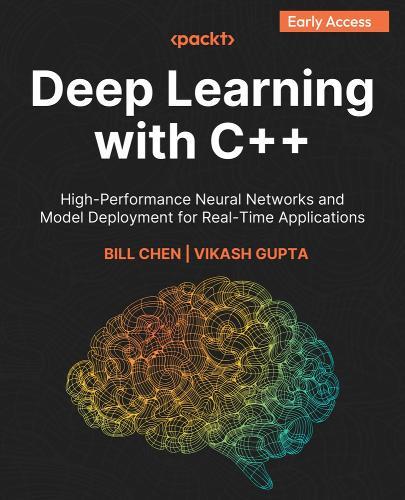
Build and deploy high-performance deep learning models using C++ for real-time applications where speed and efficiency matter. Key Features Implement neural networks using the PyTorch C++ API and Caffe2 Optimize and deploy deep learning models for real-time inference Learn CUDA acceleration, model compression, and monitoring best practices Purchase of the print or Kindle book includes a free PDF eBook Book DescriptionDeep Learning with C++ is a hands-on guide to building, optimizing, and deploying deep learning models using the power of C++. Designed for ML engineers, data scientists, and developers working in performance-critical domains, this book provides step-by-step instruction for implementing everything from basic neural networks to CNNs, RNNs, GANs, and LLMs using the PyTorch C++ API, Caffe2, and CUDA. You will begin by setting up a C++ deep learning environment and understanding foundational neural network concepts. Then, you'll move on to building various deep learning architectures, optimizing them for speed, and deploying them with robust monitoring and explainability features. Whether you work in finance, gaming, healthcare, or embedded systems, this book equips you to deploy deep learning systems at scale. Complete with real-world case studies and advanced topics like distributed training, model compression, and explainability, this book ensures you're ready for production-ready AI systems that are fast, scalable, and efficient.What you will learn Set up and use PyTorch C++ API and Caffe2 for deep learning Implement CNNs, RNNs, LSTMs, GANs, and LLMs in C++ Leverage CUDA for high-performance model training Optimize models through quantization, pruning, and compression Deploy and monitor models in production using C++ tools Apply explainability techniques like LIME, SHAP, and Grad-CAM Who this book is forThis book is for ML engineers, deep learning practitioners, and data scientists with a solid C++ background who want to build high-performance deep learning models. It also serves developers transitioning from Python-based frameworks looking for real-time deployment solutions in industries like finance, autonomous systems, and healthcare.
Full Product Details
Author: Bill Chen ,
Vikash Gupta
Publisher: Packt Publishing Limited
Imprint: Packt Publishing Limited
ISBN: 9781835880029
ISBN 10: 1835880029
Publication Date: 30 April 2026
Audience:
Professional and scholarly
,
Professional & Vocational
Format: Paperback
Publisher's Status: Forthcoming
Availability: In Print

Limited stock is available. It will be ordered for you and shipped pending supplier's limited stock.
Author Information
Xi Chen has graduated with Ph.D. in Biochemical and a Master in Statistics from the University of Kentucky. He is working as a certified NVidia Computer Vision (CV), CUDA and Deep Learning instructor. During his graduate career, he has led CV and deep learning related workshops. He also has published papers on topics of autonomic driving, reinforcement learning, and deep learning. Vikash Gupta, Ph.D., CIIP, is a Senior Research Scientist at Amazon Web Services (AWS), based in Seattle, Washington. He earned his Ph.D. in Computational Biology from INRIA, France, where his research centered on neuroimaging and statistical modeling. At AWS, he applies deep learning and artificial intelligence to advance medical imaging technologies, contributing to open-source initiatives such as the MONAI framework for healthcare. A Certified Imaging Informatics Professional, he has authored over 15 peer-reviewed publications