Overview
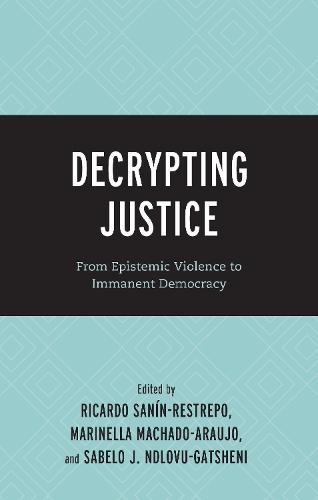
This book deploys the theory of encryption of to decrypt justice, setting in opposition Justice, written with the hegemonic capital letters of Western ideas, and justice, in its everyday workings within disparate communal forms and the exercise of multiplicity. As it decrypts justice, the book argues that late-coloniality, through its construction of the “hidden people,” shattered the possibility of true communities in the service of a transcendent model, consisting ofthe market, the constitution, the nation, and the economy. The first three chapters serve as the theoretical backbone of the book, engaging sovereignty, posthumanism, Artificial Intelligence, and epistemic injustice. Chapters 4 and 5 describe the emancipation of the people through alternate communal practices: “Quilombismo” in Brazil and “Corazonar” of Tseltal women in Mexico. Chapter 7 examines the Tosepan’s practices in Mexico to decrypt hegemonic territorial forms, and chapters 6 and 8 explore how Western judicial systems disempower the people, focusing on Central American migrants and critiques from the Colombian peace process. Edited by Ricardo Sanín-Restrepo, Marinella Machado-Araujo, and Sabelo J. Ndlovu-Gatsheni, Decrypting Justice: From Epistemic Violence to Immanent Democracy is a transforming force, not only in the way which we understand reality but also in the tools with which we build it.
Full Product Details
Author: Ricardo Sanín-Restrepo ,
Marinella Machado-Araujo ,
Sabelo J. Ndlovu-Gatsheni ,
Oscar Guardiola-Rivera
Publisher: Bloomsbury Publishing Plc
Imprint: Lexington Books
Weight: 0.526kg
ISBN: 9781666961157
ISBN 10: 1666961159
Pages: 244
Publication Date: 15 February 2025
Audience:
College/higher education
,
Postgraduate, Research & Scholarly
Format: Hardback
Publisher's Status: Active
Availability: In Print

This item will be ordered in for you from one of our suppliers. Upon receipt, we will promptly dispatch it out to you. For in store availability, please contact us.
Reviews
""We know injustice when we encounter it, but we don't know where justice lies. The theory of justice, as old as the Old Testament and Plato and as new as the latest ""Infinite Justice"" of unjust wars and conquest, has failed to give an epistemic or political model for creating more just worlds. This is the paradox Decrypting Justice explores. How can we begin to discuss justice when the legal and social presuppositions for our conversation are unjust? This collection develops the novel concepts of encryption/decryption as supplement to the critique of ideology, to deconstruction and demystification. Exploring the inclusive exclusion that the encryption of power, people and constitution begets through a number of illuminating case-studies, the book presents the living experiences of people in resistance in the global south. Through collective imagination and the solidarity of being together with others and the world they answer the paradox of justice in their everyday practices."" -- Costas Douzinas, University of London
""We know injustice when we encounter it, but we don't know where justice lies. The theory of justice, as old as the Old Testament and Plato and as new as the latest ""Infinite Justice"" of unjust wars and conquest, has failed to give an epistemic or political model for creating more just worlds. This is the paradox Decrypting Justice explores. How can we begin to discuss justice when the legal and social presuppositions for our conversation are unjust? This collection develops the novel concepts of encryption/decryption as supplement to the critique of ideology, to deconstruction and demystification. Exploring the inclusive exclusion that the encryption of power, people and constitution begets through a number of illuminating case-studies, the book presents the living experiences of people in resistance in the global south. Through collective imagination and the solidarity of being together with others and the world they answer the paradox of justice in their everyday practices."" -- Costas Douzinas, University of London --Costas Douzinas, Birkbeck College, University of London ""We know injustice when we encounter it, but we don't know where justice lies. The theory of justice, as old as the Old Testament and Plato and as new as the latest ""Infinite Justice"" of unjust wars and conquest, has failed to give an epistemic or political model for creating more just worlds. This is the paradox Decrypting Justice explores. How can we begin to discuss justice when the legal and social presuppositions for our conversation are unjust? This collection develops the novel concepts of encryption/decryption as supplement to the critique of ideology, to deconstruction and demystification. Exploring the inclusive exclusion that the encryption of power, people and constitution begets through a number of illuminating case-studies, the book presents the living experiences of people in resistance in the global south. Through collective imagination and the solidarity of being together with others and the world they answer the paradox of justice in their everyday practices."" -- Costas Douzinas, University of London
Author Information
Ricardo Sanín-Restrepo is author of Decolonizing Democracy: Power in a Solid State (2016), Being and Contingency: Decrypting Heidegger’s Terminology (2021), Editor of Decrypting Power (2018), and of Ser y Contingencia (2023) and Teoría Crítica Constitucional (2014). Marinella Machado-Araujo is professor of the graduate and post-graduation law programs of the Pontifical Catholic University of Minas Gerais - PUC Minas-Brazil. Sabelo Ndlovu-Gatsheni is professor and Chair of Epistemologies of the Global South at the University of Bayreuth in Germany.