|
|
|||
|
||||
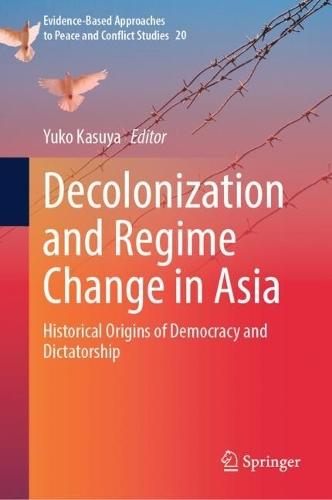
OverviewThis book analyzes and compares the history of decolonization throughout Asian countries. Is it really possible to paint a unified picture of Asia's diverse modern and contemporary history, from kingdoms to republics, from authoritarian regimes to liberal democracies? This book vividly answers this question by focusing on “decolonization,” especially in the 1940s and 1950s, before and after World War II, because the power relations that were established during this period are the “origins” that have an important influence on the current political system. This book focuses on the question of why some Asian countries became democracies while others became autocracies of various kinds after decolonization. The key is “institutions and movements” at the end of the colonial period. The book focuses on two important factors influencing the political changes before and after independence: the institutions of self-government and the royal family, and the movements, radical with armed struggle and moderate without armed struggle. Based on the combination of the existence or non-existence of these institutions and the strength or weakness of the movements, four types of leadership groups are derived to elucidate the post-independence regime typology. This approach will allow us to bring into a unified perspective for the first time the diverse history of modern and contemporary Asia. Full Product DetailsAuthor: Yuko KasuyaPublisher: Springer Nature Switzerland AG Imprint: Springer Nature Switzerland AG Volume: 20 ISBN: 9789819690008ISBN 10: 9819690005 Pages: 365 Publication Date: 15 January 2026 Audience: Professional and scholarly , College/higher education , Professional & Vocational , Postgraduate, Research & Scholarly Format: Hardback Publisher's Status: Forthcoming Availability: Not yet available This item is yet to be released. You can pre-order this item and we will dispatch it to you upon its release. Table of ContentsPreface.- Table of Contents.- About the Editor and Authors.- Theories of Political System Formation in Asia Focusing on Institutions and Movements.- Japan Prewar Political Elites and Postwar Democracy.- Indonesia The Competitiveness of Independence Movements and the Birth of Fragile Democracies.- Malaysia Independence by an Elite Protected by the Sovereign State.- Philippines Independence and the Historical Origins of Democracy.- Burma Parliamentary Democracy Chosen by Radicals.- Laos A Fleeting Democracy Established by Compromise.- India and Pakistan The Bifurcation of Democracy and Authoritarianism.- Sri Lanka Constitutional Reforms and the Formation of Democracy under British Colonial Rule.- South Korea Establishment of a dictatorship under the banner of democracy.- North Korea The Early Process of Establishing the Kim Il Sung Regime.- Taiwan Establishment of KMT One Party Rule.- China The Establishment of a One Party Dictatorship by the Communist Party.- Thailand The setback of civilian rule and the revival of oligarchic rule.- Vietnam Diverse Currents of Nationalist Movements and the Formation of Two Vietnams.- Cambodia Sihanouk s Monopoly of Political Power and the Formation of a Monarchy.- Appendix Typology of Political Regimes in the Countries and Regions Analyzed in this Book 1946 1976.- Index.ReviewsAuthor InformationYuko Kasuya is a Professor of Political Science in the Faculty of Law at Keio University, Tokyo, Japan. Her research specializes in regime transitions, political institutions, and the politics of East and Southeast Asia, with a particular focus on the Philippines. She holds a Ph.D. in International Affairs from the University of California, San Diego, an M.A. in Development Studies from the Institute of Social Studies in the Netherlands, and a B.A. in Law from Keio University. Currently she is President of the International Political Science Association (IPSA), serving the term 2025-2027. Tab Content 6Author Website:Countries AvailableAll regions |
||||