Overview
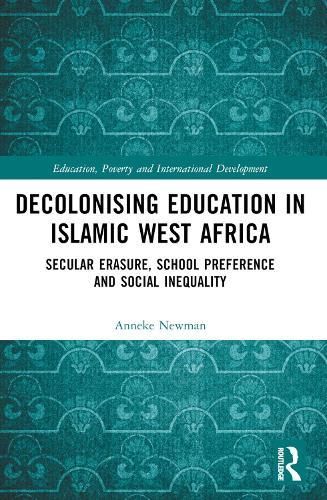
This book uses perceptions and experiences of Qur’anic schools in West Africa to outline a much-needed postsecular approach, reconsidering the place of Islamic education within African decolonial debates about educational pluralism, and the contributions of religious perspectives in academic and international development spaces. Decolonial theory is used to overcome the challenges of problematic Eurocentric and colonialist stereotypes about religious actors and faith-based schools which persist within international education scholarship and global policy agendas. Through fine-grained ethnography, chapters discuss how parents and young people today engage with classical Qur’anic schools, Islamic schools and French-medium secular education in Senegal, thereby exposing inequalities around gender, descent-based or caste identities and socioeconomic status, as well as their influence on young people’s pursuit of knowledge. These findings are valuable for scholars exploring the development-education-religion nexus and promoting Education for All in communities characterised by other-than-secular worldviews. The book will be of interest to academics, researchers and postgraduate students working in the sociology of education, international education, anthropology and religious education. Practitioners involved in postcolonial and decolonial debates will also benefit from recommendations regarding educational reform in plural educational contexts.
Full Product Details
Author: Anneke Newman (University of Ghent, Belgium)
Publisher: Taylor & Francis Ltd
Imprint: Routledge
ISBN: 9781032000466
ISBN 10: 1032000465
Pages: 288
Publication Date: 21 May 2026
Audience:
College/higher education
,
Tertiary & Higher Education
Format: Paperback
Publisher's Status: Forthcoming
Availability: Not yet available

This item is yet to be released. You can pre-order this item and we will dispatch it to you upon its release.
Reviews
""Based on rich ethnography and reflexive theoretical engagement, Decolonising Education in Islamic West Africa makes important interventions in the fields of Comparative and International Education, Education and International Development, decolonial theory, and African Studies. It demonstrates the imbrications of coloniality and racism in the assumed religious-secular binary, and the related biases, omissions, and distortions that result in scholarship and policy. Moving beyond a critique of the discourse and praxis around the Development-Education-Religion nexus, Newman develops a detailed, sensitive, and pluralistic auto-ethnography of education in the Futa Tooro in northern Senegal, attempting to think with the people and traditions being studied, not just about them. The result is a profound study that exemplifies the advantages and benefits of a truly decolonial approach. A welcome breath of fresh air, one hopes that this work will be followed by many more like it that reckon with and attempt to redress the continuing and damaging colonial legacies in the field of Education and International Development."" Oludamini Ogunnaike, Associate Professor of African Religious Thought, The University of Virginia, USA ""Anneke Newman’s Decolonising Education in Islamic West Africa offers a fascinating critique of the dominance of secular perspectives in the field of comparative and international education (CIE). Newman shows how other-than-secular cosmologies and knowledges are systematically excluded from academic and policy literature in education, and how stereotypes, silences and secular biases are steeped in assertions of colonial and racial hierarchies. In response, Newman offers counter-narratives of Qur’anic schools from parents’ and students’ own cosmological perspectives. In doing so, Newman brilliantly shows what expanding, pluralising and challenging the epistemic frame of CIE scholarship can achieve, arguing that this is essential to decolonial struggles in education."" Arathi Sriprakash, Professor of Sociology and Education, University of Oxford, UK ""This book comes to a critical juncture. It represents a major intervention into scholarship on religion, politics and education that was waiting for fresh and critical insights. It bridges important ongoing conversations and should leave a significant imprint on the debates on coloniality, decolonization, secularity, Islamic education and development in Africa, but also beyond."" Abdoulaye Sounaye, Associate Professor of Religion, Leibniz-Zentrum Moderner Orient, Berlin, Germany ""Decolonising Education in Islamic West Africa offers a lucid, well-researched, and scholarly account of Qur’anic schools in Senegal, presenting a powerful narrative of the role of religion in education. Through a theoretically rich exploration of Islamic education and schooling in West Africa, the book challenges stereotypical views of Islam and Islamic education. It throws into sharp relief the urgent need for informed engagement to counter the rise of Islamophobia, racism, and the colonial logics that influence research, scholarship, and educational practices. As such, it serves as an important resource for those committed to a decolonial approach to education scholarship, policy, and practice. The book is a clarion call for scholars and practitioners in the fields of Comparative and International Education and Education and International Development to reassess critically their epistemic orientation, relevance, and meaning in the current global context."" Yusuf Sayed, Professor of Education, University of Cambridge, UK ""Based on rich ethnography and reflexive theoretical engagement, Decolonising Education in Islamic West Africa makes important interventions in the fields of Comparative and International Education, Education and International Development, decolonial theory, and African Studies. It demonstrates the imbrications of coloniality and racism in the assumed religious-secular binary, and the related biases, omissions, and distortions that result in scholarship and policy. Moving beyond a critique of the discourse and praxis around the Development-Education-Religion nexus, Newman develops a detailed, sensitive, and pluralistic auto-ethnography of education in the Futa Tooro in northern Senegal, attempting to think with the people and traditions being studied, not just about them. The result is a profound study that exemplifies the advantages and benefits of a truly decolonial approach. A welcome breath of fresh air, one hopes that this work will be followed by many more like it that reckon with and attempt to redress the continuing and damaging colonial legacies in the field of Education and International Development."" Oludamini Ogunnaike, Associate Professor of African Religious Thought, The University of Virginia, USA ""Anneke Newman’s Decolonising Education in Islamic West Africa offers a fascinating critique of the dominance of secular perspectives in the field of comparative and international education (CIE). Newman shows how other-than-secular cosmologies and knowledges are systematically excluded from academic and policy literature in education, and how stereotypes, silences and secular biases are steeped in assertions of colonial and racial hierarchies. In response, Newman offers counter-narratives of Qur’anic schools from parents’ and students’ own cosmological perspectives. In doing so, Newman brilliantly shows what expanding, pluralising and challenging the epistemic frame of CIE scholarship can achieve, arguing that this is essential to decolonial struggles in education."" Arathi Sriprakash, Professor of Sociology and Education, University of Oxford, UK ""This book comes to a critical juncture. It represents a major intervention into scholarship on religion, politics and education that was waiting for fresh and critical insights. It bridges important ongoing conversations and should leave a significant imprint on the debates on coloniality, decolonization, secularity, Islamic education and development in Africa, but also beyond."" Abdoulaye Sounaye, Associate Professor of Religion, Leibniz-Zentrum Moderner Orient, Berlin, Germany ""Decolonising Education in Islamic West Africa offers a lucid, well-researched, and scholarly account of Qur’anic schools in Senegal, presenting a powerful narrative of the role of religion in education. Through a theoretically rich exploration of Islamic education and schooling in West Africa, the book challenges stereotypical views of Islam and Islamic education. It throws into sharp relief the urgent need for informed engagement to counter the rise of Islamophobia, racism, and the colonial logics that influence research, scholarship, and educational practices. As such, it serves as an important resource for those committed to a decolonial approach to education scholarship, policy, and practice. The book is a clarion call for scholars and practitioners in the fields of Comparative and International Education and Education and International Development to reassess critically their epistemic orientation, relevance, and meaning in the current global context."" Yusuf Sayed, Professor of Education, University of Cambridge, UK
Author Information
Anneke Newman is an anthropologist of development and Senior Postdoctoral Research Fellow at the Department of Conflict and Development Studies, University of Ghent, Belgium.