Overview
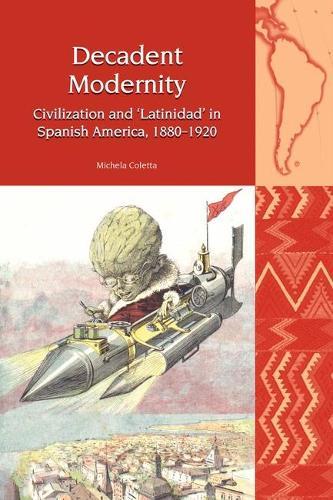
How did Latin Americans represent their own countries as modern? By treating modernity as a ubiquitous category in which ideas of progress and decadence are far from being mutually exclusive, this book explores how different groups of intellectuals, between the late nineteenth and the early twentieth century, drew from European sociological and medical theories to produce a series of cultural representations based on notions of degeneration. Through a comparative analysis of three country case studies − Argentina, Uruguay and Chile − the book investigates four themes that were central to definitions of Latin American modernity at the turn of the century: race and the nation, the search for the autochthonous, education, and aesthetic values. Using a transnational approach, it shows how civilizational constructs were adopted and adapted in a post-colonial context where cultural modernism foreshadowed economic modernization. In doing this, this work sheds new light on the complex discursive negotiations through which the idea of ‘Latin America’ became gradually established in the region.
Full Product Details
Author: Michela Coletta (Institute of Latin American Studies, University of London (United Kingdom))
Publisher: Liverpool University Press
Imprint: Liverpool University Press
Volume: 17
ISBN: 9781800855878
ISBN 10: 1800855877
Pages: 200
Publication Date: 01 September 2021
Audience:
College/higher education
,
Professional and scholarly
,
Tertiary & Higher Education
,
Professional & Vocational
Format: Paperback
Publisher's Status: Active
Availability: In Print

This item will be ordered in for you from one of our suppliers. Upon receipt, we will promptly dispatch it out to you. For in store availability, please contact us.
Reviews
Reviews 'This strikingly original book analyses how intellectuals in Argentina, Chile and Uruguay explored the concept of degeneration as inherent within their emerging modern nations. In this interpretation, the Latinity of Latin America is seen not as the wellspring of civilisation but as a source of over refined decadence. Thus there is a paradox at the heart of their nations whose development was based on widespread immigration from southern Europe: that progress and modernisation were inextricably bound up with Latin decadence and degeneration. Ways out of this dilemma were found by promoting different forms of regeneration. Based on a vast range of primary and secondary sources, theoretically informed, elegantly structured and fluently written, this comparative study offers a fresh and very substantial contribution to our understanding of the processes of modernity and modernisation in Latin America.' John King, University of Warwick
Reviews 'This strikingly original book analyses how intellectuals in Argentina, Chile and Uruguay explored the concept of degeneration as inherent within their emerging modern nations. In this interpretation, the Latinity of Latin America is seen not as the wellspring of civilisation but as a source of over refined decadence. Thus there is a paradox at the heart of their nations whose development was based on widespread immigration from southern Europe: that progress and modernisation were inextricably bound up with Latin decadence and degeneration. Ways out of this dilemma were found by promoting different forms of regeneration. Based on a vast range of primary and secondary sources, theoretically informed, elegantly structured and fluently written, this comparative study offers a fresh and very substantial contribution to our understanding of the processes of modernity and modernisation in Latin America.' John King, University of Warwick ‘Two key ideas are at the core of Coletta's important book on Spanish American modernities at the turn of the twentieth century. The first is that a common thread runs through the ways in which these 'multiple modernities' unfolded in the region: the widely accepted polarity between 'progress' and 'degeneration' (or 'civilization' and 'barbarism') can be seen, rather than as a rigid relation between opposites, as an intrinsically complementary one. [...] The second idea that informs the book is that the notion of 'Latinity' is key to understanding the forces of regeneration that were advocated to free the young American nations from modernity's 'degenerative' tendencies.’ Eduardo Zimmermann, Estudios Interdisciplinarios de América Latina y el Caribe ‘The book makes use of extensive primary sources, from which telling details are selected. It gathers together key contributions from the time (for example, that of Carlos Octavio Bunge) as well as those contributions that history has unfairly – though perhaps inevitably – forgotten. It is at its most effective when working outwards from these texts.’ Adam Sharman, Journal of Latin American Studies
Reviews 'This strikingly original book analyses how intellectuals in Argentina, Chile and Uruguay explored the concept of degeneration as inherent within their emerging modern nations. In this interpretation, the Latinity of Latin America is seen not as the wellspring of civilisation but as a source of over refined decadence. Thus there is a paradox at the heart of their nations whose development was based on widespread immigration from southern Europe: that progress and modernisation were inextricably bound up with Latin decadence and degeneration. Ways out of this dilemma were found by promoting different forms of regeneration. Based on a vast range of primary and secondary sources, theoretically informed, elegantly structured and fluently written, this comparative study offers a fresh and very substantial contribution to our understanding of the processes of modernity and modernisation in Latin America.' John King, University of Warwick 'Two key ideas are at the core of Coletta's important book on Spanish American modernities at the turn of the twentieth century. The first is that a common thread runs through the ways in which these 'multiple modernities' unfolded in the region: the widely accepted polarity between 'progress' and 'degeneration' (or 'civilization' and 'barbarism') can be seen, rather than as a rigid relation between opposites, as an intrinsically complementary one. [...] The second idea that informs the book is that the notion of 'Latinity' is key to understanding the forces of regeneration that were advocated to free the young American nations from modernity's 'degenerative' tendencies.' Eduardo Zimmermann, Resenas De Libros 'The book makes use of extensive primary sources, from which telling details are selected. It gathers together key contributions from the time (for example, that of Carlos Octavio Bunge) as well as those contributions that history has unfairly - though perhaps inevitably - forgotten. It is at its most effective when working outwards from these texts.' Adam Sharman, Journal of Latin American Studies
Author Information
Michela Coletta is Assistant Professor in Hispanic Studies at the University of Warwick and Associate Fellow of the Institute of Latin American Studies, University of London.