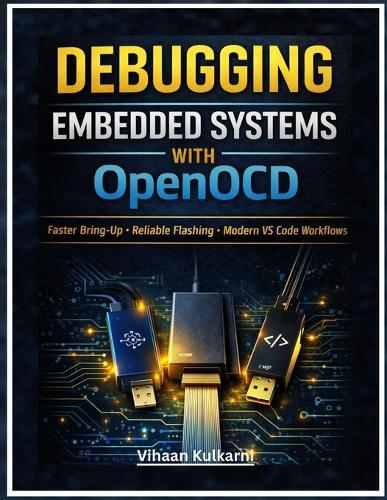
Overview
Embedded debugging is not about stepping through code. It is about shortening feedback loops, eliminating uncertainty, and shipping firmware with confidence. Debugging Embedded Systems with OpenOCD is a hands-on, production-focused guide for engineers who want to move beyond fragile, ad-hoc debug sessions and build a deterministic, repeatable, team-scale debugging system. This is not a beginner's introduction to JTAG. It is a modern, 2026-ready blueprint for: Faster bring-up on real hardware Reliable flashing and verification workflows Structured failure diagnosis VS Code + GDB integration done correctly Multi-architecture support (ARM Cortex-M, RISC-V, ESP32) Hardware-aware CI validation pipelines Secure, production-grade debug infrastructure What Makes This Book DifferentMost embedded debugging resources stop at: ""How to connect"" ""How to set a breakpoint"" ""How to flash firmware"" This book goes further. You will build a complete debugging pipeline: Version stamping → Flash + verify → Serial smoke test → Failure snapshot → CI artifact retention → Regression proof. You will deliberately break your firmware, capture structured GDB snapshots, diagnose from logs, and prove stability with automated regression runs. You will learn how to: Architect scalable OpenOCD configurations (interface, transport, target layering) Design reproducible VS Code launch and attach profiles Diagnose HardFaults, reset loops, and memory corruption Stabilize SWD/JTAG transport under real electrical constraints Script flashing workflows for teams Build hardware-backed CI runners with failure snapshots Harden debug access for production deployment Scale from development benches to factory flashing stations Who This Book Is For Embedded firmware engineers working with ARM Cortex-M RISC-V developers building custom SoCs or boards ESP32 developers moving beyond vendor IDEs Teams migrating from proprietary debug tools to open workflows Engineers building production-grade firmware validation pipelines Technical leads standardizing debug infrastructure across projects This book assumes you already build firmware. It teaches you how to debug it professionally. What You Will BuildBy the end of this book, you will have: A known-good baseline debug profile A deterministic flash + verify pipeline A ""one-click"" VS Code debug environment Automated serial smoke validation Scripted GDB failure snapshots Hardware CI integration with artifact reporting A production lockdown and security hardening checklist A roadmap to factory-scale flashing and remote debug labs You will not rely on an IDE wizard. You will control the entire system. Modern Debugging in 2026Modern embedded development requires: Reproducible configurations Logged debug sessions Version-controlled launch templates Automated hardware validation Secure debug access policies Artifact retention for audits Deterministic failure capture This book shows you how to implement all of it using OpenOCD, GDB, and VS Code - without sacrificing portability or vendor independence. If you are ready to treat debugging as engineered infrastructure - not just a tool - this book will give you the blueprint.
Full Product Details
Author: Vihaan Kulkarni
Publisher: Independently Published
Imprint: Independently Published
Dimensions:
Width: 21.60cm
, Height: 2.10cm
, Length: 27.90cm
Weight: 0.948kg
ISBN: 9798251310573
Pages: 412
Publication Date: 09 March 2026
Audience:
General/trade
,
General
Format: Paperback
Publisher's Status: Active
Availability: Available To Order

We have confirmation that this item is in stock with the supplier. It will be ordered in for you and dispatched immediately.