Overview
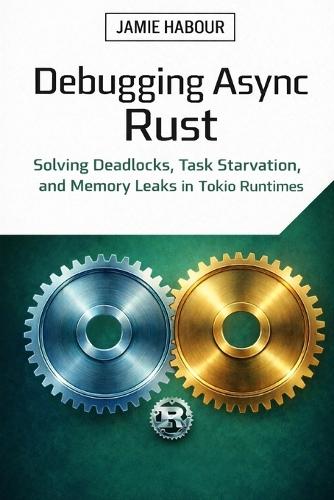
Key Features Diagnose elusive async deadlocks with precise mental models of how Tokio schedules, parks, and wakes tasks Eliminate task starvation by identifying blocking code, greedy polls, and scheduler saturation Detect and fix memory leaks caused by abandoned futures, unbounded channels, and Arc cycles Master tokio-console and tracing to gain real-time visibility into running runtimes Design cancellation-safe workflows that prevent silent data corruption under load Decode complex Send/Sync compiler errors and resolve !Send future constraints with confidence Reproduce race conditions deterministically using modern async testing strategies Profile live systems safely with flamegraphs, runtime metrics, and production diagnostics Tune executor performance for high-throughput, low-latency Rust services Book DescriptionAsync Rust is powerful-but when it fails, it fails silently. Requests hang. Workers stall. Memory climbs slowly until production collapses. Traditional debugging tools offer little help inside a cooperative executor like Tokio. Debugging Async Rust is a production-focused guide to understanding and fixing the hardest problems in modern Rust systems: deadlocks, starvation, race conditions, cancellation bugs, and memory leaks inside Tokio runtimes. This book goes beyond surface-level advice and teaches you how the executor actually works-so you can reason about task scheduling, lock behavior, backpressure, and resource contention with architectural clarity. Instead of patching symptoms, you'll learn to build observability into your async systems from the start. By mastering runtime metrics, structured tracing, and deterministic concurrency testing, you'll transform from reacting to failures to predicting and preventing them. If you ship network services, background workers, APIs, or high-concurrency systems in Rust, this book will fundamentally upgrade how you design, debug, and optimize async code. This isn't a syntax guide. It's a production survival manual for serious Rust engineers. What You Will Learn Build deep visibility into Tokio runtimes using tracing and tokio-console Identify and break async deadlocks caused by locks, channels, and cyclic dependencies Detect scheduler saturation and eliminate task starvation Prevent memory leaks from unpolled futures, unbounded queues, and Arc cycles Write cancellation-safe async logic that protects data integrity Resolve complex Send, Sync, and lifetime issues in async contexts Reproduce race conditions with deterministic concurrency testing Diagnose live production hangs using runtime metrics and core analysis Optimize task scheduling and reduce context-switch overhead Who This Book Is ForThis book is for Rust developers building real-world asynchronous systems-backend engineers, systems programmers, and performance-focused developers who rely on Tokio in production. If you already understand Rust fundamentals and want to eliminate fragile concurrency patterns, ship latency-sensitive services with confidence, and gain architectural control over high-throughput async applications, this book was written for you.
Full Product Details
Author: Jamie Habour
Publisher: Independently Published
Imprint: Independently Published
Dimensions:
Width: 15.20cm
, Height: 1.30cm
, Length: 22.90cm
Weight: 0.327kg
ISBN: 9798249672201
Pages: 242
Publication Date: 24 February 2026
Audience:
General/trade
,
General
Format: Paperback
Publisher's Status: Active
Availability: Available To Order

We have confirmation that this item is in stock with the supplier. It will be ordered in for you and dispatched immediately.