Overview
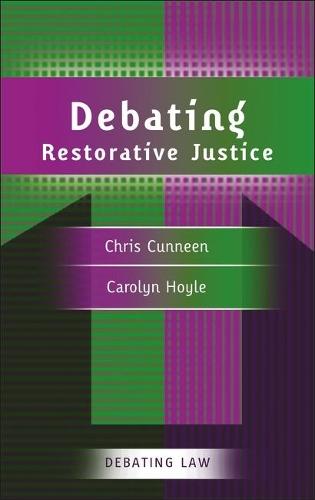
'Debating Law' is a new, exciting series that gives scholarly experts the opportunity to offer contrasting perspectives on significant topics of contemporary, general interest. In this first volume of the series Carolyn Hoyle argues that communities and the state should be more restorative in responding to harms caused by crimes, antisocial behaviour and other incivilities. She supports the exclusive use of restorative justice for many non-serious offences, and favours approaches that, by integrating restorative and retributive philosophies, take restorative practices into the 'deep end' of criminal justice. While acknowledging that restorative justice appears to have much to offer in terms of criminal justice reform, Chris Cunneen offers a different account, contending that the theoretical cogency of restorative ideas is limited by their lack of a coherent analysis of social and political power. He goes on to argue that after several decades of experimentation, restorative justice has not produced significant change in the criminal justice system and that the attempt to establish it as a feasible alternative to dominant practices of criminal justice has failed. This lively and valuable debate will be of great interest to everyone interested in the criminal justice system.
Full Product Details
Author: Carolyn Hoyle ,
Chris Cunneen
Publisher: Bloomsbury Publishing PLC
Imprint: Hart Publishing
Dimensions:
Width: 13.80cm
, Height: 1.10cm
, Length: 21.60cm
Weight: 0.262kg
ISBN: 9781849460224
ISBN 10: 1849460221
Pages: 210
Publication Date: 25 August 2010
Audience:
College/higher education
,
Professional and scholarly
,
Undergraduate
,
Postgraduate, Research & Scholarly
Format: Paperback
Publisher's Status: Active
Availability: Manufactured on demand

We will order this item for you from a manufactured on demand supplier.
Reviews
This stimulating and thought-provoking read is the first volume in a new 'Debating Law' series. ... these essays provide a critical but accessible introduction to the current debate. The merit of this work is that it is not simply an informative outline of theories and practices. As a tool of learning, the dialectical structure is excellent. Both authors make useful references to theoreticians, practices and case studies, and Hoyle provides an extensive bibliography. A must read for the student of criminology, law and sociology, we can eagerly await the next in the series. Christine Baker JUSTICE Journal July 2011 This new and interesting series is an opportunity for expert scholars to offer contrasting perspectives on contemporary issues which will be welcomed by the thoughtful undergraduate criminologist. There are many useful references and the 'Debating Law' series will be an additional invaluable source for the inquisitive criminologist who will always be on the look-out for some answers...even though it is clear from the finely balanced arguments of both schools of thought , that the debate will continue for a long time to come! Philip Taylor www.goodreads.com November 2010
The juxtaposition of [the] respective positions provides an accessible, engaging scholarly and thought-provoking read.It is almost impossible, in a review of this length, to 'do justice' to Debating Restorative Justice. Chris Cunneen's and Carolyn Hoyle's essays provide crucial critical insights and authoritatively executed scholarly analyses that serve to reflect, define and extend the core debates in equal measure. It is a remarkable achievement and their book launches the Debating Law series to excellent effect.Barry GoldsonAustralian and New Zealand Journal of CriminologyVolume 44, 2011...this is a thought-provoking, interestingly conceived book.C. Powell, University of Southern MaineCHOICE Current Reviews for Academic LibrariesSeptember 2011, Vol. 49, No. 1This stimulating and thought-provoking read is the first volume in a new 'Debating Law' series... these essays provide a critical but accessible introduction to the current debate.The merit of this work is that it is not simply an informative outline of theories and practices. As a tool of learning, the dialectical structure is excellent. Both authors make useful references to theoreticians, practices and case studies, and Hoyle provides an extensive bibliography. A must read for the student of criminology, law and sociology, we can eagerly await the next in the series.Christine BakerJUSTICE JournalJuly 2011This new and interesting series is an opportunity for expert scholars to offer contrasting perspectives on contemporary issues which will be welcomed by the thoughtful undergraduate criminologist.There are many useful references and the 'Debating Law' series will be an additional invaluable source for the inquisitive criminologist who will always be on the look-out for some answers...even though it is clear from the finely balanced arguments of both schools of thought , that the debate will continue for a long time to come!Philip Taylorwww.goodreads.comNovember 2010
This new and interesting series is an opportunity for expert scholars to offer contrasting perspectives on contemporary issues which will be welcomed by the thoughtful undergraduate criminologist. There are many useful references and the 'Debating Law' series will be an additional invaluable source for the inquisitive criminologist who will always be on the look-out for some answers...even though ti is clear from the finely balanced arguments of both schools of thought , that the debate will continue for a long time to come! Philip Taylor www.goodreads.com November 2010
Author Information
Chris Cunneen is Professor of Criminology at the Cairns Institute, James Cook University, Australia. Carolyn Hoyle is Professor of Criminology and a Fellow of Green Templeton College at the University of Oxford.