Overview
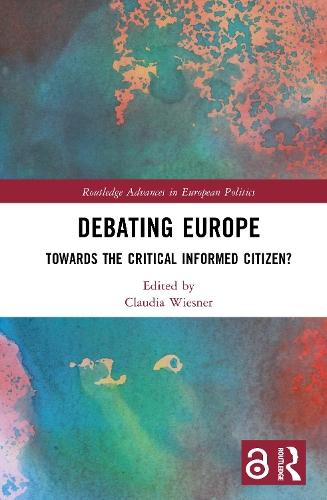
This book examines how Europe and the European Union are debated, politicised, and contested in a group of key (future) actors of European integration. Based on detailed focus group discussions with students in EU Studies and the Social Sciences from six EU countries, the book presents the core results of the theoretical, conceptual and empirical work. It first theorises and conceptualises Euroscepticism and politicisation, before presenting the core empirical findings from the collective research. These findings show that student’ views on democracy in the EU are similar across the countries. Quite unexpectedly, students express strong claims to the EU, lining out a “Normative Power Europe 2.0” that is a global actor, defends democracy and fights climate change; it is associated to values such as equality, freedom and the rule of law, and especially; non-EU citizens see the EU as an ideal. Students make out several gaps: between citizens and EU institutions, among different member states, and among citizens. Finally, the results reveal the students as critical and informed, but passive EU citizens. This book is of key interest to scholars and students of European Studies and EU Integration Studies, Social and Political Sciences, and International Relations.
Full Product Details
Author: Claudia Wiesner (Fulda University of Applied Sciences, Germany)
Publisher: Taylor & Francis Ltd
Imprint: Routledge
ISBN: 9781032954899
ISBN 10: 1032954892
Pages: 334
Publication Date: 28 January 2026
Audience:
College/higher education
,
Professional and scholarly
,
Tertiary & Higher Education
,
Professional & Vocational
Format: Hardback
Publisher's Status: Forthcoming
Availability: Not yet available

This item is yet to be released. You can pre-order this item and we will dispatch it to you upon its release.
Reviews
""No democracy without a demos, no demos without debates! Join Claudia Wiesner and the DebatEU team on a journey regarding what the quality of the debates between students in six European Member States tell us about the state of EU democracy. Supportive yet passively critical, openly utilitarian yet in demand for a more values-driven polity; an enlightening journey!"" Céline Belot, Université Grenoble Alpes, CNRS, Sciences Po Grenoble, France “How do those schooled in the ins and outs of European integration come to regard it? Does familiarity breed affection, hostility or sober realism? This is a very valuable study of what students think of the EU and why it matters.” Jonathan White, London School of Economics and Political Science, UK
Author Information
Claudia Wiesner is Professor of Political Science at Fulda University of Applied Sciences. She directs the Jean Monnet Centre of Excellence “Europe in the World and the Point Alpha Research Institute (PARI), Germany.