Overview
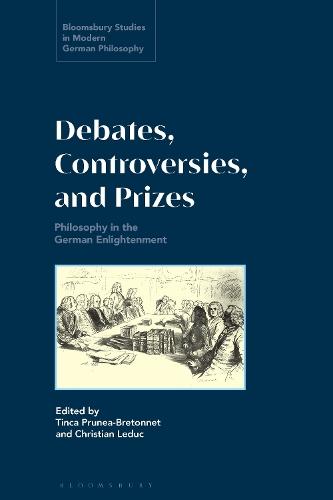
This volume brings together a series of cutting-edge studies on significant controversies and prize essay contests of the German Enlightenment. It sheds new light on the nature and impact of the philosophical debates of the period, while analyzing a range of pressing philosophical questions. In doing so, it focuses on controversies and prize competitions as conditions for the advancement of knowledge and the staking out of new philosophical terrain. Chapters address not only the rich content of the questions but also their wider context, including the theoretical framework of the debates and their institutional support and aims. Together they demonstrate how these debates created a rallying point and generated momentum for sustained philosophical argument and engagement in the Enlightenment era. The collection offers novel perspectives on the major role played by the Berlin Academy both within the German Enlightenment and across Europe more broadly. Through the introduction of several understudied but key figures such as Johann Heinrich Abicht, Leonhard Cochius, Pierre Le Guay de Prémontval, and Guillaume Raynal, it deepens our understanding of the richness and complexity of the period. Arranged in three parts – natural law and history, metaphysics, and anthropology – the essays provide fascinating new material on areas such as the problem of language, the emergence of psychology, colonialism, and the origins of aesthetics for the wider study of the intellectual milieu in eighteenth-century Germany and beyond.
Full Product Details
Author: Tinca Prunea-Bretonnet (University of Bucharest, Romania) ,
Christian Leduc (University of Montreal, Canada) ,
Christian Leduc (University of Montreal Canada) ,
Anne Pollok (Johannes Gutenberg University of Mainz Germany)
Publisher: Bloomsbury Publishing PLC
Imprint: Bloomsbury Academic
Dimensions:
Width: 15.60cm
, Height: 2.50cm
, Length: 23.40cm
Weight: 0.454kg
ISBN: 9781350348684
ISBN 10: 1350348686
Pages: 238
Publication Date: 19 February 2026
Audience:
Professional and scholarly
,
Professional & Vocational
Format: Paperback
Publisher's Status: Forthcoming
Availability: Manufactured on demand

Reviews
This collection opens up for us the stunning scope and quality of the philosophical debates that arose around the prize essay competitions of the Berlin Academy in mid-eighteenth-century Prussia. In doing so, it reveals the extent to which philosophical controversy in general was a major driving force of the early German Enlightenment. * Peter R. Anstey, Professor of Philosophy, University of Sydney, Australia *
""This collection opens up for us the stunning scope and quality of the philosophical debates that arose around the prize essay competitions of the Berlin Academy in mid-eighteenth-century Prussia. In doing so, it reveals the extent to which philosophical controversy in general was a major driving force of the early German Enlightenment."" --Peter R. Anstey, Professor of Philosophy, University of Sydney, Australia
Author Information
Tinca Prunea-Bretonnet is Researcher at the Institute of Philosophy and Psychology of the Romanian Academy and at the University of Bucharest, Romania. Christian Leduc is Professor of Philosophy at the University of Montreal, Canada.