Overview
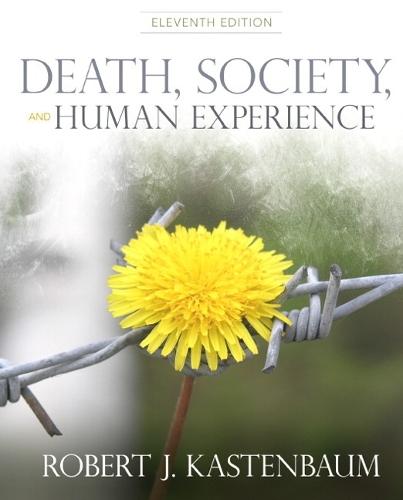
Providing an understanding of the relationship with death, both as an individual and as a member of society. This book is intended to contribute to your understanding of your relationship with death, both as an individual and as a member of society. Kastenbaum shows how individual and societal attitudes influence both how and when we die and how we live and deal with the knowledge of death and loss. Robert Kastenbaum is a renowned scholar who developed one of the world's first death education courses and introduced the first text for this market. This landmark text draws on contributions from the social and behavioral sciences as well as the humanities, such as history, religion, philosophy, literature, and the arts, to provide thorough coverage of understanding death and the dying process. Learning Goals Upon completing this book, readers should be able to: Understand the relationship with death, both as an individual and as a member of society See how social forces and events affect the length of our lives, how we grieve, and how we die Learn how dying people are perceived and treated in our society and what can be done to provide the best possible care Master an understanding of continuing developments and challenges to hospice (palliative care). Understand what is becoming of faith and doubt about an afterlife Note: MySearchLab does not come automatically packaged with this text. To purchase MySearchLab, please visit: www.mysearchlab.com or you can purchase a ValuePack of the text + MySearchLab with Pearson eText (at no additional cost). ValuePack ISBN-10: 0205863515 / ValuePack ISBN-13: 9780205863518
Full Product Details
Author: Robert J. Kastenbaum
Publisher: Taylor & Francis Inc
Imprint: Routledge
Edition: 11th edition
Dimensions:
Width: 23.00cm
, Height: 1.70cm
, Length: 18.80cm
Weight: 0.700kg
ISBN: 9780205001088
ISBN 10: 0205001084
Pages: 528
Publication Date: 06 December 2011
Audience:
Professional and scholarly
,
College/higher education
,
Professional & Vocational
,
Undergraduate
Replaced By: 9781138292406
Format: Paperback
Publisher's Status: No Longer Our Product
Availability: Out of stock 
The supplier is temporarily out of stock of this item. It will be ordered for you on backorder and shipped when it becomes available.
Table of Contents
IN THIS SECTION: 1. BRIEF 2. COMPREHENSIVE BRIEF TABLE OF CONTENTS: Chapter 1: As We Think About Death Chapter 2: What is Death? Chapter 3: Dying Chapter 4: End-of-Life Issues and Decisions Chapter 5: Suicide Chapter 6: Violent Death: Murder, Terrorism, Genocide, Disaster, and Accident Chapter 7: Euthanasia, Assisted Death, Abortion, and the Right to Die COMPREHENSIVE TABLE OF CONTENTS: Chapter 1: As We Think About Death A History of Death? Not Thinking About Death: A Failed Experiment Your Self-Inventory of Attitudes, Beliefs, and Feelings Some Answers – And The Questions They Raise Man is Mortal: But What Does That Have To DO With Me? Anxiety, Denial, and Acceptance: Three Core Concepts Studies and Theories of Death Anxiety Major Findings From Self-Reports of Death Anxiety Theoretical Perspectives on Death Anxiety Accepting and Denying Death Chapter 2: What is Death? Ideas About The Nature And Meaning Of Death Death As Observed, Proclaimed, And Imagined Biomedical Approaches To The Definition Of Death Event Versus State What Does Death Mean? Interpretations Of The Death State Conditions That Resemble Death Death As A Person Conditions That Death Resembles The Undead Death As An Agent Of Personal, Political, And Social Chapter 3: Dying The Moment Of Death: Is It Vanishing? What Is Dying, And When Does It Begin? Trajectories Of Dying: From Beginning To End Guarded Feelings, Subtle Communications Individuality And Universality In The Experience Of Dying Theoretical Models Of The Dying Process Chapter 4: End-of-Life Issues and Decisions From Description To Decision Making Who Should Participate In End-Of-Life Decisions? The Living Will And Its Impact Right-To-Die Decisions That We Can Make A Right Not To Die? The Cryonics Alternative Organ Donation Funeral-Related Decisions Chapter 5: Suicide What Do The Statistics Tell Us? Four Problem Areas Some Cultural Meanings Of Suicide A Powerful Sociological Theory Of Suicide Some Individual Meanings Of Suicide Facts And Myths About Suicide Suicide Prevention Emerging Issues And Challenges Chapter 6: Violent Death: Murder, Terrorism, Genocide, Disaster, and Accident Murder Terrorism 9/11/01 And Its Consequences Accident And Disaster Chapter 7: Euthanasia, Assisted Death, Abortion, and the Right to Die “I Swear By Appollo The Physician”: What Happened To The Hippocratic Oath? Key Terms And Concepts Our Changing Attitudes Toward A Right To Die The Right-To-Die Dilemma: Case Examples
Reviews
Thank you to the following reveiwers: Allen Richardson Cedar Crest College J. Meredith Martin University of New Mexico Patrick Ashwood Hawkeye Community College It is written by sociologist doing research in the field. These bits of original research are scattered throughout the book and gives a backbone of expertise. The author keeps up with recent trends in the death and dying field. There are good examples of different ethnic groups and their beliefs/practices in the text. -Patrick Ashwood, Hawkeye Community College The text is quite well done. The coverage of the events of September 11, 2001 are an excellent addition to the book. The material on death anxiety is first rate. -Allen Richardson, Cedar Crest College I think it is a fantastic text! It is very inclusive. -J. Meredith Martin, University of New Mexico
Thank you to the following reveiwers: Allen Richardson Cedar Crest College J. Meredith Martin University of New Mexico Patrick Ashwood Hawkeye Community College It is written by sociologist doing research in the field. These bits of original research are scattered throughout the book and gives a backbone of expertise. The author keeps up with recent trends in the death and dying field. There are good examples of different ethnic groups and their beliefs/practices in the text. -Patrick Ashwood, Hawkeye Community College The text is quite well done. The coverage of the events of September 11, 2001 are an excellent addition to the book. The material on death anxiety is first rate. -Allen Richardson, Cedar Crest College I think it is a fantastic text! It is very inclusive. -J. Meredith Martin, University of New Mexico
Author Information
Bob Kastenbaum’s exploits as skating messenger apparently qualified him to become editor of two community newspapers, an eccentric career trajectory that somehow led to a graduate scholarship in philosophy and a Ph.D. in psychology at the University of Southern California (1959). He was most interested in fields of psychological study that barely existed at the time: lifespan development and aging, time perspective, creativity, and death and dying. Kastenbaum became part of an emerging cadre that overcame the prevailing neglect and resistance to these issues. He worked in varied settings as clinician, researcher, activist, hospital administrator, educator, and author. The innovative programs he introduced into a geriatric hospital and his article, “The Reluctant Therapist” have been credited with preparing the way for increased attention to the needs and potentials of vulnerable elders and terminally ill people. With Dick Kalish, he founded Omega, the first peer-reviewed journal focused on death-related issues. Kastenbaum taught the first regularly-scheduled university course on death and dying and came up with the first textbook (Death, Society, & Human Experience, 1977). He also established the first university-based educational and research center on death and dying (Wayne State University, 1966). His other books include The Psychology of Death (1972, 1990, 2000); Dorian, Graying: Is Youth the Only Thing Worth Having? (1995), and On Our Way. The Final Passage Through Life and Death (2004). He has also served as editor of the Macmillan Encyclopedia of Death and Dying, (2003) and two previous encyclopedias. In the public sphere he has served as a co-founder of The National Caucus on Black Aging, consultant to the United States Senate Special Subcommittee on Aging, and participant in developing the Veterans Administration’s geriatric research and educational centers, and the landmark National Hospice Demonstration Project. Kastenbaum lives in Tempe, Arizona with Bunny (wife), Angel (The Incredible Leaping Dog), enhanced by Pumpkin and Snowflake in the cat department. Along with his continuing research interests, Kastenbaum has been writing book and verse for musicals and operas. He notes that nobody has died in the two most recently premiered operas (Closing Time; American Gothic, music by Kenneth LaFave), but cannot make any such promises about the next opera.
Tab Content 6
Author Website:
Countries Available
All regions
|