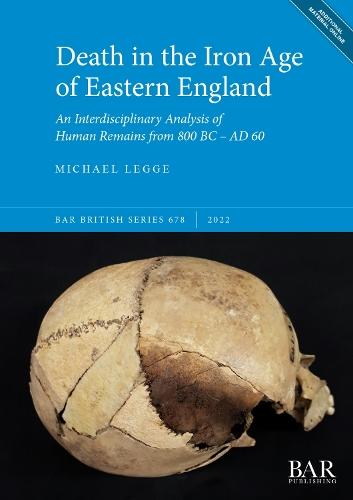
Death in the Iron Age of Eastern England: An Interdisciplinary Analysis of Human Remains from 800 BC - AD 60

Author:   Michael Legge
Publisher:   BAR Publishing
ISBN:  

9781407360232


Pages:   248
Publication Date:   30 December 2022
Format:   Paperback
Availability:   Available To Order   Availability explained
We have confirmation that this item is in stock with the supplier. It will be ordered in for you and dispatched immediately.

Our Price $213.84 Quantity:  
Add to Cart

Share |

Death in the Iron Age of Eastern England: An Interdisciplinary Analysis of Human Remains from 800 BC - AD 60


Overview

Death in the Iron Age of Eastern England explores the treatment of the non-cremated dead from 800BC - c.AD60 in what is now eastern England. The research presented identifies large-scale patterns in post-mortem treatment, furthering existing debates around excarnation practices, inhumation traditions and the 'invisible dead'. The region has seen comparatively little in-depth study in recent years, while the quantity of excavated material has increased exponentially due to the rise of development-led archaeology. This book gathers and presents the known data to shed light on an under-researched part of Iron Age Britain through the study of complete inhumations, partial skeletal remains and disarticulated human bones. The data is interpreted via integrated methodological approaches that combine contextual archaeology, osteology and bone taphonomy to better understand post-mortem processes, regional variation and the role of the dead in Iron Age societies.

Full Product Details

Author:   Michael Legge
Publisher:   BAR Publishing
Imprint:   BAR Publishing
ISBN:  

9781407360232


ISBN 10:   140736023
Pages:   248
Publication Date:   30 December 2022
Audience:   Professional and scholarly ,  Professional & Vocational
Format:   Paperback
Publisher's Status:   Active
Availability:   Available To Order   Availability explained
We have confirmation that this item is in stock with the supplier. It will be ordered in for you and dispatched immediately.

Table of Contents

List of Figures List of Tables Abbreviations 1. Introduction 1.1. The research landscape 1.2. Geographical and chronological boundaries 1.3. Large-scale data and its boundaries 1.4. Geological factors in bone preservation 1.5. Aims and objectives 1.6. Structure of the work 2. History of Research and Theoretical Themes 2.1. Introduction 2.2. Previous research 2.2.1. Large-scale burial reviews 2.2.2. Previous research on pit burials 2.2.3. The excarnation debate 2.3. Mortuary theory-key concepts 2.3.1. Defining burial 2.3.2. Defining ritual 2.3.3. Identity 2.3.4. Death and society 2.3.5. Change and transformation 2.3.6. Liminality, and the body as object 2.4. Conclusions 3. Materials and Methodologies 3.1. Introduction 3.2. Material 3.2.1. Total data 3.2.2. Inhumations 3.2.3. Disarticulated remains 3.2.4. Articulated and semi-articulated bones 3.2.5. Data limitations 3.2.6. The 'invisible dead'-other considerations 3.3. Archaeological data methods 3.3.1. Coding 3.3.2. Site conglomerations 3.3.3. Data presentation 3.3.4 Disarticulated remains-data recording 3.4. Osteological methodology and recording standards 3.4.1. Preservation 3.4.2. Age estimation 3.4.3. Sex estimation 3.4.4. Stature estimation 3.5. Common palaeopathologies-skeletal 3.5.1. Cribra orbitalia / Porotic hyperostosis 3.5.2. Osteoarthritis 3.5.3. Infection / Periosteal new bone 3.5.4. Schmorl's nodes 3.5.5. Trauma 3.6. Common palaeopathologies-Dental 3.6.1. Calculus 3.6.2. Caries 3.6.3. Periodontal disease 3.6.4. Periapical cavities 3.6.5. Antemortem tooth loss 3.6.6. Linear enamel hypoplasia (LEH) 3.7. Macroscopic taphonomy methodology 3.7.1. Weathering 3.7.2 Gnawing 3.7.3. Trampling 3.7.4. Polish / Abrasion 3.7.5. Cut and chop marks 3.7.6. Perimortem fractures 3.8. Conclusion 4. Results 1-Early Iron Age Inhumations 4.1. Introduction 4.2. Geographic distribution 4.3. Chronology 4.4. Site type 4.5. Depositional context 4.5.1. Pit burials 4.5.2. Grave burials 4.5.3. Ditch burial 4.5.4. Other contexts 4.6. Burial position 4.6.1. Extended inhumations 4.6.2. Crouched and flexed inhumations 4.6.3. Other positions 4.7. Orientation 4.8. Facing direction 4.9. Burial accompaniments 4.9.1. Pottery 4.9.2. Personal ornaments 4.9.3. Multiple associated goods/remains 4.9.4. Material in other fills 4.9.5. Other inclusions 4.10. Age 4.10.1. Age and burial context 4.10.2. Age and grave goods 4.10.3. Age and sex 4.11. Sex 4.11.1. Sex and location 4.11.2. Sex and burial context 4.11.3. Sex and position / orientation 4.11.4. Sex and grave goods 4.12. Conclusions 5. Results 2-Middle Iron Age Inhumations 5.1. Geographic distribution 5.2. Chronology 5.3. Site type 5.4. Depositional context 5.4.1. Pit burials 5.4.2. Grave burials 5.4.3. Ditch burials 5.4.4. House burials 5.4.5. Burial enclosures 5.4.6. Double burials 5.4.7. Other 5.5. Burial position 5.5.1. Extended inhumations 5.5.2. Crouched and flexed inhumations 5.5.3. Other positions 5.6. Orientation 5.7. Facing direction 5.8. Burial accompaniments 5.8.1. Animal bone 5.8.2. Pottery 5.8.3. Personal ornaments 5.8.4. Multiple associated goods 5.8.5. Material in other fills 5.8.6. Other 5.9. Age 5.9.1. Age and burial context 5.9.2. Age and grave goods 5.9.3. Age and sex 5.10. Sex 5.10.1. Sex and burial context 5.10.2. Sex and position/orientation 5.10.3. Sex and grave goods 5.11. Conclusions 6. Results 3-Late Iron Age-Conquest Period 6.1. Geographic distribution of sites and burials 6.2. Chronology 6.3. Site type 6.3.1. Cemeteries 6.3.2. Settlements 6.3.3. Hillforts/ringworks 6.3.4. Isolated burials 6.3.5. Mortuary landscapes 6.3.6. Other 6.4. Depositional context 6.4.1. Grave burials 6.4.2. Pit burial 6.4.3. Ditch burial 6.4.4. Multiple burials 6.4.5. Enclosed burials 6.4.6. Other 6.5. Burial position 6.5.1. Extended inhumations 6.5.2. Crouched and flexed inhumations 6.5.3. Other positions 6.6. Orientation 6.7. Facing direction 6.8. Burial accompaniments 6.8.1. Animal bone 6.8.2. Pottery 6.8.3. Personal ornaments 6.8.4. Metalwork and weapons 6.8.5. Multiple associated goods/remains 6.8.6. Material in other fills 6.8.7. Other 6.9. Age 6.9.1. Age and burial context 6.9.2. Age and burial position 6.9.3. Age and grave goods 6.9.4. Age and sex 6.10. Sex 6.10.1. Sex and location 6.10.2. Sex and site / burial context 6.10.3. Sex and position / orientation 6.10.4. Sex and grave goods 6.11. Conclusion 6.12. Iron Age-imprecisely dated 7. Articulated Human Skeletal Deposits 7.1. Introduction 7.2. Deposit demographics 7.3. Represented elements 7.4. Interpretation of depositional practices 7.4.1. Inhumations 7.4.2. Body bundles / secondary / tertiary inhumations 7.4.3. Articulated body parts 7.4.4. Bundles of bones (token deposits) 7.4.5. Victims of conflict and violent deposits 7.4.6. Bone spreads 7.5. Conclusion 8. Disar

Reviews

'The work is original throughout. Although the topic is attracting ever more attention, there is no other publication that offers such an in-depth analysis of all Iron Age inhumations, articulated bone groups and disarticulated remains attested in a region that has traditionally not been the focus of large-scale investigations.' Dr Greta Anthoons, Independent Researcher 'Legge's study is important to the overall understanding of Iron Age studies. The research data is a significant contribution to funerary studies in Eastern England during this period.' Dr. Nicole Roth, former Lecturer at Northern Kentucky University    


'The work is original throughout. Although the topic is attracting ever more attention, there is no other publication that offers such an in-depth analysis of all Iron Age inhumations, articulated bone groups and disarticulated remains attested in a region that has traditionally not been the focus of large-scale investigations.' Dr Greta Anthoons, Independent Researcher 'Legge's study is important to the overall understanding of Iron Age studies. The research data is a significant contribution to funerary studies in Eastern England during this period.' Dr. Nicole Roth, former Lecturer at Northern Kentucky University


Author Information

Michael Legge is a Postdoctoral Research Associate at the University of York. He completed his PhD at Cardiff University in 2021 and has also worked as a field archaeologist for commercial units across the UK. His research interests include funerary practices of all periods, identity, and non-normative treatment.

Tab Content 6

Author Website:  

Countries Available

All regions
Latest Reading Guide

April RG 26_2


Shopping Cart
Your cart is empty
Shopping cart
Mailing List