Overview
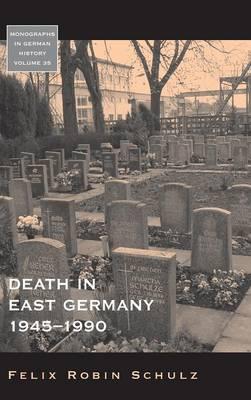
As the first historical study of East Germany‘s sepulchral culture, this book explores the complex cultural responses to death since the Second World War. Topics include the interrelated areas of the organization and municipalization of the undertaking industry; the steps taken towards a socialist cemetery culture such as issues of design, spatial layout, and commemorative practices; the propagation of cremation as a means of disposal; the wide-spread introduction of anonymous communal areas for the internment of urns; and the emergence of socialist and secular funeral rituals. The author analyses the manifold changes to the system of the disposal of the dead in East Germany—a society that not only had to negotiate the upheaval of military defeat but also urbanization, secularization, a communist regime, and a planned economy. Stressing a comparative approach, the book reveals surprising similarities to the development of Western countries but also highlights the intricate local variations within the GDR and sheds more light on the East German state and its society.
Full Product Details
Author: Felix Robin Schulz
Publisher: Berghahn Books
Imprint: Berghahn Books
Volume: 35
Dimensions:
Width: 15.20cm
, Height: 1.60cm
, Length: 22.90cm
Weight: 0.508kg
ISBN: 9781782380139
ISBN 10: 1782380132
Pages: 248
Publication Date: 01 September 2013
Audience:
College/higher education
,
Postgraduate, Research & Scholarly
Format: Hardback
Publisher's Status: Active
Availability: In Print

This item will be ordered in for you from one of our suppliers. Upon receipt, we will promptly dispatch it out to you. For in store availability, please contact us.
Reviews
[The author] offers a nuanced description of funeral practices in the GDR, which because of its broad empirical base alone can be recommended to all readers who want to explore in a sober manner the theme of death. Schulz' results deepen our knowledge of church and economic policies of the SED. * Sehepunkte Felix Robin Schulz's insightful and thoroughly researched book makes a significant contribution to the growing scholarship on the history of East Germany. It is, to my knowledge, the most comprehensive study of sepulchral culture in the GDR. Schulz is to be strongly commended for his extensive archival research in Berlin and in a number of city archives. He also visited numerous sites personally, which lends him a further layer of authority over his subject matter and allows him to make observations on how quickly certain spatial elements of socialist sepulchral culture are disappearing. * Helena Toth, Ludwig Maximilians Universitat, Munich [A] book on a fascinating subject, and one that offers a genuinely new perspective on the history of the German Democratic Republic. It links a number of topics that are of considerable interest... Although the GDR has attracted an enormous historical literature over the past couple of decades, the subject here has not been investigated until now...no one has attempted anything like this before-a book that links, among other things, the social aftermath of Nazism, the political history of the German Democratic Republic, the long-term developments in funeral and burial practices and cultures, and the relations between church and state in the GDR. * Richard Bessel, University of York
Felix Robin Schulz's insightful and thoroughly researched book makes a significant contribution to the growing scholarship on the history of East Germany. It is, to my knowledge, the most comprehensive study of sepulchral culture in the GDR. Schulz is to be strongly commended for his extensive archival research in Berlin and in a number of city archives. He also visited numerous sites personally, which lends him a further layer of authority over his subject matter and allows him to make observations on how quickly certain spatial elements of socialist sepulchral culture are disappearing. * Helena Toth, Ludwig Maximilians Universitat, Munich [A] book on a fascinating subject, and one that offers a genuinely new perspective on the history of the German Democratic Republic. It links a number of topics that are of considerable interest - Although the GDR has attracted an enormous historical literature over the past couple of decades, the subject here has not been investigated until now - no one has attempted anything like this before - a book that links, among other things, the social aftermath of Nazism, the political history of the German Democratic Republic, the long-term developments in funeral and burial practices and cultures, and the relations between church and state in the GDR. * Richard Bessel, University of York
Author Information
Felix Robin Schulz is Lecturer in Modern European History at Newcastle University. He has taught at Lancaster University, the University of York, and Sunderland University. His research interests include the history of sepulchral cultures, regional and national memorialization, and the link between landscape and identity. He has published on death and disposal in East Germany as well on the history of the Alps.