Overview
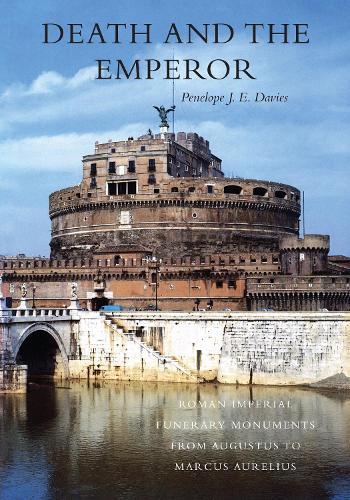
The role of monuments in the Roman imperial cult.
Full Product Details
Author: Penelope J. E. Davies
Publisher: University of Texas Press
Imprint: University of Texas Press
Dimensions:
Width: 17.80cm
, Height: 1.80cm
, Length: 25.40cm
Weight: 0.513kg
ISBN: 9780292702752
ISBN 10: 0292702752
Pages: 281
Publication Date: 01 March 2004
Audience:
Professional and scholarly
,
Professional & Vocational
Format: Paperback
Publisher's Status: Active
Availability: In Print

This item will be ordered in for you from one of our suppliers. Upon receipt, we will promptly dispatch it out to you. For in store availability, please contact us.
Reviews
Davies sets out to ask, How did the Romans bury Caesar? And with what monuments did they sing his praises? . . . The architectural elaboration of these structures, their siting in the capital, the lines of vision and approaches that exposed them to view, the paths their complex outworks formed for visitors to walk, are all picked out with skill and presented with care in Death and the Emperor. * Times Literary Supplement * This concise and lucidly written book is a very valuable new contribution to the studies of Roman imperial cult, political propaganda, and topography, and has the added benefit of discussing complex scholarly disputes in a manner that the non-specialist will probably follow with ease. . . . There is material in this volume that will be immensely useful to researchers in many areas: archaeology, history of architecture, iconography, history of religion, and Roman political propaganda, to name just a few. I strongly recommend it to scholars interested in any or all of the above topics. * Bryn Mawr Classical Review * Even though its focus is on only seven specimens of architecture, the book touches upon a broad array of aspects of Roman imperial culture. Elegantly written and generously illustrated . . . this book should be of great interest to the general public as well as to the scholarly community. * American Journal of Archaeology *
Davies sets out to ask, How did the Romans bury Caesar? And with what monuments did they sing his praises? ... The architectural elaboration of these structures, their siting in the capital, the lines of vision and approaches that exposed them to view, the paths their complex outworks formed for visitors to walk, are all picked out with skill and presented with care in Death and the Emperor. Times Literary Supplement This concise and lucidly written book is a very valuable new contribution to the studies of Roman imperial cult, political propaganda, and topography, and has the added benefit of discussing complex scholarly disputes in a manner that the non-specialist will probably follow with ease... There is material in this volume that will be immensely useful to researchers in many areas: archaeology, history of architecture, iconography, history of religion, and Roman political propaganda, to name just a few. I strongly recommend it to scholars interested in any or all of the above topics. Bryn Mawr Classical Review Even though its focus is on only seven specimens of architecture, the book touches upon a broad array of aspects of Roman imperial culture. Elegantly written and generously illustrated ... this book should be of great interest to the general public as well as to the scholarly community. American Journal of Archaeology
Even though its focus is on only seven specimens of architecture, the book touches upon a broad array of aspects of Roman imperial culture. Elegantly written and generously illustrated . . . this book should be of great interest to the general public as well as to the scholarly community. * American Journal of Archaeology * This concise and lucidly written book is a very valuable new contribution to the studies of Roman imperial cult, political propaganda, and topography, and has the added benefit of discussing complex scholarly disputes in a manner that the non-specialist will probably follow with ease. . . . There is material in this volume that will be immensely useful to researchers in many areas: archaeology, history of architecture, iconography, history of religion, and Roman political propaganda, to name just a few. I strongly recommend it to scholars interested in any or all of the above topics. * Bryn Mawr Classical Review * Davies sets out to ask, How did the Romans bury Caesar? And with what monuments did they sing his praises? . . . The architectural elaboration of these structures, their siting in the capital, the lines of vision and approaches that exposed them to view, the paths their complex outworks formed for visitors to walk, are all picked out with skill and presented with care in Death and the Emperor. * Times Literary Supplement *
Author Information
Penelope J. E. Davies is Associate Professor of Roman Art and Architecture at the University of Texas at Austin. Her book Death and the Emperor was first published by Cambridge University Press in 2000. It won the Vasari Award, sponsored by the Dallas Museum of Art.