Awards
- Winner of BASEES Women's Forum Prize 2018
- Winner of BASEES Women's Forum Prize 2018 (United States)
- Winner of BASEES Women’s Forum Prize 2018 (United States)
Overview
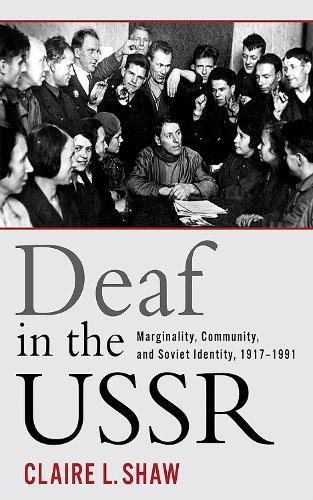
In Deaf in the USSR, Claire L. Shaw asks what it meant to be deaf in a culture that was founded on a radically utopian, socialist view of human perfectibility. Shaw reveals how fundamental contradictions inherent in the Soviet revolutionary project were negotiated-both individually and collectively- by a vibrant and independent community of deaf people who engaged in complex ways with Soviet ideology. Deaf in the USSR engages with a wide range of sources from both deaf and hearing perspectives-archival sources, films and literature, personal memoirs, and journalism-to build a multilayered history of deafness. This book will appeal to scholars of Soviet history and disability studies as well as those in the international deaf community who are interested in their collective heritage. Deaf in the USSR will also enjoy a broad readership among those who are interested in deafness and disability as a key to more inclusive understandings of being human and of language, society, politics, and power.
Full Product Details
Author: Claire L. Shaw
Publisher: Cornell University Press
Imprint: Cornell University Press
Dimensions:
Width: 15.20cm
, Height: 2.70cm
, Length: 22.90cm
Weight: 0.907kg
ISBN: 9781501713668
ISBN 10: 1501713663
Pages: 310
Publication Date: 15 October 2017
Recommended Age: From 18 years
Audience:
General/trade
,
General
Format: Hardback
Publisher's Status: Active
Availability: Manufactured on demand

We will order this item for you from a manufactured on demand supplier.
Reviews
Deaf in the USSR offers a fresh critical lens to examine concepts of citizenship, Soviet identity, political organization, and social status through the contested meanings of deaf and the lived experiences of deaf people. A splendid addition to deaf studies and Soviet studies. --Susan Burch, author of Signs of Resistance Engagingly written and impeccably researched, this history of the deaf community in the USSR is a welcome addition to the history of the Soviet Union, to the history of welfare, and to disability studies. --Diane P. Koenker, author of Club Red Deaf in the USSR offers a fresh critical lens to examine concepts of citizenship, Soviet identity, political organization, and social status through the contested meanings of deaf and the lived experiences of deaf people. A splendid addition to deaf studies and Soviet studies. --Susan Burch, author of Signs of Resistance
Deaf in the USSR offers a fresh critical lens to examine concepts of citizenship, Soviet identity, political organization, and social status through the contested meanings of deaf and the lived experiences of deaf people. A splendid addition to deaf studies and Soviet studies. --Susan Burch, author of Signs of Resistance Engagingly written and impeccably researched, this history of the deaf community in the USSR is a welcome addition to the history of the Soviet Union, to the history of welfare, and to disability studies. --Diane P. Koenker, author of Club Red
Engagingly written and impeccably researched, this history of the deaf community in the USSR is a welcome addition to the history of the Soviet Union, to the history of welfare, and to disability studies. -- Diane P. Koenker, author of <I> Club Red</I> Deaf in the USSR offers a fresh critical lens to examine concepts of citizenship, Soviet identity, political organization, and social status through the contested meanings of deaf and the lived experiences of deaf people. A splendid addition to deaf studies and Soviet studies. -- Susan Burch, author of <I>Signs of Resistance</I>
An outstanding work. [Deaf in the USSR] will be of considerable interest to a number of different kinds of readers. For historians of the Soviet Union, it addresses a little-known but potentially quite important aspect of Soviet history. For those interested in the history of deafness and the deaf, it offers fascinating insights into the unique case of deafness in post-revolutionary Russia.... The volume is well-written, cogent, and thoroughly grounded in both historical and archival sources. It is a significant contribution to the literature on the history of deafness and Deaf identity, and we have much for which to be grateful to Shaw. * Sign Language Studies * Deaf in the USSR succeeds best in offering a deaf-centered, unique overview of the development of political identity of deaf people in urban Russia under the Soviet system, and is a significant contribution to the fields of Deaf Studies and Soviet History. * The Russian Review * One of the strengths of Deaf in the USSR is its identification of-indeed, emphasis on-tensions that remained unresolved throughout the Soviet era. It is a testimony to Shaw's analytical rigor that she can keep all these dialectical balls in the air without succumbing to incoherence. * American Historical Review * Shaw traces how deaf individuals challenged prevailing notions about their abilities and legal competence while also participating in the underlying goal of the Soviet project to transform backward masses into productive and literate citizens.... An important scholarly contribution to the field of deaf history. * Choice * A compelling study of the Soviet deaf community.... Deaf in the USSR deserves to be widely read and suggests ways for the experiences of other minority and marginalized Soviet communities to be re-examined. * Times Literary Supplement * This is an important book for not just historians of Russia and the Soviet Union, nor only scholars of deafness and disability, but for researchers in all of these fields and beyond. * Journal of the History of Medicine and Allied Sciences * A landmark in the history of disability and the Soviet welfare state. A stunning first book, it covers the entire Soviet experience from a thought-provoking perspective. * Australian Book Review * Shaw's approach is, first and foremost, historically rigorous. With this, the first definitive account of deaf political advocacy throughout the Soviet twentieth century, Shaw has proffered a fertile platform for further scholarship. * Slavic Review *
Deaf in the USSR offers a fresh critical lens to examine concepts of citizenship, Soviet identity, political organization, and social status through the contested meanings of deaf and the lived experiences of deaf people. A splendid addition to deaf studies and Soviet studies. -- Susan Burch, author of <I>Signs of Resistance</I> Engagingly written and impeccably researched, this history of the deaf community in the USSR is a welcome addition to the history of the Soviet Union, to the history of welfare, and to disability studies. -- Diane P. Koenker, author of <I> Club Red</I>
An outstanding work. [Deaf in the USSR] will be of considerable interest to a number of different kinds of readers. For historians of the Soviet Union, it addresses a little-known but potentially quite important aspect of Soviet history. For those interested in the history of deafness and the deaf, it offers fascinating insights into the unique case of deafness in post-revolutionary Russia.... The volume is well-written, cogent, and thoroughly grounded in both historical and archival sources. It is a significant contribution to the literature on the history of deafness and Deaf identity, and we have much for which to be grateful to Shaw. * Sign Language Studies * One of the strengths of Deaf in the USSR is its identification of-indeed, emphasis on-tensions that remained unresolved throughout the Soviet era. It is a testimony to Shaw's analytical rigor that she can keep all these dialectical balls in the air without succumbing to incoherence. * American Historical Review * Shaw traces how deaf individuals challenged prevailing notions about their abilities and legal competence while also participating in the underlying goal of the Soviet project to transform backward masses into productive and literate citizens.... An important scholarly contribution to the field of deaf history. * Choice * A compelling study of the Soviet deaf community.... Deaf in the USSR deserves to be widely read and suggests ways for the experiences of other minority and marginalized Soviet communities to be re-examined. * Times Literary Supplement * This is an important book for not just historians of Russia and the Soviet Union, nor only scholars of deafness and disability, but for researchers in all of these fields and beyond. * Journal of the History of Medicine and Allied Sciences * A landmark in the history of disability and the Soviet welfare state. A stunning first book, it covers the entire Soviet experience from a thought-provoking perspective. * Australian Book Review * Shaw's approach is, first and foremost, historically rigorous. With this, the first definitive account of deaf political advocacy throughout the Soviet twentieth century, Shaw has proffered a fertile platform for further scholarship. * Slavic Review *
Author Information
Claire L. Shaw is a Lecturer in Russian at the University of Bristol.