Overview
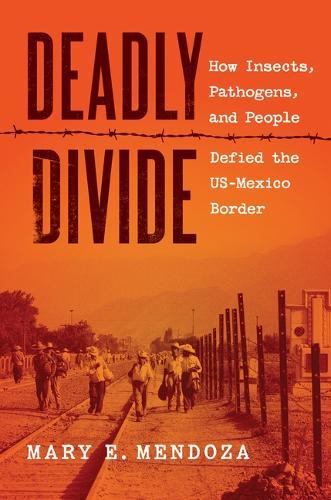
When most people picture the US-Mexico border, they think of walls, fences, concrete, and wire. But in this first history of how the environment influenced physical boundary-making between the two nations, Mary E. Mendoza focuses on how the natural world shaped ideas about race, gender, and security. In so doing, she unearths surprising origins of the modern-day immigration debate. Mexican migrants have historically been seen by some in the US as invasive and less than human. But actual invasive pests are part of this story. Deadly Divide shows how cattle ticks, the body louse, foot-and-mouth disease, and the female Mexican fruit fly contributed to the to the ever-increasing racialization of Mexican migrants, which in turn led to increased policing, criminalization, and fears about immigrants infiltrating the US. As Mendoza follows the stories of migrants in relation to various species, Indigenous peoples, and officials on both sides of the border, she argues that the need for mobility overpowered both governments’ laws, fences, and agents. At the same time, the border’s symbolic power became a source of terror not only for migrants who try to cross into the US but for those who feel they cannot cross back, making the US a nation that suspends immigrants between two worlds.
Full Product Details
Author: Mary E. Mendoza
Publisher: The University of North Carolina Press
Imprint: The University of North Carolina Press
Dimensions:
Width: 2.50cm
, Height: 15.50cm
, Length: 23.50cm
ISBN: 9781469695402
ISBN 10: 1469695405
Pages: 256
Publication Date: 28 April 2026
Audience:
College/higher education
,
Postgraduate, Research & Scholarly
Format: Paperback
Publisher's Status: Active
Availability: Not yet available

This item is yet to be released. You can pre-order this item and we will dispatch it to you upon its release.
Reviews
""A brilliantly researched, clearly written book. Mendoza shows, in exquisite detail, the environmental, geopolitical, and social dimensions of the history of border-making."" --Virginia Scharff, University of New Mexico ""In adding the nonhuman to the history of the border, Mendoza makes one of the most important contributions that I have read in a while. This book will become part of the central set of books on the US-Mexico border."" --María E. Montoya, New York University
""A brilliantly researched, clearly written book. Mendoza shows, in exquisite detail, the environmental, geopolitical, and social dimensions of the history of border-making."" —Virginia Scharff, University of New Mexico ""In adding the nonhuman to the history of the border, Mendoza makes one of the most important contributions that I have read in a while. This book will become part of the central set of books on the US-Mexico border."" —María E. Montoya, New York University
Author Information
Mary E. Mendoza is assistant professor of history at Penn State University and the editor of Not Just Green, Not Just White: Race, Justice, and Environmental History.