Overview
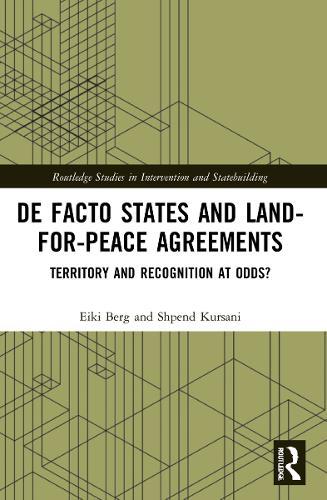
This book presents an analytical framework which assesses how 'land-for-peace' agreements can be achieved in the context of territorial conflicts between de facto states and their respective parent states. The volume examines geographic solutions to resolving ongoing conflicts that stand between the principle of self-determination (prompted by de facto states) and the principle of territorial integrity (prompted by parent states). The authors investigate the conditions under which territorial adjustments can bring about a possibility for peace between de facto states and their parent states. It does so by interrogating the possibility of land-for-peace agreements in four de facto state–parent state pairs, namely Kosovo–Serbia, Nagorno–Karabakh–Azerbaijan, Northern Cyprus–Republic of Cyprus, and Abkhazia–Georgia. The book suggests that the value that parties put on land to be exchanged and peace to be achieved stand at odds for land-for-peace agreements to materialise. The book brings theoretical and empirical insights that open several avenues for discussions on the conservative stance that the international community has held on territorial changes in the post-1945 international order. This book will be of much interest to students of statebuilding, state formation, secessionism, political geography, and international relations.
Full Product Details
Author: Eiki Berg ,
Shpend Kursani
Publisher: Taylor & Francis Ltd
Imprint: Routledge
Weight: 0.360kg
ISBN: 9781032182186
ISBN 10: 1032182180
Pages: 184
Publication Date: 25 September 2023
Audience:
College/higher education
,
Professional and scholarly
,
Tertiary & Higher Education
,
Professional & Vocational
Format: Paperback
Publisher's Status: Active
Availability: In Print

This item will be ordered in for you from one of our suppliers. Upon receipt, we will promptly dispatch it out to you. For in store availability, please contact us.
Reviews
'Are there geographic solutions to peacefully resolving ongoing conflicts between the principles of self-determination and territorial integrity? Given repeated failures to implement power-sharing agreements, Berg and Kursani’s pioneering work directs our attention to the problems and prospects for land for peace agreements.'--Scott Pegg, Indiana University-Purdue University Indianapolis (IUPUI), USA 'This is an extraordinarily timely book about secessionist conflicts, and the creation and persistence of quasi-independent states within the territories of recognised nation-states. Territorial revanchism, irredentism, and secessionism illuminate their well-chosen case studies. The territorial rules of the game are changing and they explain how, where and why.'--Klaus Dodds, Royal Holloway University of London, UK 'Land for peace agreements have fallen out of favour in modern international relations. The idea of trading territory to resolve longstanding disputes is seen as passé at best, if not an affront to norms of contemporary peace-making. But is this preventing the settlements of many conflicts? Using real case studies, this ground-breaking work opens up a much needed conceptual and practical debate about the role of land for agreements in contemporary conflict resolution practices.'--James Ker-Lindsay, London School Economics and Political Science, UK
Author Information
Eiki Berg is Professor of International Relations at the University of Tartu, Estonia. Shpend Kursani is Lecturer at the Institute of Political Science, Leiden University, The Netherlands.