Overview
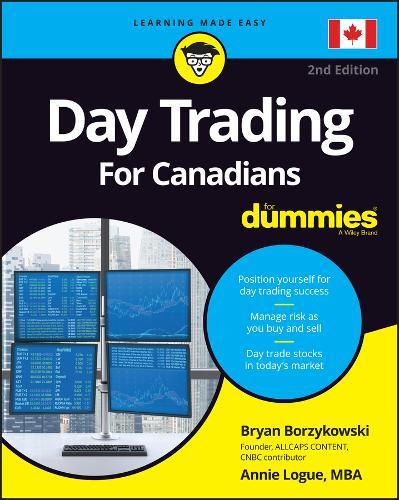
Purchase the power to trade smart Knowledge is power in any endeavor, and in the quick-action world of day trading—with roller-coaster markets, trade wars, and new tax laws inflating both opportunity and risk—being expertly informed is what gives you the power to trade fast with a cool head. The fully updated new edition of Day Trading For Canadians For Dummies—the first in almost a decade—gives you that knowledge, taking you from the basic machinery of short-term markets to building and sticking to a plan of action that keeps your bottom line sitting pretty. In an easy-to-follow, no-jargon style, award-winning business journalist Bryan Borzykowski provides a complete course in day trading. He covers the basics—such as raising capital and protecting one's principal investments—as well as specialized skills and knowledge, including risk-management strategies and ways to keep your emotions in check when you're plugged into an overheating market. You'll also find sample trading plans and important Canada-specific information, such as the best online brokerage firms, useful local resources, and an overview of the unique tax issues faced by Canadian traders. Evaluate strategy and performance Read market indicators Know your crypto Get your options For day traders, every second counts: With the help of Day Trading For Canadians For Dummies, you'll know where you want to be and how to get there—and how best to profit—fast.
Full Product Details
Author: Bryan Borzykowski (ALLCAPS Content) , Ann C. Logue (University of Illinois)
Publisher: John Wiley & Sons Inc
Imprint: For Dummies
Edition: 2nd edition
Dimensions:
Width: 18.50cm
, Height: 2.80cm
, Length: 23.40cm
Weight: 0.499kg
ISBN: 9781119736714
ISBN 10: 1119736714
Pages: 384
Publication Date: 15 January 2021
Audience:
General/trade
,
General
Replaced By: 9781394388837
Format: Paperback
Publisher's Status: Active
Availability: Available To Order 
We have confirmation that this item is in stock with the supplier. It will be ordered in for you and dispatched immediately.
Table of Contents
Introduction 1 About This Book 2 Foolish Assumptions 2 Icons Used in This Book 3 Beyond the Book 3 Where to Go from Here 4 Part 1: Day Trading Fundamentals 5 Chapter 1: All You Need to know about Day Trading 7 It’s All in a Day’s Work 8 Speculating, not hedging 9 Understanding zero-sum markets 9 Keeping the discipline: Closing out each night 10 Committing to Trading as a Business 11 Trading part-time: An okay idea if done right 11 Trading as a hobby: A bad idea 12 Working with a Small Number of Assets 13 Managing your positions 14 Focusing your attention 14 Working with risk capital 15 Personality Traits of Successful Day Traders 15 Independence 16 Quick-wittedness 17 Decisiveness 17 The Difference between Trading, Investing, and Gambling 18 Investing is slow and steady 18 Trading works fast 19 Gambling is nothing more than luck 19 Busting Some Day Trading Myths 20 Myth #1: I can make millions 20 Myth #2: Profits are guaranteed 21 Myth #3: Day trading is dangerous 21 Myth #4: It’s easy 21 A lot of other worthwhile activities are stressful too 22 Chapter 2: The Business of Day Trading 25 A Day in the Life of a Trader 26 Setting Up Your Trading Laboratory 29 Where to sit, where to work 30 Count on your computer 30 See it on the big screen 30 Connect to the Internet 31 Fix hours, vacation, and sick leave 31 Stay virus- and hacker-free 32 The department of redundancy department: Back up your systems 33 Planning Your Trading Business 33 Setting your goals 34 Finding volatility 34 Investing in your business 36 Evaluating and revising your plan 36 Getting Mobile with the Markets 37 Controlling Your Emotions 37 Dealing with destructive emotions 38 Having an outlet 41 Setting up support systems 42 Watching your walk-away money 43 Managing the Risks of Day Trading 44 It’s your business 44 It’s your life 44 Chapter 3: Introducing the Financial Markets 45 Having a Firm Grasp How Markets Work 46 Supply and demand 46 Exchanges versus over the counter 47 Commissions, fees, and spreads 48 Understanding zero-sum games 49 Opening an Account and Placing an Order 50 Opening a brokerage account 50 Placing your initial order 50 Closing out your order 50 Taking your cash 50 Defining the Principles of Successful Day Trading 51 Working with a small number of assets 51 Managing your positions 52 Focusing your attention 53 Understanding Risk and Return 53 Recognizing what risk is 54 Getting rewarded for the risk you take 57 Market efficiency in the real world 58 Chapter 4: Assets 101: Stocks, Bonds, Currency, and Commodities 61 Grasping the Different Things to Trade 61 Defining a Good Day Trading Asset 62 Looking for liquidity 62 Homing in on high volatility 64 Staying within your budget 65 Making sure you can use margin 65 Taking a Closer Look at Stocks 67 How Canadian and U.S stocks trade 68 Where Canadian stocks trade 69 Where U.S stocks trade 72 The high-risk over-the-counter exchanges 74 Dark pools 75 Examining Bonds 75 How bonds trade 76 Listed bonds 77 Over-the-counter trading 77 Treasury dealers 77 Cashing In with Currency 78 How currency trades 78 How the Canadian dollar is traded 79 Where currency trades 79 Considering Commodities and How They Trade 80 Chapter 5: Assets 102: ETFs, Cryptocurrency, Options, and Derivatives 81 Explaining Exchange-Traded Funds (ETFs) in Plain English 82 Traditional ETFs 83 Strategy ETFs 84 How ETFs trade 85 ETF risks 86 Getting Familiar with Cryptocurrency 86 Bitcoin and blockchain 87 Other cryptocurrencies 88 Understanding how cryptocurrencies trade 89 Avoiding the risks of cryptocurrencies 91 Dealing in Derivatives 91 Getting to know types of derivatives 92 Buying and selling derivatives 94 Comprehending Arbitrage and the Law of One Price 96 Understanding how arbitrage and market efficiency interact 96 Creating synthetic securities 97 Taking advantage of price discrepancies 98 Reducing arbitrage opportunities: High-frequency trading 99 Chapter 6: Increasing Risk and Potential Return with Short Selling and Leverage 101 Understanding the Magic of Margin 102 Making margin agreements 103 Understanding the costs and fees of margin 104 Managing margin calls 105 Enjoying margin bargains for day traders 105 The Switch-Up of Short Selling 105 Selling short 106 Short selling in Canada 107 Choosing shorts 108 Losing your shorts? 108 Leveraging All Kinds of Accounts 109 In stock and bond markets 109 In options markets 110 In futures trading 111 In foreign exchange 112 Borrowing in Your Trading Business 113 Taking margin loans for cash flow 113 Borrowing for trading capital 114 Assessing Risks and Returns from Short Selling and Leverage 115 Losing your money 115 Losing your nerve 115 Chapter 7: Managing Your Money and Positions 117 Setting Your Earnings Expectations 118 Finding your expected return 118 Determining your probability of ruin 119 Gaining Advantage with a Money-Management Plan 121 Minimizing damage while increasing opportunity 121 Staying in the market longer 122 Getting out before you lose everything 123 Accounting for opportunity costs 123 Examining Styles of Money Management 124 Limiting portions: Fixed fractional 124 Protecting profits: Fixed ratio 125 Sticking to 10 percent: Gann 126 Finding the ideal percentage: Kelly criterion 126 Doubling down: Martingale 127 Letting a program guide you: Monte Carlo simulation 127 Considering past performance: Optimal F 128 How Money Management Affects Your Return 129 Planning for Your Profits 130 Compounding interest 131 Pyramiding power 131 Making regular withdrawals 133 Chapter 8: Planning Your Trades and Trading Your Plans 135 Starting to Plan Your Trades: Just the Basics, Please 136 What do you want to trade? 136 When will you be trading? 137 How do you want to trade? 137 Figuring out when to buy and when to sell 139 Setting profit goals 139 Setting limits on your trades 141 What if the trade goes wrong? 144 Closing Out Your Position 146 Swing trading: Holding for days 146 Position trading: Holding for weeks 147 Investing: Holding for months or years 147 Maxims and Clichés That Guide and Mislead Traders 147 Pigs get fat, hogs get slaughtered 148 In a bear market, the money returns to its rightful owners 148 The trend is your friend 149 Buy the rumour, sell the news 149 Cut your losses and ride your winners 150 You’re only as good as your last trade 150 If you don’t know who you are, Wall Street is an expensive place to find out 151 There are old traders and bold traders, but no old, bold traders 151 Part 2: Developing Your Strategy 153 Chapter 9: Picture This: Technical Analysis 155 Comparing Research Techniques Used in Day Trading 156 Knowing what direction your research is 156 Examining fundamental research 157 Looking closer at technical analysis 158 Using Technical Analysis 160 First things first: Should you follow a trend or deviate from it? 160 Finding trends 161 Those ever-changing trends 165 Reading the Charts 167 Wave your pennants and flags 167 Not just for the shower: Head and shoulders 169 Drink from a cup and handle 169 Mind the gap 170 Grab your pitchforks! 171 Considering Different Approaches to Technical Analysis 172 Dow Theory 172 Fibonacci numbers and the Elliott Wave 172 Japanese candlestick charting 173 The Gann system 174 Avoiding Technical Analysis Pitfalls 174 If it’s obvious, there’s no opportunity 175 Overanalyzing the data 175 Success may be the result of an upward bias 175 Chapter 10: Following Market Indicators and Tried-and-True Day Trading Strategies 177 Psyching Out the Markets 178 Betting on the buy side 179 Avoiding the projection trap 179 Taking the Temperature of the Market 180 Pinpointing with price indicators 180 Volume 183 Volatility, crisis, and opportunity 185 Measuring Money Flows 187 Accumulation/distribution index 188 Money-flow ratio and money-flow index 189 Short interest ratios 189 Considering Information That Crops Up during the Trading Day 190 Price, time, and sales 191 Order book 191 Quote stuffing 192 News flows 192 Identifying Anomalies and Traps 193 Bear traps and bull traps 194 Calendar effects 195 Chapter 11: Eliminating Emotion with Program Trading 197 Creating Your Own Trading Program 198 Recognizing what you want to automate 198 Knowing the limitations of robots 199 Programming, the Day Trading Way 199 Looking at basic brokerage offerings 200 Adding a trading platform 200 Finding trading modules 200 Backtesting Once, Backtesting Twice 201 Building on Some Standard Strategies 201 Range trading 202 Contrarian trading 202 News trading 203 Pairs trading 203 Arbitraging for Fun and Profit 203 Understanding how arbitrage and market efficiency interact 204 Taking advantages of price discrepancies 205 Scalping, the Dangerous Game 206 Understanding Risk Arbitrage and Its Tools 207 Arbitrating derivatives 208 Levering with leverage 209 Short selling 209 Creating synthetic securities 209 Examining Arbitrage Strategies 210 Convertible arbitrage 211 ETF arbitrage 211 Fixed income and interest-rate arbitrage 212 Index arbitrage 213 Merger arbitrage 213 Option arbitrage 215 Watching Out for Those Pesky Transaction Costs 215 Chapter 12: Day Trading for Investors 217 Recognizing What Investors Can Glean from Traders 217 Being disciplined 218 Dealing with breaking news and breaking markets 219 Setting targets and limits 220 Judging execution quality 221 Applying Momentum 223 Earnings momentum 224 Price momentum 224 For investors only: Momentum-research systems 225 When an Investor Considers Trading 227 The idea has a short shelf life 227 Your research shows you some trading opportunities 227 You see some great short opportunities 228 Chapter 13: Researching Research Services 229 Understanding the Trade of Trading 230 Enjoying freebies from the exchanges and the regulators 230 Hitting the (virtual) road for conferences 233 Taking training classes 234 Getting the Research You Need 236 (Price) Quote me on that 237 Charting your strategy 238 News, newsletters, gurus, and strategic advice 240 Doing Your Due Diligence 243 Where to start your research 243 Questions to ask 244 Chapter 14: Testing, Tracking, and Evaluating Performance 247 Before You Trade: Testing Your System 247 Backtesting 248 Simulation trading 250 Backtesting and simulation software 251 During the Day: Tracking Your Trades 254 Setting up your spreadsheet 254 Pulling everything into a profit and loss statement 255 Keeping a trading diary 256 After You Trade: Calculating Overall Performance 257 Reviewing types of return 258 Calculating returns 258 Determining the risk to your return 263 Using benchmarks to evaluate your performance 265 Part 3: Day Trading, Incorporated 267 Chapter 15: Your Key Vendor: Your Broker 269 Choosing a Brokerage 270 Getting proper pricing 270 Evaluating types of platform 272 Opening an account 274 Exploring Brokers for Day Traders 275 Brokers for stocks and a bit of the rest 275 Brokers for foreign exchange 278 Watching Out for Brokerage Scams 279 Chapter 16: Regulation Right Now 281 How Regulations Created Day Trading 282 Who Regulates What? 283 Provincial securities commissions 284 Investment Industry Regulatory Organization of Canada (IIROC) 285 Mutual Fund Dealers Association of Canada (MFDA) 286 The exchanges 286 Brokerage Basics for Firm and Customer 286 Are you suitable for day trading? 286 Staying out of the money laundromat 287 Rules for day traders 288 Tax reporting 289 Hot Tips and Insider Trading 289 Taking on Partners 290 Chapter 17: Choosing the Right Accounts 291 Understanding Investment Accounts 292 RRSP 292 TFSA 293 RRIF 294 Non-registered accounts 295 Deciding on an Account to Use for Day Trading 295 Chapter 18: Taxes for Traders 297 Are You a Trader or an Investor? 298 Claiming Business Expenses 298 Hiring a Tax Adviser 299 The many flavours of tax experts 299 Questions to ask a prospective adviser 300 You still want to do it yourself? 301 What is Income, Anyway? 302 Earned income 302 Capital gains and losses 303 Tracking Your Investment Expenses 305 Qualified and deductible expenses 306 Paying Taxes All Year 308 Using Your RRSP 308 Trading within a Tax-Free Savings Account 309 Part 4: The Part of Tens 311 Chapter 19: Ten Good Reasons to Day Trade 313 You Love Being Independent 313 You Want to Work Anywhere You Like 314 You’re Comfortable with Technology 314 You Want to Eat What You Kill 315 You Love the Markets 315 You Have Market Experience 315 You’ve Studied Trading Systems and Know What Works for You 316 You’re Decisive and Persistent 316 You Can Afford to Lose Money 317 You Have a Support System 318 Chapter 20: Ten Common Day Trading Mistakes 319 Starting with Unrealistic Expectations 319 Beginning without a Business and Trading Plan 320 Ignoring Cash Management 321 Failing to Manage Risk 321 Not Committing the Time and Money to Do It Right 322 Chasing the Herd 322 Switching between Research Systems 323 Overtrading 323 Sticking Too Long with Losing Trades 324 Getting Too Emotionally Involved 324 Chapter 21: Almost Ten Alternatives to Day Trading 325 Proprietary Trading for an Investment Company or Hedge Fund 325 Trading for an Agricultural, Energy, or Commodities Company 326 Joining a Market Making Firm 326 Traditional Investing for Your Own Account 327 Taking a Swing at Swing Trading 327 Gambling for the Fun of It 327 Playing Day Trading Video Games 328 Trading in Demo Accounts 328 Participating in a Trading Contest 329 Chapter 22: Ten Tested Money-Management Techniques 331 Taking Money off the Table 332 Using Stops 332 Applying Gann’s 10 Percent Rule 332 Limiting Your Losses with the Fixed Fractional System 333 Increasing Returns with the Fixed-Ratio System 333 Following the Kelly Criterion Formula 334 Figuring the Amount to Trade with Optimal F 334 Measuring Risk and Sizing Trades with Monte Carlo Simulation 335 Taking a Risk with the Martingale System 335 Throwing It to the Fates 336 Appendix: Additional Resources For Day Traders 337 Index 345
Reviews
Author Information
Bryan Borzykowski is Founder and President of ALLCAPS Content. He is a renowned business journalist and has written for outlets including The New York Times, CNBC, CNNMoney, and more. Ann Logue, MBA teaches finance at the University of Illinois. She's also a finance writer and has edited publications on equity trading and risk management.
Tab Content 6
Author Website:
Countries Available
All regions
|