Overview
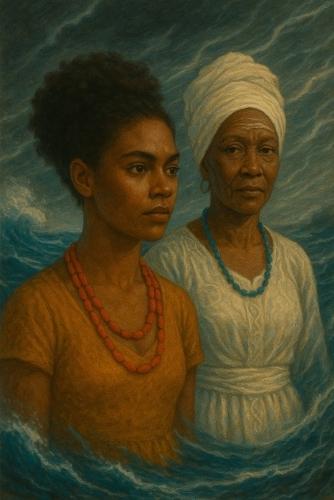
DAUGHTER OF TWO TIMES The Woman Who Crossed, the Woman Who Remembered Two women. Two centuries. One lineage that refuses to be erased. In nineteenth-century Bahia, a young Black woman is torn from Yorùbá land and carried across the Atlantic into Brazil's final decades of slavery. In Salvador and the Recôncavo, she learns the harsh grammar of survival-hiding rooms, forged papers, bitter leaves, whispered alliances-until survival becomes something rarer: the slow construction of a life that can hold others when ""freedom"" arrives only on paper. In present-day São Paulo, her descendant lives in another kind of captivity: polite racism, corporate corridors, and a modern city that demands silence as the price of belonging. Speaking into the night as if the future were already listening, she retells the ancestor's story-and discovers her own transformation unfolding in parallel. Sea and wind, memory and ambition, grief and desire: the past is not a museum here. It is a living force. Structured as sixteen cinematic gates, this novel follows the cycle of the Sixteen Major Odù of Ifá-an ancient map of human development-without requiring any prior knowledge of the tradition. For spiritual readers, it is a love letter to Orí, Ẹ̀gún, and Àṣẹ. For everyone else, it is a universal story of becoming: how a person stops running, learns to return, and finally chooses what kind of ""house"" they will be. Written in lush, atmospheric prose with the pulse of historical romance and the shimmer of Afro-Atlantic memory, Daughter of Two Times is made for readers in the USA and Brazil-and for anyone who wants a story that could live on screen. Inside you'll find A dual timeline (1850s Bahia ↔ modern São Paulo) with mirrored inner/outer transformation Ifá concepts woven into story-not sermons: Odù, Orí, Ìwà Pẹ̀lẹ́, Ẹgbẹ́, Ẹ̀gún, Àṣẹ, Èlénìnì, Àjogún Òrìṣà resonance as character forces-especially Yemọja (Iemanjá) and Ọ̀yá (Santa Bárbara) Prologue, epilogue, glossary, and dramatis personae for complete accessibility Carefully harmonized Yorùbá orthography with tonal accents for credibility and tradition-respect About the author Babá Tilo de Àjàgùnnà is a writer and teacher of Afro-diasporic spiritual traditions, known for blending mythic storytelling with practical clarity. He is the author of THE ORISHA CHRONICLES and THE 256 ODU IFÁ A Journey Through the Divine Codes of Creation, Existence, and Return, bringing decades of lived study across Ifá and Brazilian traditions into literature that is both culturally grounded and deeply human.
Full Product Details
Author: Tilo Plöger de Àjàgùnnà
Publisher: Independently Published
Imprint: Independently Published
Dimensions:
Width: 15.20cm
, Height: 1.00cm
, Length: 22.90cm
Weight: 0.249kg
ISBN: 9798276443836
Pages: 182
Publication Date: 27 November 2025
Audience:
General/trade
,
General
Format: Paperback
Publisher's Status: Active
Availability: Available To Order

We have confirmation that this item is in stock with the supplier. It will be ordered in for you and dispatched immediately.