Overview
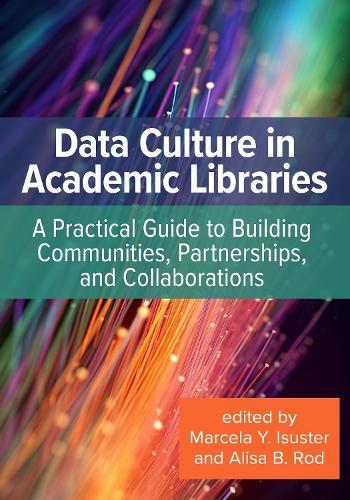
Librarians and academic data specialists support the research data needs of faculty and students through conventional services such as consultations and workshops, but also increasingly by cultivating a data culture that supports the diverse data needs of their communities. The shift toward data-related research as a driver of social capital is a critical opportunity to reassess data literacy training and build a local scholarly culture around data. In five parts, Data Culture in Academic Libraries: A Practical Guide to Building Communities, Partnerships, and Collaborations can help you foster an institutional culture that favors the curation, creation, and wider use of datasets. Data at all Levels Data Services and Instruction Data Outreach Data Communities Data Partnerships Chapters include case studies, practical examples, and strategies from practitioners in North America, Asia, and Europe working in a wide range of academic contexts and fostering data partnerships and communities that often go beyond their libraries and institutions. Data Culture in Academic Libraries highlights the ways that library workers are developing novel and innovative models of relationship-building to improve data-related services while incorporating a lens of equity, diversity, anti-racism, and inclusion in programming events and partnerships.
Full Product Details
Author: Marcela Y. Isuster , Alisa B Rod
Publisher: Association of College & Research Libraries
Imprint: Association of College & Research Libraries
Dimensions:
Width: 17.80cm
, Height: 1.80cm
, Length: 25.40cm
Weight: 0.454kg
ISBN: 9798892556156
Pages: 338
Publication Date: 30 April 2025
Audience:
College/higher education
,
Tertiary & Higher Education
Format: Paperback
Publisher's Status: Active
Availability: In Print 
This item will be ordered in for you from one of our suppliers. Upon receipt, we will promptly dispatch it out to you. For in store availability, please contact us.
Table of Contents
Acknowledgments Introduction Alisa B. Rod and Marcela Y. Isuster Section 1: Data at All Levels Chapter 1. Collections as Data: A Data Literacy Tool for Community Engagement Daria Orlowska and Lynn Houghton Chapter 2. Teaching with Institutional History Data Mackenzie Brooks Chapter 3. Beyond Data Literacy: Helping Nontraditional Students Get “Ready4Research” Ann Glusker and Dean Tanioka Chapter 4. Managing Research Data and Information in Support of Accreditation Goals Jeannie Bail and Tatiana Zaraiskaya Chapter 5. Data Skills Taught on Campus Jingjing Wu Section 2: Data Services and Instruction Chapter 6. Putting “Fun” in Fundamental Research Data Management: Data Communities and Education Justin de la Cruz, Nicole Contaxis, Fred Willie Zametkin LaPolla, Genevieve Milliken, and Peace Ossom Chapter 7. “Developing Others in Digital Stewardship”: Intersections Between Critical Data Literacies, an Ethics of Care, and Digitized Collections in GLAM Institutions Angela I. Fritz Chapter 8. Building as They Come: Comparative Case Studies of Co-constructing Data Visualization Services with Academic Communities Alexandra Wong and Subhanya Sivajothy Chapter 9. Collaboration, Materiality, and Multiplicity: New Approaches to Data Visualization Pedagogy Subhanya Sivajothy and Alexandra Wong Chapter 10. Developing a Primer for Developing Data Skills: The Story Behind Carnegie Mellon University Libraries Data Literacy Program Emma Slayton Section 3: Data Outreach Chapter 11. Love Data Week: The World Collaborates on Data Engagement Annalee Shelton Chapter 12. UC Love Data Week as a Model for Building Grassroot Data Communities at Scale Stephanie G. Labou, Katherine E. Koziar, and Ariel Deardorff Chapter 13. Data + You: Promoting Data Literacy at Binghamton University Ruth Carpenter, Amber Simpson, Melissa Haller, Mamen Rodriguez Galindo, Mary Tuttle, Hannah Jones, and Amanda Ortiz Section 4: Data Communities Chapter 14. Beyond Workshops: Building a Data Community Through Participatory Events Marcela Y. Isuster Chapter 15. Meeting the Challenges of Data Support Services in Academic Libraries: Advocating for an International DataSquad Model Deborah Wiltshire, Paula Lackie, Tim Dennis, and Elizabeth Parke Chapter 16. Connecting to Communities: Data Research Guide Partnerships as Agents of Change Kevin Manuel, Alexandra Cooper, and Rosa Orlandini Chapter 17. Curating, Catalyzing, Creating: Cultivating Data Culture in a Growing Research and Learning Community Yun Dai Section 5: Data Partnerships Chapter 18. Engaging Communities to Build a Culture of Data Mutualism with Limited Resources Jill Krefft, Jamie Rogers, Molly Castro, Elana Karshmer, and Rebecca Bakker Chapter 19. Toward Fostering a Community Beyond Institutional Walls: Tone Perfect as a Case Study Catherine Ryu and Devin Higgins Chapter 20. Odesi: A Story of Partnerships to Improve Discovery and Access to Canadian Survey and Public Opinion Data Jane Fry and Amber Leahey Chapter 21. Building a Community of Canadian Dataverse Collection Administrators: Consortial Collaboration and Communities of Practice Meghan Goodchild and John Huck About the Editors and Authors
Reviews
Author Information
Marcela Y. Isuster is the coordinator of the Digital Scholarship Hub, and liaison librarian to the School of Information Studies and the Department of Hispanic Studies at McGill University in Montreal, Canada. She completed her master of library and information studies at McGill University. Prior to that, she earned a bachelor of arts degree with a specialization in journalism from Concordia University. Her research focuses on information literacy, digital humanities, diversity, equity, and inclusion (DEI) in libraries and, of course, data culture. Marcela is also the founder of Humanidades Digitales en Bibliotecas, a series of digital humanities workshops for Spanish-speaking librarians. She is originally from Argentina and has worked in both Canada and the US. Dr. Alisa Beth Rod is the research data management specialist at the McGill University Libraries. Alisa holds a master of information studies from McGill University, an MA and PhD in political science from the University of California, Santa Barbara, and a BA in bioethics from the American Jewish University. Prior to joining McGill, Alisa was the survey methodologist at Ithaka S+R and then the associate director of the Empirical Reasoning Center at Barnard College of Columbia University. Her research interests include research data management, data librarianship, and building community around data.
Tab Content 6
Author Website:
Countries Available
All regions
|