Overview
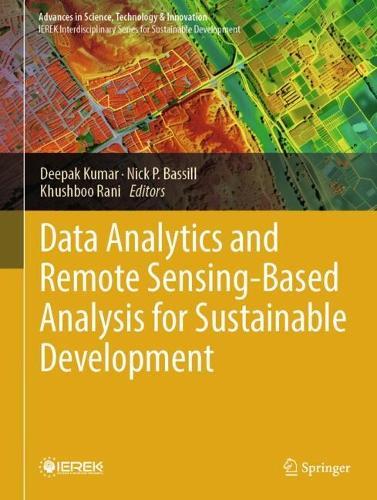
This book presents analysis of data analytics and remote sensing which are two powerful tools that can be used to support sustainable development. Remote sensing involves the use of sensors to gather data about the environment from a distance, while data analytics refers to the use of statistical and computational techniques to extract insights and patterns from large datasets. Sustainable development and remote sensing are used to monitor changes in the environment, such as deforestation, land use change, and water quality. This information is analyzed using data analytics to identify trends and patterns and to develop strategies for sustainable development. Remote sensing is used to monitor the health of forests, and data analytics is used to identify areas where deforestation is particularly high. This information is then used to develop targeted strategies for reducing deforestation, such as promoting sustainable forestry practices or supporting reforestation efforts. It is alsoused to monitor water quality, and data analytics is used to identify sources of pollution and to develop strategies for improving water quality. This information is particularly important in developing countries, where access to clean water is often a major challenge. Furthermore, data analytics and remote sensing are powerful tools for supporting sustainable development. By gathering and analyzing data about the environment, authors better understand the challenges they face and develop effective strategies for addressing them.
Full Product Details
Author: Deepak Kumar ,
Nick P. Bassill ,
Khushboo Rani
Publisher: Springer International Publishing AG
Imprint: Springer International Publishing AG
ISBN: 9783031980947
ISBN 10: 3031980948
Pages: 187
Publication Date: 02 January 2026
Audience:
Professional and scholarly
,
Professional & Vocational
Format: Hardback
Publisher's Status: Forthcoming
Availability: Not yet available

This item is yet to be released. You can pre-order this item and we will dispatch it to you upon its release.
Author Information
Dr. Deepak Kumar is an academic researcher with a multidisciplinary background in geospatial sciences, computational sciences, climate change, and sustainability. He is currently working as a research scientist in the Atmospheric Sciences Group at Texas Tech University, USA. Before this, he served as a research scientist in the Atmospheric Sciences Research Center (ASRC) at the State University of New York at Albany, USA. He has been conducting interdisciplinary research on the urban-climate-energy nexus, focusing on policymaking from the perspectives of the humanities, social sciences, and technology. He has also served at Amity University, Delhi-NCR (India), as a full-time assistant professor with wide experience in the research development-cum-implementation pipeline comprising idea conceptualization, research design, data collection, processing, and analysis. He has implemented two government-sponsored research projects as the sole principal investigator and filed seven patents with one copyright as an inventor/co-inventor. He has mentored, advised, and supervised a cross-functional research group of 4 Ph.D. and 29 postgraduate students and conducted fifteen academic, research, and industrial field visits for students. As a young researcher, he enjoys developing skills, knowledge, and involvement through conference appearances, outreach activities, training services, and contributions to the professional membership of scholarly associations. He has extensive experience in presenting research at international, national, regional, and local conferences and successful grant writing and has published 75+ research articles in high-impact Web of Science and Scopus-indexed international journals. He has participated in review activities for more than 230 research articles, project proposals, and grants as an invited/ad hoc/adjunct reviewer or as an editorial board member or associate/assistant editor. He has authored, edited, or co-edited around 10 books for publishers like Elsevier, Springer, CRC Press, Taylor & Francis, and Wiley. He is dedicated to finding solutions for complex problems in the areas of climate change, urban planning, energy, the environment, and sustainability (SDGs 7, 10, 11, and 13). Dr. Nick P. Bassill has several years of experience in climate computing research and its impact assessment. He is currently working as Director of the State Weather Risk Communications Center, along with Director of Research and Development at the Center of Excellence, State University of New York at Albany and Adjunct Professor at the Atmospheric Sciences Research Center, Department of Atmospheric and Environmental Sciences, the State University of New York at Albany, New York, USA. Dr. Bassill received his Ph.D. in Atmospheric and Oceanic Sciences from the University of Wisconsin-Madison, with a research focus on ensemble and parameterisation studies. Afterwards, he worked as a post-doctoral researcher at the University of Utah, where he studied aspects of Hurricane Sandy’s unusual track (including what led some models to make an incorrect forecast). Afterwards, he was hired as a post-doctoral researcher with the New York State Mesonet to begin building an operational analysis system that would utilise Mesonet observations. Concurrently, he is actively involved in building meteorological products for and doing basic research with the New York State Mesonet. Nick is currently engaged in a number of projects with the Center of Excellence. He has published various research papers in international journals of high repute. He has also conducted sessions on various topics, including Numerical Weather Prediction, WRF modeling, Data Assimilation, Weather Forecasting, Tropical Cyclones, and the analysis of both gridded model data and weather observations, as well as the New York State Mesonet. He also has experience providing scientific leadership to high-profile strategic computational sustainability and conservation initiatives and has several years of research experience. He has managed cross-sectoral and interdisciplinary teams of professionals to deliver on complex research projects. His core areas of interest cover financial markets, energy, and utilities; emergency management; risk management; climate computing; AI and machine learning; and Industry 4.0. He has presented several research papers at international and national conferences on these topics. He has experience in providing scientific leadership for high-profile strategic sustainability and conservation initiatives, backed by several years of research experience. Dr. Khushboo Rani has over five years of experience in sustainable computing research and its impact assessment. She has published various research papers in international journals of high repute. She has also conducted FDPs on data analysis using contemporary tools and techniques. She received her Ph.D. in Computer Science and Engineering from the Indian Institute of Technology Guwahati (India). She has also conducted FDPs on data analysis using contemporary tools and techniques. She has academic experience teaching graduate and postgraduate students at the Indian Institute of Technology Guwahati (India). Her core area of research includes Network-on-Chip, Systems-on-Chip, Memory System Design, Embedded Systems, Secure Processor, Hardware Security and Trust, and Malware Detection. Along with that, her interest also lies in sustainability, sustainable computing, and machine learning. She has presented several research papers at international and national conferences on these topics. She also has experience in providing scientific leadership to high-profile strategic computational sustainability and conservation initiatives, with several years of research experience. She managed cross-sectoral and interdisciplinary teams of professionals to deliver on complex research projects. Currently, she is working as a postdoctoral associate in the System Software Research Group (SSRG), Bradley Department of Electrical & Computer Engineering at Virginia Tech. Before this, she was a postdoctoral researcher at the University of Florida. She has presented several research papers at international and national conferences on these topics. Also, she has experience in providing scientific leadership to high-profile strategic sustainability and conservation initiatives with several years of research experience.