Overview
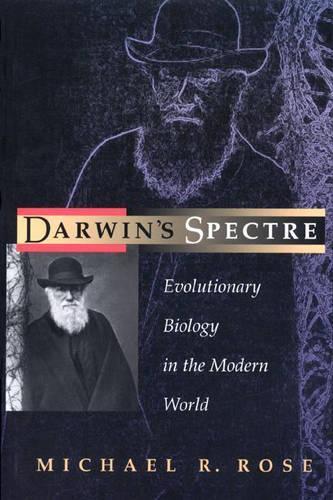
Extending the human life-span past 120 years. The ""green"" revolution. Evolution and human psychology. These subjects make today's newspaper headlines. Yet much of the science underlying these topics stems from a book published nearly 140 years ago--Charles Darwin's On the Origin of Species. Far from an antique idea restricted to the nineteenth century, the theory of evolution is one of the most potent concepts in all of modern science. In Darwin's Spectre, Michael Rose provides the general reader with an introduction to the theory of evolution: its beginning with Darwin, its key concepts, and how it may affect us in the future. First comes a brief biographical sketch of Darwin. Next, Rose gives a primer on the three most important concepts in evolutionary theory--variation, selection, and adaptation. With a firm grasp of these concepts, the reader is ready to look at modern applications of evolutionary theory. Discussing agriculture, Rose shows how even before Darwin farmers and ranchers unknowingly experimented with evolution. Medical research, however, has ignored Darwin's lessons until recently, with potentially grave consequences.Finally, evolution supplies important new vantage points on human nature.If humans weren't created by deities, then our nature may be determined more by evolution than we have understood. Or it may not be. In this question, as in many others, the Darwinian perspective is one of the most important for understanding human affairs in the modern world. Darwin's Spectre explains how evolutionary biology has been used to support both valuable applied research, particularly in agriculture, and truly frightening objectives, such as Nazi eugenics. Darwin's legacy has been a comfort and a scourge. But it has never been irrelevant.
Full Product Details
Author: Michael R. Rose, M.D.
Publisher: Princeton University Press
Imprint: Princeton University Press
Edition: New edition
Dimensions:
Width: 19.70cm
, Height: 1.30cm
, Length: 25.40cm
Weight: 0.340kg
ISBN: 9780691050089
ISBN 10: 0691050082
Pages: 288
Publication Date: 20 February 2000
Audience:
General/trade
,
College/higher education
,
Professional and scholarly
,
General
,
Tertiary & Higher Education
Format: Paperback
Publisher's Status: Active
Availability: Manufactured on demand

We will order this item for you from a manufactured on demand supplier.
Language: English
Reviews
A world of grand ideas, daring speculation... Best of all is his discussion of the ideas surrounding evolution and human behavior... Rose plumps for a more flexible, less deterministic (but, he is keen to stress, no less Darwinian) view of the human mind. -- Martin Brookes New Scientist Ironically, Rose evokes the image of a hovering Darwinian ghost in this altogether rational, absorbing account of the past 150 years of Darwinism... He makes an excellent case for the importance of evolutionary biology to all of science. Kirkus Reviews
A world of grand ideas, daring speculation... Best of all is his discussion of the ideas surrounding evolution and human behavior... Rose plumps for a more flexible, less deterministic (but, he is keen to stress, no less Darwinian) view of the human mind. -- Martin Brookes, New Scientist Ironically, Rose evokes the image of a hovering Darwinian ghost in this altogether rational, absorbing account of the past 150 years of Darwinism... He makes an excellent case for the importance of evolutionary biology to all of science. -- Kirkus Reviews
Ironically, Rose (Evolutionary Biology/Univ. of Calif., Irvine) invokes the image of a hovering Darwinian ghost in this altogether rational, absorbing account of the past 150 years of Darwinism. His three-part analysis first addresses the origins of the ideas we call Darwinism; next, its applications; and finally, what Darwinism may or may not contribute to our understanding of human nature. Part one places the theory of natural selection into the context of Darwin's life - and the familiar influences of family, Malthus, and Erasmus (included are unfamiliar tales of Erasmus's prodigious feats of paternity!). The rediscovery of Mendelism at the turn of the century led to furious disputes between mutationists and biometricians who espoused Darwin's erroneous theory of blending inheritance. Rose touches on the theory of kin selection, epitomized by insect societies, and introduces a number of game theoretic principles in discussions of intraspecies male-male competition. Part two deals with the seldom discussed importance of Darwinism in animal and plant breeding; the evils of eugenics; and the implications of evolutionary biology for medicine. Rose's own research figures here: he has demonstrated that forced delays in the reproduction of a population of fruit flies over a dozen generations led to doubling the lifespan - presumably, by forcing natural selection to work harder to keep the older flies fit until they could reproduce. Part three is the most speculative, as Rose ponders questions of brain size, the origin of values and religion, and the various attempts of sociobiology and evolutionary psychology to ground human behavior in genetics and selection-driven behavioral strategies. Discussion here is limited to how people act in the contexts of marketplace economics and political ideology; missing are any references to our urges to create art or science, to love or sacrifice. No doubt opponents will argue that Rose, for all his rationality, has put a Darwinian ghost in the machine. Be that as it may, he makes an excellent case for the importance of evolutionary biology to all of science. (Kirkus Reviews)
This is a sound introduction to evolutionary biology, with a good deal of background on Darwin himself. It adds little (if anything) to the existing library of information on the subject, but there is always room for another perspective on such a fundamentally important idea. Anyone who feels they have missed out on what evolution is all about could do a lot worse than start here. (Kirkus UK)
A world of grand ideas, daring speculation... Best of all is his discussion of the ideas surrounding evolution and human behavior... Rose plumps for a more flexible, less deterministic (but, he is keen to stress, no less Darwinian) view of the human mind. -- Martin Brookes, New Scientist Ironically, Rose evokes the image of a hovering Darwinian ghost in this altogether rational, absorbing account of the past 150 years of Darwinism... He makes an excellent case for the importance of evolutionary biology to all of science. -- Kirkus Reviews
Author Information
Michael R. Rose is Professor of Evolutionary Biology at the University of California, Irvine. A researcher in the biology of aging, he is known for selection experiments that made fruit flies live twice as long as normal. He is also the author of The Evolutionary Biology of Aging and a coeditor of Adaptation.