Overview
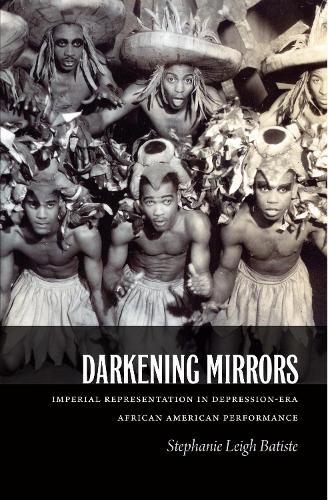
In Darkening Mirrors, Stephanie Leigh Batiste examines how African Americans participated in U.S. cultural imperialism in Depression-era stage and screen performances. A population treated as second-class citizens at home imagined themselves as empowered, modern U.S. citizens and transnational actors in plays, operas, ballets, and films. Many of these productions, such as the 1938 hits Haiti and The ""Swing"" Mikado recruited large casts of unknown performers, involving the black community not only as spectators but also as participants. Performances of exoticism, orientalism, and primitivism are inevitably linked to issues of embodiment, including how bodies signify blackness as a cultural, racial, and global category. Whether enacting U.S. imperialism in westerns, dramas, dances, songs, jokes, or comedy sketches, African Americans maintained a national identity that registered a diasporic empowerment and resistance on the global stage. Boldly addressing the contradictions in these performances, Batiste challenges the simplistic notion that the oppressed cannot identify with oppressive modes of power and enact themselves as empowered subjects. Darkening Mirrors adds nuance and depth to the history of African American subject formation and stage and screen performance.
Full Product Details
Author: Stephanie Leigh Batiste
Publisher: Duke University Press
Imprint: Duke University Press
Dimensions:
Width: 16.30cm
, Height: 2.80cm
, Length: 23.90cm
Weight: 0.676kg
ISBN: 9780822348986
ISBN 10: 0822348985
Pages: 352
Publication Date: 06 January 2012
Audience:
Professional and scholarly
,
Professional & Vocational
Format: Hardback
Publisher's Status: Active
Availability: In Print

This item will be ordered in for you from one of our suppliers. Upon receipt, we will promptly dispatch it out to you. For in store availability, please contact us.
Reviews
In Darkening Mirrors, Stephanie Leigh Batiste rigorously explores black Americans' complicity in imperialist discourse at the height of the Depression era. She makes an important, enlivening contribution to a growing body of scholarship examining some of the more complicated and ambiguous political affiliations of black cultural producers of the nineteenth century and early twentieth. This is a tremendously provocative study. Daphne Brooks, author of Bodies in Dissent: Performing the Transatlantic Imaginary Darkening Mirrors is a powerful argument that during the 1930s, African American popular performers took part in US imperial and nationalist projects even as they resisted the dominant culture's racism. In vivid, illuminating readings of films and stage shows - from The Swing Mikado and the Federal Theater Project's 'voodoo' Macbeth to Katherine Dunham's concert ballet L'Ag'Ya - Stephanie Leigh Batiste makes her case stick, and she makes it sting. At the same time, she writes beautifully about how black Americans asserted the genius of African and Afro-diasporic arts on the national and transnational scene. Joseph Roach, Yale University
Darkening Mirrors is an important contribution to thinking about what has been, until now, an undertheorized subject: black Americans' complicity in imperialist discourse. Stephanie Leigh Batiste covers drama, film, and dance; analyzes texts that have received little critical attention; and brings the insights of postcolonial, critical race, performance, and theater studies to bear on complex issues of power, desire, imperialism, aesthetics, and racial solidarity. Her nuanced readings of Depression-era performances show not only how African Americans were implicated in the quest to solidify American imperialism and the colonization of the 'racial other, ' but also how they rejected those same projects through performance practices including costume, set design, speech, movement, and music. --E. Patrick Johnson, author of Appropriating Blacknesss: Performance and the Politics of Authenticity
In Darkening Mirrors , Stephanie Batiste rigorously explores black Americans' complicity in imperialist discourse at the height of the Depression era. She makes an important, enlivening contribution to a growing body of scholarship examining some of the more complicated and ambiguous political affiliations of black cultural producers of the nineteenth century and early twentieth. This is a tremendously provocative study. --Daphne Brooks, author of Bodies in Dissent: Performing the Transatlantic Imaginary
Darkening Mirrors is a powerful argument that during the 1930s, African American popular performers took part in US imperial and nationalist projects even as they resisted the dominant culture's racism. In vivid, illuminating readings of films and stage shows--from The Swing Mikado and the Federal Theater Project's 'voodoo' Macbeth to Katherine Dunham's concert ballet L'Ag'Ya --Stephanie Leigh Batiste makes her case stick, and she makes it sting. At the same time, she writes beautifully about how black Americans asserted the genius of African and Afro-diasporic arts on the national and transnational scene. --Joseph Roach, Yale University
Author Information
Stephanie Leigh Batiste is a performance artist and Associate Professor of English and Black Studies at the University of California, Santa Barbara.